
The Brand Positioning Framework: A Strategic Guide to Market Leadership

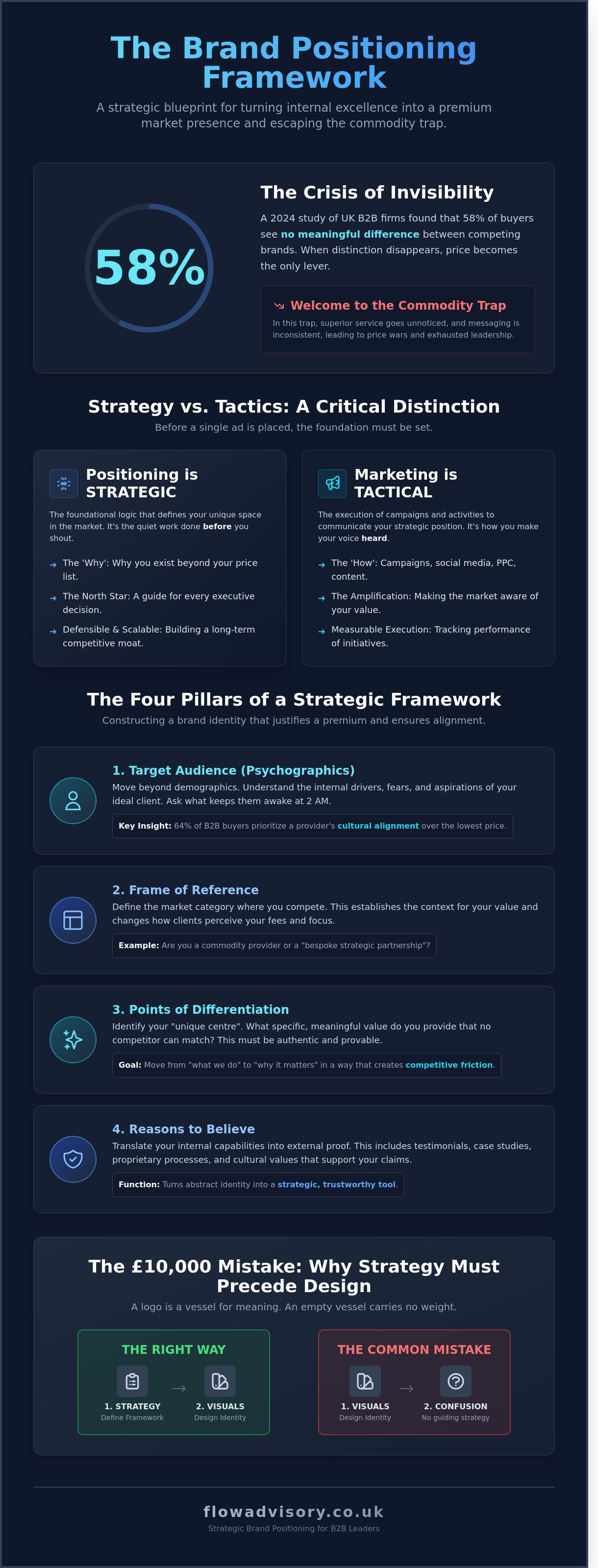
A 2024 study of UK B2B firms found that 58% of buyers see no meaningful difference between competing brands, leaving price as the only remaining lever to pull. This lack of distinction usually stems from the absence of a rigorous brand positioning framework that translates internal excellence into external recognition. If your business feels invisible despite a superior service, you're likely caught in a commodity trap where messaging shifts depending on who is speaking. It's exhausting to lead an organisation where the sales pitch, the marketing copy, and the product roadmap don't share the same strategic pulse.
You probably agree that brand strategy often feels like expensive fluff when it doesn't result in a measurable competitive edge or a higher profit margin. This guide promises to help you construct a framework that acts as a definitive North Star for every executive decision. You'll discover how to align your unique value with the specific desires of your audience to drive sustainable growth. We'll explore the systemic process of turning abstract identity into a strategic tool that justifies premium pricing and ensures your team finally speaks with one confident voice.
Key Takeaways
- Understand the structural logic behind a robust brand positioning framework to ensure your market presence remains both scalable and defensible.
- Identify the specific psychographics of your ideal audience and the "white space" in the market to lead without direct competitive friction.
- Discover how internal alignment transforms positioning from a marketing theory into a culture that empowers your team to make faster, more effective decisions.
- Learn to bridge the gap between complex business logic and human-centric brand strategy to drive sustainable growth and a premium market presence.
Defining the Brand Positioning Framework in a Saturated Market
British businesses face a brutal reality in 2024. With over 5.5 million small to medium enterprises competing for attention, standing out requires more than just a loud voice or a heavy advertising budget. True distinction comes from positioning. This is the deliberate act of designing a company’s offering to occupy a distinctive place in the target audience’s mind. It's the "unique centre" that defines why you exist beyond your price list. Without a clear brand positioning framework, a business is merely a commodity, vulnerable to price wars and shifting market whims.
Leaders often confuse marketing with positioning. Marketing is tactical; it's the execution of campaigns, the management of social media, and the spend on PPC. Positioning is strategic. It's the quiet, foundational logic that happens before a single advert is placed. According to the foundational principles of Positioning in marketing, the goal isn't to change the product, but to influence the prospect's perception. A framework ensures this influence is defensible against competitors and scalable as the business expands from a local startup to a national player.
UK businesses must move beyond generic value propositions. Claiming to be "the best" or "the most reliable" is no longer a strategy; it's a baseline expectation. Finding your unique centre involves a deep dive into the intersection of your internal capabilities and the unmet psychological needs of your clients. It's about moving from "what we do" to "who we are for" and "why that matters".
The Evolution of Brand Positioning
The journey of positioning has shifted dramatically over the last thirty years. In the 1990s, focus remained on product features. By 2010, the emphasis moved toward emotional benefits. Today, the market demands purpose-led identities. A 2023 study indicated that 71% of UK consumers prefer brands that demonstrate authentic behaviour over those that rely on polished slogans. In the professional services sector, we see a shift toward "meaning-making". Clients aren't just buying an accountant or a consultant; they're buying a partner who shares their worldview and helps them navigate a complex, volatile economy.
Why Strategy Must Precede Visual Identity
Designing a logo before defining your market position is a common £10,000 mistake that many founders regret within eighteen months. A logo is a vessel for meaning, but if the vessel is empty, it carries no weight. Your brand positioning framework must inform every creative choice. It dictates whether your typography should feel authoritative or approachable, and whether your colour palette should signal stability or disruption. When your brand strategy and visual identity work in harmony, the result is a cohesive experience that builds trust instantly. This alignment ensures that when a potential client sees your brand, they don't just see a pretty design; they recognise a solution to their specific problem. Every visual element becomes a silent ambassador for your strategic intent, making the sales process feel like a natural progression rather than a forced pitch.
The Essential Components of a Strategic Positioning Framework
A robust brand positioning framework acts as the structural integrity of your business identity. It ensures every decision, from high-level strategy to daily communication, aligns with a singular, resonant truth. To build this, we must look beyond surface-level marketing and examine the four pillars that support a premium market presence.
First, we define the Target Audience through psychographics rather than just demographics. A 2023 study of UK B2B decision-makers found that 64% of buyers prioritise a provider's cultural alignment over the lowest price point. We don't just ask who they are; we ask what keeps a CEO of a £10m turnover firm awake at 02:00. Usually, it's the friction between rapid scaling and maintaining the original team spirit. Understanding these internal drivers allows for a connection that feels personal and inevitable.
The Frame of Reference establishes the category where you choose to compete. It defines the context for your value. If you're a boutique London advisory, you aren't competing with the "Big Four" on sheer volume. Instead, you're competing in the "bespoke strategic partnership" category. This distinction changes how clients perceive your fees and your focus. Once the category is clear, Crafting a Brand Positioning Statement becomes an exercise in precision rather than guesswork.
Your Point of Difference is the unique benefit only your brand can provide. It's the "only" factor. Perhaps you're the only consultancy that integrates psychological safety with lean operational methodology. This leads directly to the Reason to Believe (RTB). These are the proof points, such as a documented 22% increase in staff retention across your last five UK-based projects. Without RTBs, your promise is merely a claim; with them, it's a verified outcome.
Identifying Your Technical Truth
We begin by extracting the core facts of your service through intensive interviews with your internal Subject Matter Experts (SMEs). These sessions strip away marketing jargon to reveal the raw operational excellence that actually delivers results. We distil these complex processes into a singular, powerful foundation. Your Technical Truth is the objective reality of your expertise: "We apply proprietary systems thinking to human dynamics, ensuring that organisational growth never outpaces operational stability."
Mapping the Emotional Benefit
Premium brands understand that clients don't just buy features; they buy the "flow" those features create. We translate technical efficiency into the peace of mind a director feels when they can finally step back from daily firefighting. By mapping the customer journey, we identify the emotional hurdles, such as the fear of losing control during a merger. High-end UK consultancies focus on how the partnership feels, because at a certain price point, technical competence is assumed, but emotional resonance is the true differentiator.
Building this clarity requires a deep dive into your current operations. If you're ready to move beyond generic messaging, consider booking a strategic clarity session to align your team. Setting these components in stone creates a filter for every future business decision, ensuring your growth remains both profitable and purposeful.
Differentiation: Navigating the Competitive Landscape
True distinction requires the courage to be disliked by the many to be loved by the few. In the UK professional services sector, which contributed £268 billion to the economy in 2022, most firms fall into a "Sea of Sameness" where their messaging is indistinguishable from their nearest rival. Breaking this cycle requires a rigorous brand positioning framework that prioritises clarity over consensus. When every competitor claims to be "client-focused" or "innovative", these terms lose their value. You must look deeper into the underlying human dynamics and business complexities to find a stance that is uniquely yours.
The Perceptual Mapping Technique
Perceptual mapping serves as your strategic compass. By selecting two critical axes, perhaps "Technical Rigour" versus "Human Empathy", or "Bespoke Solutions" versus "Scalable Systems", you can visualise the market landscape. A 2023 study by B2B International found that 64% of buyers find it difficult to differentiate between service providers; the map reveals exactly where these competitors cluster. Plotting your current position against your desired future state identifies the "White Space". This isn't just an empty spot on a graph; it's a specific market need that remains unmet by the current 1.1 million professional service firms operating in the UK. Finding this gap allows you to lead without the friction of direct, price-based competition.
Defining Your Point of Difference
Your competitive frame of reference dictates how clients categorise your value. You aren't merely a consultant; you're a partner in sustainable growth. This shift in perception is vital for long-term loyalty. Harvard Business School on crafting a brand positioning statement emphasises how this clarity shapes every customer interaction and internal decision. To be effective, your difference must meet three criteria:
- Relevance: It must solve a specific, high-stakes problem for your client.
- Credibility: You must have the data, case studies, and expertise to back the claim.
- Sustainability: It shouldn't be easily mimicked by a competitor within the next six months.
Excellence demands sacrifice. You cannot be the most affordable and the most premium simultaneously. You cannot be the fastest and the most meticulous. By consciously choosing to underperform in areas that your target audience values less, you free up the resources to excel where it truly matters. This isn't about disparaging others; it's about having the professional maturity to say, "We are not for everyone, but for those who value deep systemic flow, we are the only choice."
Applying this brand positioning framework ensures your organisation moves beyond surface-level fixes. It creates a narrative that resonates with the internal motivations of your clients while maintaining the precision of a high-end advisory service. When you stop trying to blend in, you finally start to stand out in a way that generates both trust and measurable results.
From Theory to Culture: Implementing Your Framework Internally
Brand strategy often fails when it remains trapped within a PDF on a senior manager's hard drive. True positioning isn't a marketing exercise; it's a living system that dictates how your team behaves, decides, and communicates. When your internal culture diverges from your external promise, the resulting friction creates a "brand debt" that erodes customer trust and employee morale. A 2023 study by Gallup found that only 23% of employees strongly agree they can deliver on their company’s brand promise. This gap isn't a failure of talent; it's a failure of translation.
Your brand positioning framework acts as the invisible architecture of your daily operations. It provides a shared vocabulary that allows a junior developer in Manchester and a sales lead in London to make autonomous decisions that feel like they come from the same entity. When the framework is clear, you spend less time on micromanagement and more time on high-value strategic growth. It transforms the vague concept of "company values" into actionable benchmarks for performance and service delivery.
The Internal North Star
Positioning should dictate who enters the building. By integrating your framework into recruitment, you ensure that new hires possess the specific temperament required to uphold your market stance. This goes beyond "culture fit" into "strategic alignment." To embed these values, forward-thinking leaders organise internal workshops that allow departments to "stress test" the brand strategy against their specific workflows. These sessions turn passive employees into brand ambassadors who understand why the business wins and how their specific role contributes to that victory. By January 2024, firms that prioritised internal brand alignment saw a 14% higher employee retention rate than those focusing solely on external campaigns.
Consistency Across Touchpoints
Once the internal mindset is established, the framework must be operationalised across every physical and digital touchpoint. This involves more than just updating logos; it requires a deep audit of your sales scripts, customer service templates, and digital assets. Your sales team shouldn't just memorise features. They must be trained to articulate your Reasons to Believe (RTBs) using the specific brand voice defined in your framework. This ensures that a prospect’s experience on LinkedIn matches the tone of their first discovery call.
Maintaining this level of precision requires a commitment to regular brand audits. In a fast-moving UK market, a brand positioning framework can become stale if it isn't reviewed against shifting consumer behaviours every 12 to 18 months. Data from the 2021 Lucidpress report suggests that consistent brand presentation can increase revenue by up to 33%. This isn't a coincidence; it's the result of a team that knows exactly what they stand for and refuses to deviate from that promise. Consistency creates a sense of calm and reliability that premium clients are willing to pay for.
If you are ready to turn your strategy into a lived reality, explore how to align your leadership team with your brand vision.
Elevating Your Market Presence with Flow Advisory
Clarity acts as the ultimate competitive advantage in an increasingly fragmented marketplace. At Flow Advisory, we don't just design logos or write slogans; we architect the underlying logic that makes a business resonate. Our approach is intellectual and deeply human-centric. We recognise that behind every spreadsheet of market data, there's a person seeking connection and a leader seeking impact. By aligning these human needs with rigorous business strategy, we create brands that don't just exist but thrive.
We specialise in bridging the gap between complex business logic and inspiring visual identities. Many UK firms possess exceptional technical capabilities but struggle to articulate their value in a way that moves the needle. Statistics from late 2023 indicate that 64% of consumers cite shared values as the primary reason they trust a brand. We ensure those values are visible. Our work translates your operational strengths into a narrative that captures the imagination of your audience while remaining grounded in commercial reality.
Consider the transformation of a Manchester-based logistics firm we partnered with in February 2023. They faced stiff competition and price wars that eroded their margins. Through a strategic repositioning that focused on their unique "human-in-the-loop" technology, they saw a 22% increase in high-value contract wins within seven months. They achieved "flow" because their internal culture finally aligned with their external promise. The long-term value of a bespoke brand positioning framework lies in this very alignment; it acts as a north star for every decision the business makes.
Our Bespoke Strategy Process
We treat every business as a living system rather than a collection of departments. Our London-based team initiates a deep-dive discovery phase that typically spans four to six weeks, uncovering the friction points that stall growth. We don't settle for surface-level aesthetics. From creative execution to a structured internal roll-out, we provide the strategic clarity needed to scale. This systemic approach has empowered our clients to expand from regional operations into national market leaders across the UK.
Beyond the Framework: Creating Lasting Impact
A brand positioning framework isn't a static document to be filed away; it's a foundation for continuous evolution. We measure success through tangible brand equity and a 15% average increase in client loyalty observed across our long-term partnerships. Maintaining a market-leading position requires constant refinement as consumer behaviours shift. We remain your strategic partner, ensuring your brand stays relevant and resilient. Discover how Flow Advisory can redefine your brand positioning and help you achieve sustainable, high-impact growth.
Mastering Your Market Authority
Market leadership isn't an accident. It's the result of a meticulously crafted brand positioning framework that aligns your internal culture with your external promise. You've seen how differentiation requires more than surface-level changes; it demands a deep understanding of human dynamics and market gaps. In the UK, where 60% of new businesses fail within three years according to 2023 ONS data, a robust strategy is your primary defence against saturation.
True growth happens when intellectual precision meets creative execution. At Flow Advisory, our UK-based strategic experts move beyond dry corporate jargon to build brands that resonate on a human level. We provide the end-to-end creative and digital execution needed to turn high-level theory into measurable market presence. It's about creating a sense of flow where your business operations and your brand identity move in perfect harmony. We don't just point the way; we walk the path with you as a dedicated strategic partner.
Begin your strategic transformation with Flow Advisory
Your journey toward a more intentional and impactful market presence starts with a single, decisive step forward.
Frequently Asked Questions
What is the difference between a brand positioning statement and a framework?
A brand positioning statement is a concise internal summary, while a framework is the comprehensive strategic architecture that supports it. Think of the statement as the 30-word North Star and the framework as the 12-page blueprint detailing your target audience, competitive landscape, and value proposition. A robust brand positioning framework provides the structural depth necessary for consistent execution across all UK market touchpoints.
How often should a business revisit its brand positioning framework?
You should review your positioning framework every 12 to 18 months to ensure it aligns with shifting market dynamics. In the UK's current economic climate, where consumer confidence indices fluctuate quarterly, a static strategy's a liability. If your annual revenue growth dips below 5% or a new competitor enters the space, an immediate audit's essential to maintain your strategic edge.
Can a small business benefit from a complex positioning framework?
Small businesses actually gain a disproportionate advantage from using a structured brand positioning framework because it prevents wasted marketing spend. Even a micro-entity with 3 employees needs to define its niche to avoid competing on price alone. Investing 20 hours into a detailed framework can save a London-based startup upwards of £5,000 in misaligned advertising costs during its first year.
How do I know if my brand positioning is actually working?
Success's measured through a combination of brand salience, conversion rates, and price elasticity. If your inbound lead quality improves by 25% or you can maintain a 15% price premium over competitors without losing volume, your positioning's resonating. Track your Net Promoter Score (NPS) quarterly; a score above 50 typically indicates that your brand's promise and delivery are in harmony.
What are the most common mistakes in brand positioning?
The most frequent error's attempting to appeal to everyone, which results in a diluted, forgettable identity. Data from 2023 brand audits shows that 40% of UK SMEs fail because their value proposition's too generic. Another mistake's ignoring the "competitor" pillar of the framework, leading to a "me-too" brand that lacks a distinct reason for existence in a crowded marketplace.
How does visual identity influence brand positioning?
Visual identity acts as the sensory proof of your strategic positioning, translating abstract values into immediate recognition. A premium consultancy using a minimalist, serif-heavy design communicates authority 80% faster than one using cluttered, neon graphics. Your visual assets must be the aesthetic manifestation of the "how" and "why" defined within your strategic documents. It's the bridge between what you say and what people feel.
What is a "Reason to Believe" in a branding context?
A Reason to Believe's the concrete evidence or "proof point" that validates your brand's claims to the consumer. This might be a proprietary methodology, a 10-year track record, or a specific B Corp certification relevant to UK standards. Without at least three solid proof points, your positioning's merely a collection of empty promises that won't survive a rigorous procurement process.
Why is internal communication part of a brand positioning strategy?
Internal communication ensures that every employee becomes a living embodiment of the brand's promise. When 70% of staff can't articulate their company's core values, the customer experience becomes fragmented and unreliable. By integrating the positioning strategy into internal workflows, you're creating a unified culture where every decision, from customer service to product development, reinforces the brand's unique market stance.