
The Ultimate Rebranding Process Checklist: A Strategic Guide for 2026

What if the very identity that built your success is now the primary barrier to your next stage of growth? It's a sobering thought for any leader. You've likely spent years cultivating trust, yet 74% of UK mid-market executives admit their current brand no longer aligns with their 2026 strategic vision. The hesitation is understandable. The prospect of updating thousands of assets or facing internal pushback can feel overwhelming. This is why we've developed a comprehensive rebranding process checklist that prioritises strategic depth over surface-level aesthetics.
We understand that a true transformation isn't just about a new palette; it's about reclaiming your market position and energising your people. You don't have to sacrifice your heritage to embrace the future. In this guide, we'll walk through the essential phases of a successful transition, from protecting your hard-earned equity to launching a brand that resonates with clarity. You'll discover how to manage the logistical complexity of the 2026 market while fostering a sense of ownership and flow across your entire organisational culture.
Key Takeaways
- Identify the strategic catalysts for change to ensure your brand transformation is a meaningful evolution rather than a mere aesthetic update.
- Distil your brand’s core purpose and values into a "Strategic North Star" that provides clarity and direction for your entire organisation.
- Execute a seamless transition across all digital and physical platforms by following our comprehensive rebranding process checklist designed for the UK market.
- Prioritise internal alignment to transform your employees into authentic brand ambassadors who embody your new identity from the inside out.
- Establish robust KPIs to measure the long-term impact of your rebrand and maintain momentum far beyond the initial launch phase.
Phase 1: The Strategic Audit and Catalyst Identification
Rebranding is a strategic evolution, not a cosmetic mask. It’s a fundamental realignment of your organisation’s identity with its future intentions. Many leaders mistake a visual update for a complete transformation, yet the most successful shifts in 2026 focus on the underlying business logic. Rebranding involves a deliberate process of changing the corporate image, often driven by a need to signal a new direction or respond to significant market changes. Understanding whether you require a subtle brand refresh or a total overhaul is the first critical decision in your rebranding process checklist.
A brand refresh acts like a renovation; it modernises the aesthetic while keeping the foundation intact. A total overhaul is more akin to a relocation, often necessitated by a merger, a pivot in service delivery, or a complete loss of market relevance. To decide which path to take, you must conduct a Brand Equity Audit. This process identifies the intangible assets that hold genuine value. If 45% of your clients cite your current reputation for reliability as their primary reason for staying, that "heritage value" must be protected at all costs during the transition.
Identifying the Why Behind the Change
Start by evaluating if your current brand creates friction in your sales cycle. If your business development team spends the first ten minutes of every meeting correcting misconceptions about what you do, your identity is an obstacle. In the UK market, where B2B buyers now complete roughly 70% of their research before contacting a supplier, your digital presence must speak clearly. Analyse your competitors to see where they’ve moved. If 60% of your peer group has shifted toward a "consultative partner" model while you still look like a "service provider," there’s a gap in your positioning that needs closing.
Write a one-sentence Rebrand Mission Statement to keep the project on track. It shouldn't be marketing fluff. A strong example would be: "We’re evolving our identity to reflect our shift from a local logistics firm to a national technology-led supply chain partner by December 2026." This clarity ensures every subsequent decision serves the same goal.
The Comprehensive Brand Audit Checklist
A thorough audit requires looking at your business as a living organism. You can learn more about our philosophy on integrated business growth at Flow Advisory, where we view these transitions as opportunities for systemic improvement. Your rebranding process checklist must include these three pillars:
- Visual Asset Inventory: Document every touchpoint, from the website and pitch decks to email signatures and office signage. This list often runs into hundreds of items.
- Internal Stakeholder Surveys: Ask your employees what the brand represents. A 2024 study found that 52% of UK firms have a significant disconnect between what leadership thinks the brand is and what staff actually tell customers.
- Customer Sentiment Analysis: Review feedback and conduct interviews to find emotional disconnects. Use hard data, like Net Promoter Scores, to see if your current identity still resonates with your highest-value clients.
This diagnostic phase ensures you aren't just changing for the sake of change. It provides the evidence-based foundation needed to build a brand that feels both authentic and aspirational.
Phase 2: Defining the Brand DNA and Strategic North Star
Rebranding is an act of structural evolution. Once the audit phase concludes, the focus shifts from observation to architecture. This second stage of the rebranding process checklist requires a deliberate pause to define the Strategic North Star. It's where we translate raw data into a cohesive brand DNA that will guide every decision through 2026 and beyond.
Organising a brand workshop is the catalyst for this transformation. This isn't a mere brainstorming session; it's a rigorous distillation of why the business exists. To ensure these critical sessions are productive, partnering with experts like Echelon Facilitation can provide the structured guidance needed to align diverse perspectives. In the UK market, where 63% of consumers now prefer brands that demonstrate a clear social impact according to 2024 Deloitte research, your purpose must transcend profit. We align these abstract ideals with your long-term commercial goals to ensure the strategy is both inspiring and scalable. This alignment ensures that the new identity isn't just a veneer, but a reflection of the company's internal reality and its future ambitions.
Crafting Purpose, Mission, and Values
Purpose is the heartbeat of the organisation. It provides the emotional resonance that attracts both talent and loyal customers. We move beyond generic statements to define concrete organisational behaviours. If "integrity" is a value, we define how that manifests in a 2026 supply chain or an AI-driven service model. A compelling brand story bridges your heritage with your future; it acknowledges where you've come from while articulating a clear vision for what's next. This narrative depth is a critical component of your rebranding process checklist, as it builds the internal buy-in necessary for a successful rollout.
Positioning and Differentiation in a Saturated Market
True differentiation happens at the "Strategic Sweet Spot", the intersection where your unique capabilities meet the unmet needs of your audience. We use brand archetypes to move beyond dry corporate speak, establishing a tone of voice that feels human and consistent. By 2026, the customer journey will be even more fragmented across digital and physical realms. Mapping this journey allows us to identify the high-impact touchpoints where the new brand must work hardest. Discover how we help leaders find their strategic focus through this transition.
- Strategic Sweet Spot: Identify the specific value you provide that competitors cannot easily replicate.
- Archetypal Framework: Select a brand personality that resonates with your target demographic's aspirations.
- Touchpoint Mapping: Ensure the brand experience is seamless across all £-generating channels.
A 2024 report from the UK Design Council indicated that companies focusing on design-led strategy outperform the FTSE 100 by 200%. This phase ensures your rebranding efforts are rooted in that same strategic rigour, turning your brand into a measurable asset rather than a marketing expense.
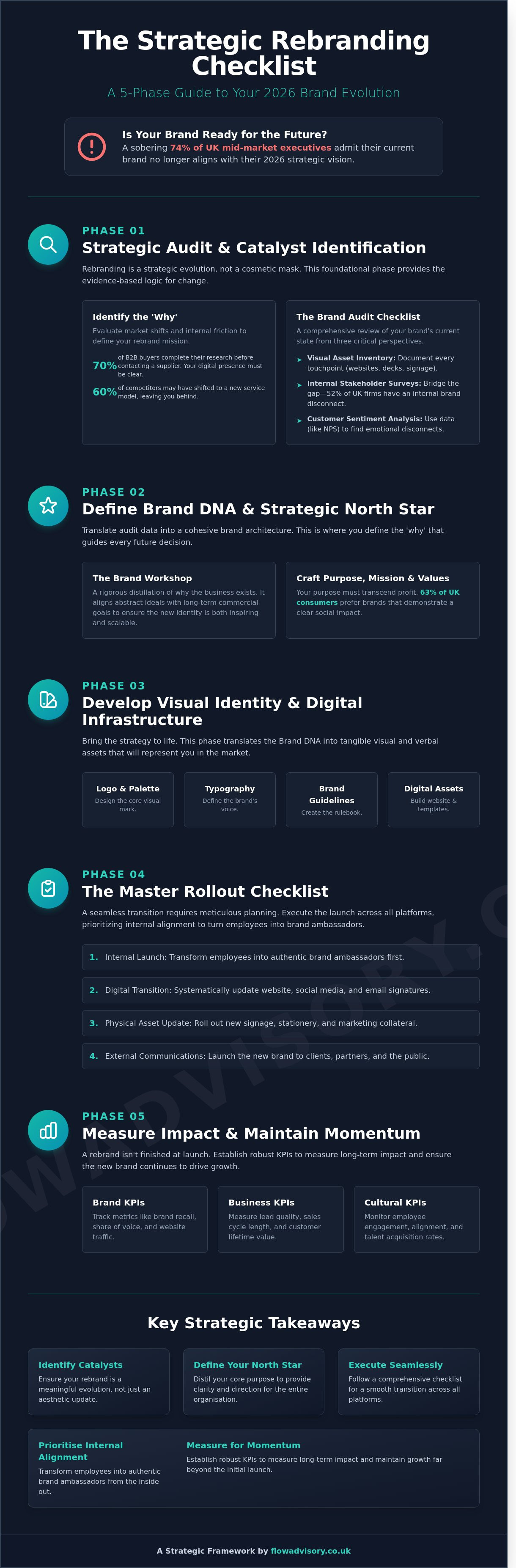
Phase 3: Developing the Visual Identity and Digital Infrastructure
The transition from abstract strategy to tangible assets marks the most visible stage of your evolution. It's here that the rebranding process checklist moves from the boardroom into the design studio. This phase focuses on creating a visual language that doesn't just look modern but feels inevitable for your brand's new direction. We're building a system that functions as effectively on a six-inch smartphone screen as it does on physical signage in a London office. True visual identity is about resonance and cohesion, ensuring every touchpoint whispers the same promise of quality and intent.
The Visual Identity System: Beyond the Logo
A logo is a signature, not the whole story. To evoke a genuine emotional response, you must curate a palette that aligns with psychological triggers and cultural contexts. Typography must balance distinct character with absolute legibility, adhering to the latest accessibility standards to ensure inclusivity. Your art direction should move away from generic stock imagery, favouring bespoke photography and iconography that captures the unique human dynamics within your organisation. This creates a proprietary look that's impossible for competitors to replicate.
Digital Presence and Website Architecture
Your website serves as the primary touchpoint for the modern client. Integrating your new identity into a business website design and development strategy ensures that the user experience mirrors your brand promise. This isn't merely about aesthetics; it's about architecture. The site structure must reflect your updated positioning, making it intuitive for users to find value quickly. Precision is required during this stage of the rebranding process checklist to ensure technical stability.
- SEO Migration: You must plan a meticulous migration to protect existing search rankings. Failing to map 301 redirects correctly can lead to a 20% drop in organic traffic within the first month of launch.
- UX Standards: Prioritise WCAG 2.2 compliance. In 2026, digital accessibility isn't just a legal requirement in the UK; it's a hallmark of a sophisticated brand.
- Digital Brand Guidelines: Abandon static PDF guides. Create a centralised, cloud-based "Source of Truth" that allows teams to access live assets, hex codes, and components in real-time.
The goal is to create a digital infrastructure that's flexible enough to grow with you. By the time this phase concludes, your brand shouldn't just look different. It should feel more aligned, more functional, and ready to support the next decade of your business journey.
Phase 4: The Master Checklist for Internal and External Rollout
Transitioning a brand requires more than a visual refresh; it demands a synchronised movement of people, systems, and perceptions. A successful transition depends on a structured rebranding process checklist that balances technical migration with human psychology. By the time you reach this stage, the strategic foundation is set, and the focus shifts to the precision of execution. You aren't just changing a name or a logo; you're recalibrating the entire organisational flow to ensure the new identity resonates from the inside out.
Execution should follow a phased approach to prevent logistical bottlenecks. Start by auditing your administrative backbone. In the United Kingdom, this involves updating your details with Companies House; a change of name filing (NM01) currently costs £30 for online submissions and usually takes around 24 hours to process. You'll also need to notify HMRC and update your VAT registration to maintain compliance. Neglecting these legal foundations can stall your momentum before the public even sees the new brand.
For commercial and industrial organisations, this administrative audit should also extend to operational safety and environmental standards. Professional consultancies such as AFN Industrial Services Ltd help businesses navigate these complex compliance requirements during periods of organisational change, ensuring the brand's foundation is as secure as its new visual identity.
Aligning Internal Culture and Communications
Your team is the primary engine of your brand. If they don't embody the new values, the external market will sense the disconnect immediately. Organise an internal launch event that goes beyond a simple presentation. This is an opportunity to foster a shared flow-experience, where every employee understands how the new messaging framework supports their daily work. Update internal portals and HR documentation to reflect the new tone. Providing staff with updated email signatures and brand voice guides ensures that every interaction from day one is consistent and professional.
External Launch Strategy and Asset Migration
The external rollout should feel like an evolution, not a shock. Build anticipation with a teaser campaign across LinkedIn and industry-specific channels approximately 14 days before the full reveal. When the launch date arrives, update all social media profiles and digital marketing collateral simultaneously to avoid brand fragmentation. High-value clients deserve a personal touch. A direct, thoughtful letter explaining the strategic reasons behind the evolution can strengthen trust. Research from the 2024 Edelman Trust Barometer indicates that 63% of consumers buy or advocate for brands based on their values, so use this communication to highlight your renewed commitment to their success.
To ensure your team is ready to lead this transition with confidence, explore our approach to leadership and organisational culture at Flow Advisory.
- Legal Audit: File NM01 with Companies House and update HMRC records.
- Internal Buy-in: Conduct workshops to train staff on the new messaging framework.
- Digital Migration: Redirect old URLs and update metadata to maintain SEO health.
- Client Continuity: Send personalised briefings to your top 20% of stakeholders.
A comprehensive rebranding process checklist serves as your map through the complexity of change. By prioritising internal alignment before the external reveal, you create a stable foundation that allows the new brand to thrive. This phase isn't merely about ticking boxes; it's about ensuring the energy of the business remains focused and uninterrupted during the transition.
Phase 5: Measuring Impact and Maintaining Brand Momentum
The launch event is a threshold, not a finish line. True brand maturity requires an ongoing commitment to the principles established during the creative phase. Your rebranding process checklist must extend into a sustained period of observation and refinement to ensure the investment yields the expected dividends. We view this stage as the transition from creation to stewardship; where the abstract values of the brand become the lived experience of your clients and employees.
Success isn't a vague feeling of "newness". It's a measurable shift in market position. You should establish clear Key Performance Indicators (KPIs) within the first 30 days post-launch. These metrics often include a 12% target increase in website conversion rates or a specific uplift in brand recall within your primary UK market segments. Without these benchmarks, the rebranding effort remains a cosmetic exercise rather than a strategic business lever. We recommend scheduling quarterly brand health checks to audit every touchpoint against your original strategic intent. This ensures that the "flow" of your communication doesn't stagnate or drift as market conditions shift in 2026.
Post-Launch Brand Equity Monitoring
Tracking changes in brand sentiment requires a disciplined approach over the initial 12 months. You should monitor your Net Promoter Score (NPS) for a projected 10% improvement, indicating that the new identity resonates more deeply with your audience. Gather qualitative feedback from your sales team; they're the front line of your brand narrative. If the new visual and verbal identity shortens the sales cycle or leads to higher-quality enquiries, your rebranding is functioning as a genuine growth engine. Data from the first year provides the necessary evidence to justify the initial capital expenditure.
Scaling the Brand with Flow Advisory
Maintaining long-term consistency is often where internal teams struggle as the business scales. Partnering with experts for visual identity design services ensures that your brand evolves without losing its core essence. This partnership provides a system of ongoing governance, preventing the "brand debt" that accumulates when teams create assets in isolation. You can learn more about our approach to strategic creative consultancy and how we help UK leaders maintain their brand's equilibrium during periods of rapid expansion. We focus on the intersection of organisational psychology and high-end design, ensuring your brand remains a living, breathing asset that supports your long-term commercial goals.
Advancing Your Brand Evolution into 2026
A successful brand transformation requires more than a fresh coat of paint. It demands a rigorous rebranding process checklist that aligns your internal culture with a sophisticated external identity. By prioritising a strategic audit and defining a clear brand DNA, you ensure your organisation's growth is rooted in authenticity. Industry data indicates that consistent brand presentation can increase revenue by up to 23%, but this only happens when your digital infrastructure and visual assets work in perfect harmony.
Flow Advisory is an independent UK consultancy founded in 2020. We specialise in high-end visual identity and digital development, focusing on the deep connection between people and performance. We don't just deliver designs; we build the strategic frameworks that allow your business to thrive in a complex market. Our approach ensures your team doesn't just see the change, they live it every day. You're ready to move beyond the surface and create a brand that resonates on every level.
Start your strategic brand evolution with Flow Advisory
The path to a renewed identity is challenging, but with the right partner, it becomes your most significant competitive advantage.
Frequently Asked Questions
How long does the typical rebranding process take for a UK business?
A comprehensive rebranding process for a UK business typically spans six to twelve months. This timeframe allows for the deep strategic alignment and cultural integration necessary for a sustainable transition. While a visual refresh might conclude in three months, a structural shift involving internal values and external market repositioning requires a more deliberate, phased approach to ensure every stakeholder is aligned.
Will rebranding my business negatively affect my current SEO rankings?
Your search visibility may experience temporary fluctuations, but following a rigorous rebranding process checklist ensures long-term SEO stability. By implementing precise 301 redirects and updating your Google Business Profile, you can mitigate the risk of traffic loss. Data from industry benchmarks suggest that sites following a professional migration protocol usually recover their baseline rankings within 4 to 8 weeks of the launch.
What is the difference between a brand refresh and a full rebrand?
A brand refresh is a tactical update to your visual identity, whereas a full rebrand involves a fundamental shift in your company's DNA. Refreshes focus on modernising logos or colour palettes to maintain relevance in a shifting market. In contrast, a full rebrand redefines your core mission and target audience. It's the difference between repainting a house and rebuilding its foundation to support future scalability.
How much should a company budget for a comprehensive rebranding project?
Mid-market UK firms often allocate between 5% and 15% of their annual turnover to a comprehensive rebranding project. This investment covers strategic consultancy, visual identity development, and the physical rollout across all digital and physical touchpoints. According to the Design Council, businesses that invest in strategic design see a 125% increase in their ability to compete on quality rather than price alone.
How do I handle negative feedback from long-term customers after a rebrand?
Address customer concerns by leading with empathy and transparent communication. It's natural for long-term clients to feel a sense of loss when a familiar identity changes. You should explain the strategic reasons behind the evolution, showing how it serves their needs better. Research indicates that 70% of brand loyalty is driven by emotional connection, so focus on the shared values that remain unchanged during the transition.
Should I change my company name as part of the rebranding process?
Changing your name is only necessary if your current title creates a glass ceiling for your growth or no longer reflects your service offering. If your name is geographically limiting or tied to an obsolete product, a change is vital for your future strategy. However, if you possess strong brand equity, retaining the name while evolving the visual and cultural narrative is often the more efficient path to transformation.
How can I ensure my team stays consistent with the new brand guidelines?
Consistency is achieved through deep internal buy-in rather than just a static PDF of brand guidelines. You must host interactive workshops that connect the new brand values to daily operational tasks and individual motivations. When employees understand the purpose behind the change, they become natural ambassadors. Providing a centralised digital asset manager ensures that 100% of your team has access to the correct templates and messaging.
When is the best time of year to launch a new brand identity?
The optimal time to launch a new brand identity is typically January or September, coinciding with periods of renewed business focus in the UK market. Launching in Q1 aligns with new fiscal budgets and the "fresh start" mindset of many B2B clients. You should avoid the December holiday period or the August summer lull, as these times typically see a 30% drop in professional engagement and media receptivity.