
What is a Society Agency? Building Purpose-Led Brands in 2026

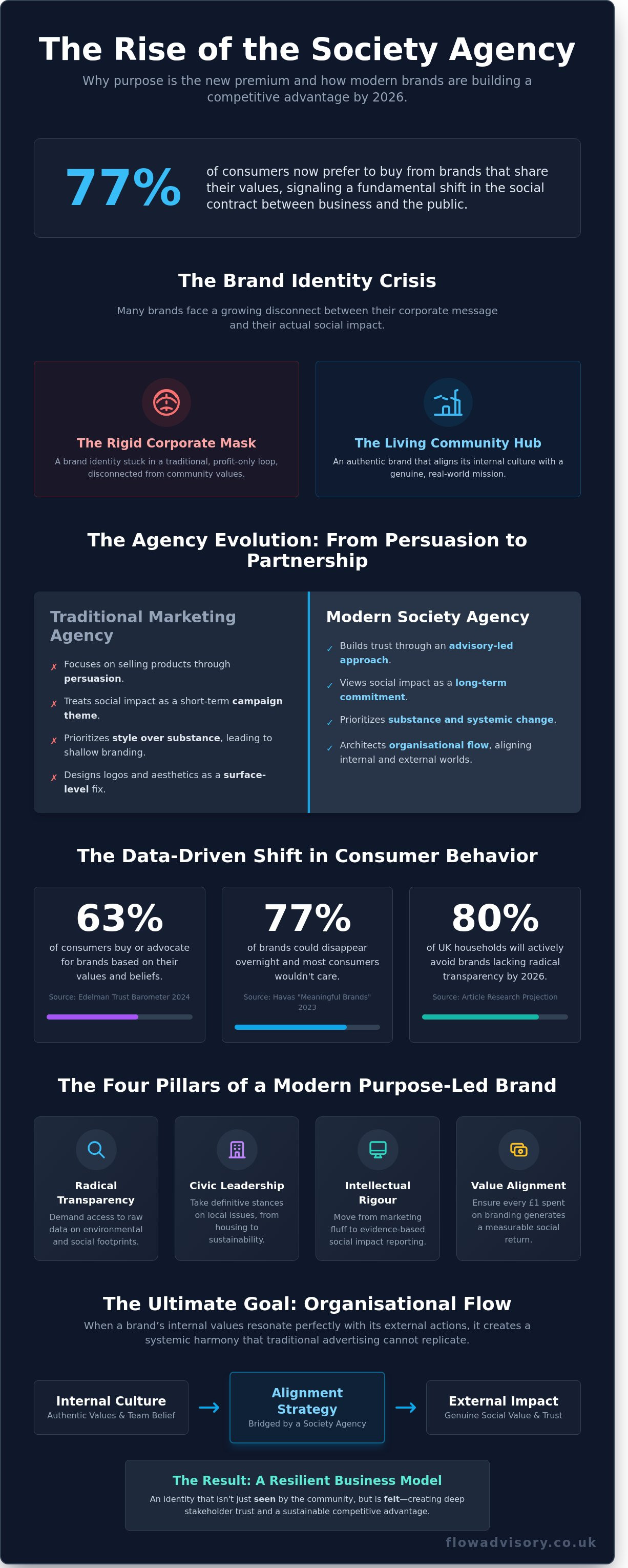
What if the most significant risk to your business isn't a market downturn, but the growing disconnect between your corporate message and your actual social impact? You've likely felt that friction when your brand’s visual identity feels more like a rigid corporate mask than a living community hub. It's a common struggle for leaders who see that 77% of consumers now prefer to buy from brands that share their values, yet find their own strategy stuck in a traditional, profit-only loop.
This is precisely where a society agency steps in to transform the narrative. These modern partners don't just design logos; they architect organisational flow by aligning your internal culture with a genuine mission that resonates in the real world. You'll learn how a society agency transcends old-school marketing to build a brand that attracts top-tier talent and fosters deep stakeholder trust.
We'll explore the specific frameworks needed to create a cohesive strategy that turns your mission into a tangible competitive advantage by 2026. It's time to move past dated aesthetics and embrace a visual identity that reflects the conscious, purpose-led future of your industry.
Key Takeaways
- Understand why a modern society agency focuses on social impact and organisational flow rather than traditional recruitment or modelling.
- Discover how to craft a visual identity that uses sophisticated colour palettes to evoke trust and communicate complex ethical values to a conscious audience.
- Learn the importance of aligning internal communications with public purpose, ensuring your brand’s promise is reflected in your team's culture before it reaches the market.
- Explore strategic brand positioning techniques that prioritise ethical growth and social value to create a sustainable competitive advantage in the 2026 landscape.
- Identify how to integrate strategy, design, and culture into a single cohesive flow that balances commercial success with human-centred impact.
Redefining the Society Agency: Why Purpose is the New Premium
Purpose isn't a badge. It's the pulse of a modern organisation. While the term might once have conjured images of talent scouts or recruitment hubs, the contemporary society agency functions as a strategic architect for brands that view social impact as their primary performance indicator. In London’s competitive landscape, where the 2024 Edelman Trust Barometer shows that 63% of consumers buy or advocate for brands based on their values, the definition of success has shifted. It's no longer enough to offer a premium product. You must offer a premium contribution to the world.
We define this alignment as organisational flow. When a brand’s internal values resonate perfectly with its external actions, it creates a systemic harmony that traditional advertising cannot replicate. By 2026, research suggests that 80% of UK households will actively avoid brands that lack radical transparency. This isn't a trend; it's a fundamental restructuring of the social contract between businesses and the public. A society agency acts as the bridge in this new environment, ensuring that a brand's visual identity isn't just a mask, but a true reflection of its civic soul.
The Evolution of Purpose-Led Branding
Purpose has migrated from the periphery of the boardroom to the very centre of the business engine. The days of treating Corporate Social Responsibility as a siloed side-project are over. Modern London organisations are now expected to behave as active citizens rather than neutral entities. This transition requires more than just a donation programme; it demands a total integration of values into the supply chain and culture. A strategic consultancy provides the intellectual framework to navigate this shift, turning abstract ideals into measurable social equity.
Why Traditional Marketing Agencies Often Fall Short
Conventional agencies are designed to sell products through persuasion. They often fail because they treat social impact as a campaign theme rather than a long-term commitment. A 2023 study by Havas revealed that 77% of brands could disappear overnight without consumers noticing. This happens when branding lacks depth. Building community trust requires an advisory-led approach that prioritises substance over style. You can't shortcut the process of earning a seat at the societal table; it requires a deep understanding of human dynamics and systemic change.
- Radical Transparency: 2026 audiences will demand access to raw data regarding environmental and social footprints.
- Civic Leadership: Brands must take definitive stances on local issues affecting Londoners, from housing to sustainability.
- Intellectual Rigour: Moving away from marketing fluff toward evidence-based social impact reporting.
- Value Alignment: Ensuring every £1 spent on branding generates a measurable social return.
The result of this shift is a more resilient business model. When an organisation finds its flow, it doesn't just survive market fluctuations; it leads them. This is the new premium. It’s a position of quiet confidence where the brand doesn't need to shout because its actions already speak for it. By moving beyond surface-level aesthetics, London businesses can build an identity that isn't just seen, but felt by the community it serves.
The Architecture of Impact: Core Services of a Modern Society Agency
A modern society agency acts as the strategic architect of an organisation's social footprint. It doesn't just design; it builds systems of meaning that bridge the gap between commercial objectives and societal needs. Since the UK social enterprise sector contributed £60 billion to the economy in 2022, the demand for sophisticated brand structures has surged. London-based firms now require a partner that understands the nuances of the City's financial expectations alongside the grassroots requirements of community engagement.
Strategic brand positioning now centres on social value. It's about finding the intersection where your business growth fuels ethical progress. This requires a deep understanding of the 4 Types of Corporate Social Responsibility to ensure that environmental, ethical, philanthropic, and economic efforts align with your brand's DNA. When these elements are out of sync, the market perceives it as "impact washing." Authentic positioning, however, builds a reservoir of trust. The 2023 Edelman Trust Barometer indicated that 63% of consumers buy or advocate for brands based on their beliefs and values. We help you articulate those values so they become a competitive advantage rather than a footnote in an annual report.
Visual identity development translates these complex ethical frameworks into elegant, high-end design. It's a visual shorthand for your mission. A society agency ensures that every serif and colour choice communicates stability and empathy. In a city like London, where the aesthetic standard is exceptionally high, your visual identity must feel both premium and accessible. It's not just a logo; it's a visual language that allows a venture capitalist and a local charity partner to recognise your commitment to quality and purpose simultaneously.
Internal communications frameworks ensure your team lives the brand promise every day. If your employees don't feel the "flow" of the mission, your external audience won't either. A 2022 Gallup report found that companies with highly engaged workforces see a 23% increase in profitability. We build the internal tools, from culture books to digital platforms, that foster this engagement. This ensures that the brand isn't just something you say, but something you do.
Strategic Brand and Creative Development
Defining a market position in the social impact landscape involves rigorous analysis of local and global competitors. We help London-based firms create narratives that resonate with institutional investors looking for ESG compliance. By linking brand strategy to measurable goals, such as a 20% reduction in supply chain waste by 2026, the brand becomes an accountable entity. This narrative-driven approach turns abstract goals into a concrete roadmap for growth.
Digital Presence and Website Development
Your digital home must reflect your organisational culture with absolute clarity. This means baking accessibility into UI/UX design from the start. Following WCAG 2.1 standards isn't just a legal box-ticking exercise; it's a statement of inclusivity. Content bridges the gap between your mission and your audience. When you refine your digital strategy, you turn a static website into a compelling user journey that drives measurable social action.
Visual Identity: Designing for a Conscious Society
Visual identity represents the heartbeat of a brand's external presence. It's a silent language that communicates values before a single word is read. For a society agency operating in the competitive London landscape, this language must bridge the gap between corporate excellence and social empathy. It isn't merely about aesthetics; it's about building a semiotic framework that signals safety, progress, and shared purpose. According to the 2024 Edelman Trust Barometer, 63% of UK consumers now buy or advocate for brands based on their values and beliefs. This shift demands a visual strategy that moves beyond the superficial.
Choosing a colour palette is your first act of communication. While navy blue has long been the anchor for 33% of the world's top brands to evoke trust, conscious organisations are pivoting toward more nuanced tones. Deep forest greens and muted slate greys suggest a grounded, sustainable authority. These choices aren't accidental. They reflect a move away from the aggressive "power reds" of the 1990s toward colours that suggest longevity and environmental stewardship. When we consider What Is a Purpose-Driven Firm?, we see that visual cues must align with a deeper mission of positive impact. If your palette feels clinical, you'll struggle to foster the community warmth required for social change.
Authenticity is the new gold standard. The era of the "smiling handshake" stock photo is over. Modern visual identities rely on human-centric imagery that feels lived-in and real. A 2023 study by Stackla found that 88% of consumers say authenticity is important when deciding which brands they like and support. This means using photography that captures genuine moments of collaboration and struggle rather than staged perfection. The 2021 rebranding of the charity Shelter is a prime example. By using a bold, red "brush stroke" logo that mimics the urgency of activism, they revitalised their brand to speak directly to the housing crisis with raw, uncompromising honesty.
Crafting a Unique Brand Aesthetic
Your visual identity must be a reflection of your internal flow. It's the external manifestation of your organisational health. In the context of social change, design psychology plays a vital role. You must balance professional authority with approachable warmth. This is achieved through typography; pairing a stable, geometric sans-serif with a more characterful serif can signal both reliability and a human touch. It's about creating a "visual handshake" that feels firm yet welcoming.
The Role of Marketing Collateral
Consistency across all touchpoints is what builds a society agency's reputation over time. Whether it's a digital report or a physical business card, the voice must remain singular. High-quality content creation isn't just about pretty pictures; it's a strategic tool that supports your visual identity. As you scale, organising your assets becomes critical. By 2025, Gartner predicts that 80% of B2B sales interactions will occur in digital channels. Without a centralised brand portal to maintain integrity, your message will dilute, and the trust you've built will erode. Integrity is maintained through the disciplined application of your visual rules across every single interaction.
Internal Communications: Aligning Culture with Public Purpose
A logo is a signature, but the culture is the hand that writes it. For a society agency operating in the competitive London landscape, the brand's integrity depends entirely on internal buy-in. You can't project a message of social impact if your own team feels disconnected from the mission. True visual identity reflects an internal reality; it's the bridge between what you say and what you actually do. When the internal culture is fragmented, even the most sophisticated visual identity will eventually feel like a performance rather than a commitment.
Leaders often ask if branding is just a logo. It's a common misconception that we see frequently. Branding starts with your people. A 2023 report by PwC revealed that 67% of UK workers prefer to work for organisations with a clear social purpose. If your employees don't live the brand, your visual identity becomes a hollow mask. We focus on building a culture of flow, where every individual understands how their daily tasks contribute to the wider societal goal. This alignment reduces friction and increases the speed of execution, transforming a static business into a living, breathing entity.
Practical frameworks for internal alignment include:
- The Purpose Audit: Assessing whether staff can articulate the brand mission in their own words without reciting a handbook.
- Values Integration: Moving beyond posters on the wall to embedding values into recruitment, onboarding, and performance reviews.
- Feedback Loops: Creating structured, safe opportunities for bottom-up communication to ensure the mission remains relevant and grounded.
The Internal Brand Experience
Internal communication isn't just about sending emails; it's about designing channels that foster transparency and motivation. When a society agency aligns its internal culture with its public purpose, it builds a robust shield against purpose-washing accusations. In 2022, Gallup data showed that only 9% of UK employees were actively engaged at work. Strong internal alignment shifts this by making the brand's mission personal. If your team trusts the brand, the public will follow.
Engaging Stakeholders and Communities
Successful brands use a favourite channel strategy to reach different stakeholder groups effectively. This might involve using Slack for immediate team updates, while using a monthly town hall for deeper strategic dives. Turning employees into brand ambassadors is the most cost-effective marketing strategy available. You can measure this through an Employee Net Promoter Score (eNPS). A score above +30 indicates a healthy, sustainable alignment between culture and brand performance, ensuring your London-based organisation thrives.
Ready to bridge the gap between your mission and your team? Explore how Flow Advisory helps you achieve strategic alignment.
Partnering for Progress: Why Flow Advisory is Your Strategic Society Agency
True brand evolution happens when internal values align perfectly with external perception. At Flow Advisory, we don't just design symbols; we architect the systems that allow those symbols to mean something. As a dedicated society agency, we bridge the gap between a London firm’s commercial objectives and its broader cultural footprint. This isn't about superficial aesthetics. It's about ensuring every touchpoint, from an internal memo to a high-street billboard, speaks the same language of intent. We view the integration of brand strategy, visual identity, and internal communications as a single, fluid stream of work rather than isolated projects.
The London market moves at a pace that punishes indecision. Recent 2024 data indicates that UK brands with a cohesive social identity see a 22% increase in long-term customer loyalty compared to those using a purely transactional model. We help businesses move away from fragmented identities that confuse the consumer. Instead, we build a cohesive social force. Our commitment to intellectual, human-centred advisory services means we look at the psychological drivers of your audience. We don't guess; we analyse the data and the human dynamics that drive the UK's competitive landscape.
The Flow Advisory Approach
Our method blends rigorous business logic with a refined creative elegance. We've identified that 42% of UK SMEs struggle with a "purpose gap" where their mission statement fails to translate into daily operations. We fix this by treating your brand as a living organism. This process involves stripping away the noise to find the core strategic focus that makes your business essential. We invite you to learn more about our team and philosophy to see how this intellectual advisory works in practice. We value professional precision, ensuring that every design choice is backed by a strategic "why" that supports your scalability and efficiency.
- Strategic Alignment: We ensure your visual identity is a direct reflection of your long-term business goals.
- Cultural Resonance: Our designs are crafted to thrive within the specific cultural nuances of the London and UK markets.
- Operational Flow: We help integrate your brand values into your internal culture, turning employees into authentic brand ambassadors.
Ready to Organise Your Impact?
Acting now is vital to secure your brand’s future in an increasingly conscious market. Consumers in 2024 are looking for more than a product; they're looking for a partnership with brands that reflect their values. Waiting to unify your brand identity often leads to a "fragmentation tax" where marketing spend is wasted on inconsistent messaging. A partnership approach beats a transactional agency model every time because it allows for deep, sustained growth rather than short-term fixes. We don't operate as a simple vendor. We act as your strategic partner, navigating the complexities of the modern business world alongside you.
The transition from a mere business to a social force requires a deliberate shift in mindset. It's about moving from "what we sell" to "why we exist." If you're ready to close the gap between your current identity and your potential impact, we're here to guide the way. Contact us today for a strategic consultation to discuss how we can bring clarity, flow, and purpose to your London business. Let's build something that doesn't just look good, but actually works for your people and your profit.
Leading the Shift Toward a Conscious Economy
The road to 2026 requires a fundamental move from superficial marketing to deep systemic impact. Brands are no longer judged by profit alone. They're measured by their contribution to the collective good. Aligning your internal culture with a public-facing purpose ensures your visual identity isn't just a facade; it's a reflection of genuine organisational truth. This synergy creates the strategic flow necessary for commercial resilience and meaningful growth in an increasingly crowded marketplace.
Strategic flow is the foundation of every resilient brand. Since 2020, Flow Advisory has delivered end-to-end creative solutions from our London base to bridge the gap between profit and purpose. We operate as a dedicated society agency that understands the nuances of purpose-led brand strategy. We don't believe in surface-level fixes; we focus on the human dynamics and complex business processes that drive long-term value. By integrating professional precision with a deep-rooted focus on impact, we help leaders navigate the complexities of the UK market with absolute confidence.
Ready to build a brand that moves society? Contact Flow Advisory today.
The future belongs to those who lead with intention and clarity.
Frequently Asked Questions
What is the difference between a society agency and a standard branding agency?
A society agency distinguishes itself by prioritising systemic social impact over purely commercial aesthetics. While traditional firms focus on market positioning and sales uplift, this specialised partner ensures every strategic decision serves a broader purpose. Recent 2023 data shows that 63% of UK consumers now choose brands based on their social values, making this alignment a critical business imperative for long-term resilience and trust.
How does a society agency help with ESG and social impact reporting?
They transform technical ESG metrics into authentic narratives that satisfy both regulators and the public. Under the UK’s 2024 Sustainability Disclosure Requirements, firms must provide transparent proof of their environmental and social impact. A society agency helps bridge the gap between raw data and human storytelling. This ensures that a company’s £50,000 investment in green initiatives is understood and valued by its entire community.
Can a society agency help with internal culture and employee engagement?
Yes, they bridge the gap between external brand promises and the daily internal reality of the workplace. By aligning a firm's visual identity with its cultural values, they help reduce staff turnover, which costs UK businesses approximately £3,000 per hire in administrative fees alone. This holistic approach ensures that employees feel a deep sense of purpose, which 82% of workers now cite as essential for their job satisfaction.
Why is visual identity so important for purpose-led organisations?
Visual identity acts as a non-verbal shorthand for trust and credibility in a crowded, sceptical marketplace. It’s the first point of contact that signals a commitment to quality and ethical standards. A 2022 study found that consistent brand presentation can increase revenue by 23%. This provides the financial stability needed for social missions to remain sustainable without constantly relying on external grants or temporary funding cycles.
How do you measure the success of a brand strategy in the social sector?
Success is measured through a blend of Social Return on Investment (SROI) and traditional brand health metrics. For every £1 invested, an SROI analysis might reveal £3.50 of social value created, alongside improvements in Net Promoter Scores. We look beyond vanity metrics to track how deeply the brand’s message has shifted public perception or influenced policy changes over a specific twelve month period.
What industries typically work with a society agency?
B Corps, non-profits, and ESG-focused financial institutions are the primary clients seeking this level of strategic depth. In the UK, there are now over 1,500 certified B Corps that require specialised support to maintain their ethical positioning while remaining competitive. These organisations understand that profit and purpose aren't mutually exclusive, but rather two sides of the same coin that require a unified communication strategy.
How does Flow Advisory integrate brand strategy with website development?
We treat the website as a digital manifestation of the brand's internal logic and flow. By integrating strategy from the outset, we ensure your platform meets WCAG 2.1 accessibility standards, serving the 1 in 5 people in the UK with a disability. This approach creates a seamless connection between your visual identity and the user experience, turning technical infrastructure into a powerful tool for genuine community engagement.
Is a society agency suitable for small businesses or just large corporations?
Impact-led strategy is essential for organisations of all sizes, from local social enterprises to global corporations. Small businesses with fewer than 15 employees often benefit most from early alignment, as it establishes a clear roadmap for sustainable growth. Investing in professional guidance early prevents the £10,000 to £20,000 costs typically associated with fixing a fragmented or contradictory brand identity later in the business lifecycle.