
Choosing the Right Web Design Agencies: A Strategic Guide for UK Businesses in 2026

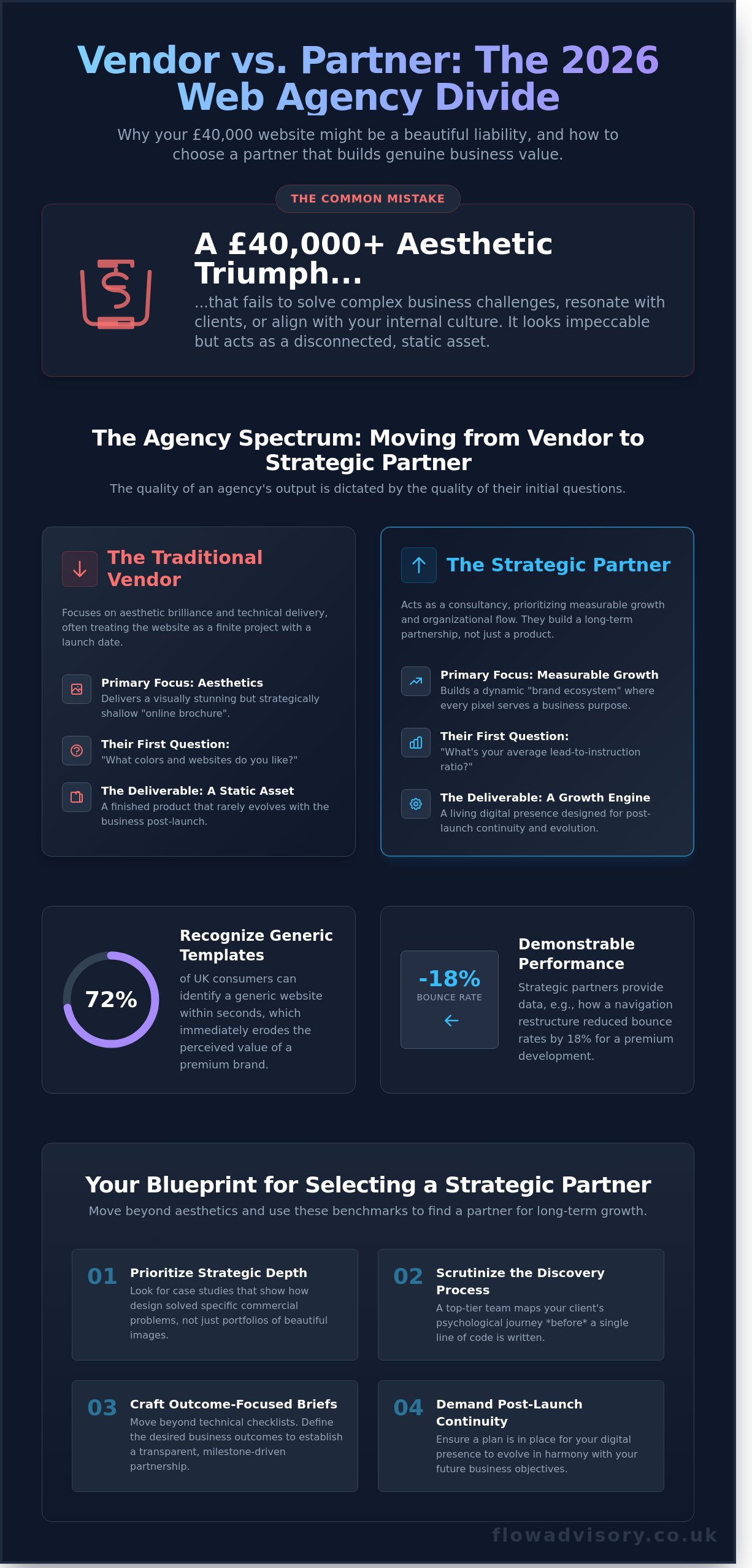
A visually stunning website is often the most expensive mistake a UK business can make in 2026. You've likely experienced the dissonance of approving a £40,000 project that looks impeccable but fails to resonate with your actual clients or internal culture. It's a common frustration when web design agencies deliver aesthetic brilliance without the strategic depth required to solve complex business challenges. You know that a digital presence should be a living extension of your brand's purpose, yet the results often feel like a disconnected, technical-only exercise.
You're right to expect more than just a launch date; you need a partnership that prioritises measurable growth and organisational flow. This guide reveals how to evaluate potential partners through a strategic lens to ensure your digital assets drive genuine value. We'll explore the transition from hiring simple vendors to finding consultancies that align your external brand with your internal vision, creating a sustainable foundation for the years ahead.
Key Takeaways
- Shift your perspective from viewing websites as static brochures to seeing them as dynamic brand ecosystems where strategic intent precedes every creative decision.
- Discover how to rigorously evaluate web design agencies by prioritising their strategic depth and discovery methodologies over mere aesthetic appeal.
- Uncover the psychological drivers behind visual identity and how intentional UI choices foster the digital trust necessary for sustainable brand growth.
- Learn to craft outcome-focused briefs that move beyond technical checklists to establish a transparent, milestone-driven partnership with your chosen agency.
- Understand the necessity of post-launch continuity and how internal alignment ensures your digital presence evolves in harmony with your business objectives.
Defining the Role of Modern Web Design Agencies in 2026
Digital presence is no longer a static asset. It's a living extension of your corporate identity. By early 2026, the transition from "online brochures" to dynamic brand ecosystems has become absolute. For UK property firms, this means a website must do more than display floorplans; it must facilitate a complex emotional and financial journey. Many web design agencies have historically focused on the aesthetic surface, yet the current market demands a deeper integration of business intelligence and user psychology.
Strategic intent must precede every visual or technical decision. If you don't define the commercial objective first, the most beautiful interface will still fail to convert. We see a clear divide emerging between "full-service" shops that offer a broad but shallow range of tactical outputs and strategic consultancies that prioritise long-term growth. The 2026 digital landscape rewards brand authenticity. Recent data from UK consumer surveys indicates that 72% of users can identify a generic template within seconds, which immediately erodes the perceived value of a premium property development.
The Shift Toward Brand-Led Development
Your website is the primary touchpoint for your brand experience. It's where your values meet the user's needs. We've moved beyond the "mobile-first" era into an age of "strategy-first" design. This approach ensures that the digital interface isn't just responsive to screen sizes, but responsive to human intent. Narrative plays a vital role here; it’s the thread that connects a visitor’s initial curiosity to their final enquiry. Without a compelling story, your site is just a database of images.
Why National Brands Require a Strategic Approach
Scaling a message across diverse UK markets requires precision. A developer operating across distinct market segments, such as high-value property and urban regeneration projects, cannot rely on a one-size-fits-all digital solution. You need a system that maintains messaging consistency while allowing for local nuance. This complexity is why choosing the right partner is vital for your strategic growth. A strategic web design agency is a partner that aligns digital architecture with commercial goals. Professional web design agencies now act as the bridge between your internal vision and the external market's expectations, ensuring that every pixel serves a measurable business purpose.
Key Benchmarks for Selecting a Strategic Design Partner
Aesthetics are a commodity in the current market. When you browse the portfolios of various web design agencies, you'll likely see plenty of high-resolution imagery and sleek typography. However, visual appeal is merely the price of entry. A truly strategic partner looks beneath the surface to understand how digital architecture impacts your bottom line. For a property firm managing a portfolio worth £50 million, a beautiful site that fails to capture qualified leads is a liability, not an asset.
The most effective agencies demonstrate strategic depth by showcasing how their designs solved specific commercial frictions. They don't just talk about "user experience"; they provide data on how a navigation restructure reduced bounce rates by 18% or how a bespoke booking integration increased viewing requests for premium London developments. You're looking for a partner that treats your website as a 24/7 sales consultant rather than a digital brochure. Technical proficiency is the floor of their value; their ability to translate your business model into a digital interface is the ceiling.
The Discovery and Strategy Framework
The quality of an agency's output is dictated by the quality of their initial questions. During your first consultation, a top-tier team won't ask what colours you like. They'll ask about your average lead-to-instruction ratio and the specific demographic nuances of your target investors. This discovery phase is vital because it bridges the gap between user research and commercial conversion. Agencies that prioritise brand positioning will spend significant time mapping the psychological journey of your clients before a single line of code is written. If they skip this phase, they aren't building a strategy; they're just painting a template.
Technical Excellence vs. Strategic Vision
While clean code and robust SEO are non-negotiable, they're insufficient for driving long-term growth. The real value lies in how web design agencies integrate your digital presence with your wider marketing collateral. This includes ensuring your site architecture supports complex content strategies and mirrors the "flow" of your internal business processes. When technology and strategy align, the result is a seamless experience that feels intuitive to the user and effortless for your team to manage. You can identify this "flow" by asking how they handle integrated content creation and whether their technical stack allows for effortless scaling as your portfolio grows.
Choosing a partner who understands these dynamics requires a shift in perspective. It's about moving away from transactional relationships and towards a strategic partnership that values sustainable performance over quick wins. Look for an agency that can articulate their creative process with the same precision they use for their technical stack, ensuring every design choice serves a measurable business objective. This alignment is what transforms a simple website project into a powerful engine for organisational growth.
The Critical Link Between Visual Identity and Digital Performance
Digital presence serves as the primary touchpoint for high-net-worth investors and commercial tenants in the UK property market. If your visual identity feels disconnected from your digital interface, trust erodes before a single property detail is read. Leading web design agencies recognise that user interface (UI) design isn't a decorative layer; it's the functional manifestation of a brand's core values. When a developer's visual identity is weak, the website often compensates with unnecessary flourishes that distract from the investment opportunity.
Psychology plays a silent but dominant role in digital engagement. In the UK corporate sector, slate greys and deep navy tones signal stability and heritage, while specific serif typefaces can increase perceived brand authority by as much as 20% compared to generic alternatives. Every choice, from the weight of a line to the speed of a transition, informs the user's subconscious assessment of your reliability. If the digital experience feels fragmented, the property itself is perceived as a higher risk.
A common pitfall for many firms is investing in a "pretty" site that lacks a strategic foundation. Aesthetics alone don't drive conversions. A 2023 report indicated that design-led companies outperform their competitors by 211% in terms of revenue growth, but only when that design is rooted in strategy. Without a clear link between the brand's promise and the site's architecture, even a £50,000 digital build will fail to retain sophisticated users who value efficiency over decoration.
Translating Brand Values into UX/UI
Digital behaviour must mirror your brand promise to create a seamless flow for the user. If your agency claims to lead the market in innovation, your website shouldn't rely on restrictive, outdated templates. Minimalist design has emerged as a powerful tool for high-stakes engagement because it removes cognitive load, allowing the property data to speak for itself. A 2024 analysis of corporate digital projects showed that reducing visual clutter can increase high-quality lead generation by 14.5%. You can see this principle in action in our study on Jade Engineering: Integrating Brand Strategy into Industrial UX/UI Design.
Measuring the ROI of Visual Cohesion
Consistency reduces user friction and builds long-term loyalty. When a printed brochure, a social media post, and a website share a unified visual language, the user's brain spends less energy verifying the source's legitimacy. This perceived authority is vital for web design agencies working within the competitive UK real estate landscape. Strategic cohesion ensures that your brand remains memorable long after the browser tab is closed. For a forward-looking perspective on these trends, explore our Visual Identity Design Services: A Strategic Guide for UK Brands in 2026.
Managing the Agency Partnership: From Briefing to Launch
Successful partnerships thrive on intellectual synergy rather than transactional exchange. It's a common mistake to view a property marketing agency as a mere vendor. Instead, treat them as a strategic extension of your internal team. When engaging with web design agencies, the most effective briefs prioritise business outcomes over specific aesthetic features. You aren't just buying a website; you're investing in a digital asset designed to facilitate a specific human experience and drive measurable growth.
Clarity in communication acts as the foundation for this growth. Establishing transparent milestones ensures that both parties remain aligned on the project's trajectory. Balancing creative exploration with strict project timelines requires a disciplined approach. You must allow the agency the psychological safety to innovate while maintaining the structural integrity of your 12-week or 16-week launch schedule. Constructive feedback should always be objective. Instead of stating you "dislike" a colour, explain how it might conflict with the brand's promise of stability or luxury. This level of discourse respects the design process and keeps the project's "flow" intact.
The Collaborative Briefing Process
Defining your user personas is the first step toward a high-performing site. A 2023 analysis of UK property portals showed that personalised user journeys can increase lead quality by 22%. You must distinguish between your primary persona, such as a high-net-worth investor looking for 6% yields, and secondary personas like local tenants. Setting clear KPIs is equally vital. Move beyond "more traffic" and aim for specific targets, such as a 4% conversion rate on viewing bookings. Internal stakeholder alignment is the final piece of the puzzle. If your directors and marketing leads aren't aligned before the build begins, you risk a 30% budget creep due to late-stage structural changes.
Navigating the Development Lifecycle
The transition from low-fidelity wireframes to high-fidelity prototypes is where logic meets emotion. Wireframes serve as the architectural blueprint, ensuring the user journey is intuitive before the visual layer is applied. Top-tier web design agencies will insist on integrating a content strategy at this stage. Content should dictate the design, not be squeezed into it as an afterthought. As you approach the launch, prepare your team for the digital transition. This involves more than just a login; it requires training to ensure your staff can manage the new system without breaking the site's strategic focus. A smooth handover ensures the platform remains a living, breathing asset for your business.
Beyond the Build: Why Strategic Continuity Drives Long-term Growth
A high-performing digital asset is never truly complete. The UK property market underwent a seismic shift in 2023 as interest rates hit a 15-year high of 5.25 per cent. This volatility proved that static websites fail when the market demands agility. Most web design agencies focus on the launch date as the finish line; yet, the most successful property firms view it as the starting point. They treat their digital presence as a living organism that matures alongside their business objectives. When your strategy shifts from high-volume sales to premium consultancy, your website must reflect that transition instantly.
A consultancy partner provides a level of depth that a one-off developer cannot match. While a developer delivers code, a consultant delivers a roadmap for sustainable growth. This partnership ensures that your investment, which often exceeds £25,000 for bespoke enterprise solutions, doesn't become obsolete within eighteen months. It's about maintaining a strategic focus that balances technical performance with the human dynamics of your team. Real growth happens when the digital tool becomes an extension of the leadership's vision.
Aligning Internal Culture with Digital Brand
Your digital presence is a promise that your physical team must keep. If your website exudes premium sophistication but your internal response times lag, the brand fracture is immediate. Success depends on every team member understanding the digital narrative. Internal brand guidelines serve as more than just a style guide; they are a manifesto for digital maintenance. This philosophy of integration is central to how we approach business growth, as detailed in our About Flow Advisory page. When internal culture and digital branding move in synchronicity, the resulting flow creates a powerful competitive advantage in the crowded UK property sector.
Future-Proofing Your Digital Investment
Scalability isn't just a technical requirement; it's a financial imperative. Technical debt can cost UK businesses upwards of £15,000 in lost efficiency within just two years of a poorly planned launch. Strategic reviews every six months ensure your platform adapts to emerging technologies and shifting buyer behaviours. Leading web design agencies should facilitate these evolutions through modular architecture and proactive content updates. For a deep dive into long-term planning, explore our Strategic Business Website Design and Development: The 2026 Guide to Digital Growth. By planning for 2026 today, you secure a legacy of digital excellence that transcends temporary market trends.
Defining Your Digital Future
Success in 2026 requires a shift in perspective. Your digital presence isn't a static asset; it's a dynamic engine for growth that demands a fusion of psychological insight and technical precision. Selecting from the diverse landscape of web design agencies involves finding a partner that looks beyond the build to the strategic continuity of your brand. UK businesses that integrate their visual identity with measurable performance benchmarks can see a 35% increase in lead quality according to recent market projections for the 2026 fiscal year.
Our approach combines award-winning visual identity expertise with deep strategic consultancy to ensure your platform scales effectively. We provide a national service across the UK, focusing on the human dynamics that drive user behaviour. It's about creating a state of flow where your business goals and customer needs meet seamlessly. By prioritising this holistic alignment, you're not just launching a website; you're securing a long-term competitive advantage in an increasingly complex digital economy. We're ready to help you navigate this evolution with clarity and confidence.
Discover how we align your digital presence with your strategic vision. Contact Flow Advisory today.
Frequently Asked Questions
How much do top web design agencies in the UK charge in 2026?
Top-tier web design agencies in the UK typically charge between £25,000 and £150,000 for a comprehensive strategic project in 2026. This investment reflects the depth of research and custom engineering required for high-performance platforms. Smaller boutique firms may offer packages starting from £10,000, while enterprise-level solutions often exceed £200,000. These figures account for a 12% increase in specialist labour costs over the last two years.
How long does a strategic website design and development project typically take?
A strategic website project usually requires a timeline of 14 to 20 weeks from inception to launch. This duration allows for a 4-week discovery phase followed by 6 weeks of architectural design and 8 weeks of technical development. Projects often extend beyond 24 weeks if complex API integrations or bespoke property management systems are involved. Rushing this process compromises the structural integrity and long-term scalability of the digital asset.
What is the difference between a web design agency and a brand strategy consultancy?
A brand strategy consultancy defines your market position and core identity, whereas a web design agency focuses on the digital manifestation of that identity. Consultancies look at the "why" and the "who" to ensure your business resonates with specific demographics. Agencies translate these insights into functional user interfaces and code. Choosing a partner that bridges both disciplines ensures your brand's narrative remains coherent across every digital touchpoint.
Do I need to have my brand strategy finalised before contacting an agency?
You don't need a finished brand strategy, but starting without one often leads to a 40% increase in revision cycles. Many premium web design agencies include a strategic discovery phase to align your visual identity with your commercial objectives. If your internal values aren't clear, the design will lack the necessary depth to convert high-value clients. Establishing these foundations early prevents costly pivots during the development stage.
How can I measure the success of my new business website?
Success is measured through a combination of conversion rates, organic search visibility, and user engagement metrics. A high-performing property website should aim for a lead conversion rate of 3% to 5% within the first six months. You should also track the reduction in bounce rate and the increase in average session duration. These data points provide a clear picture of how well the site facilitates the user's journey from curiosity to commitment.
Should I choose a niche-specific agency or a generalist creative firm?
Niche-specific agencies offer deep sector knowledge, but generalist firms often bring 25% more innovation by cross-pollinating ideas from different industries. A property-specific agency understands the technical requirements of portal integrations and local planning regulations. Conversely, a generalist firm might introduce a more sophisticated user experience inspired by high-end retail or finance. The right choice depends on whether your priority is industry compliance or market disruption.
What role does SEO play in the web design process?
SEO is a foundational element that must be integrated into the site's architecture from the very first wireframe. Leading web design agencies prioritise site speed, mobile responsiveness, and schema markup to ensure the site ranks for competitive terms. Neglecting SEO until after launch can result in a 60% loss in potential organic traffic. A well-structured site acts as a silent salesperson, working 24 hours a day to attract qualified leads through search engines.
How often should a business website be redesigned for optimal performance?
A business website should undergo a significant refresh every 2 to 3 years to maintain its competitive edge. Technical standards and search engine algorithms change frequently, making older sites obsolete quickly. If your site's load time exceeds 3 seconds or your mobile conversion rate is 20% lower than desktop, it's time for a redesign. Regular updates ensure your digital presence evolves alongside your business growth and client expectations.