
Beyond the Visual: A Strategic Guide to Selecting a Design Agency in London

A stunning portfolio is often the most unreliable metric for choosing a design agency london. While a visually arresting website might catch your eye, it rarely reveals whether the studio can translate complex business objectives into measurable market share. You've likely felt the exhaustion of reviewing dozens of near-identical pitches, fearing that a £45,000 investment might result in a "pretty" brand that fails to connect with your specific industry stakeholders.
We understand that a true creative partnership should feel like a strategic extension of your leadership team. This guide dismantles the three most persistent myths about creative collaborations to help you secure an ally that prioritises your long-term growth over their own design awards. We'll provide a clear framework for auditing agency culture and validating ROI, ensuring your external identity finally aligns with the internal excellence of your organisation.
Key Takeaways
- Understand why foundational strategy has replaced mere aesthetics as the primary driver of competitive advantage in the 2026 creative landscape.
- Identify how to bridge the "strategy gap" to ensure high-end visuals are supported by robust messaging that converts prospects into partners.
- Challenge the legacy mindset of the "postcode tax" when selecting a design agency london to prioritise strategic depth over a prestigious address.
- Learn to quantify the impact of your creative investment by tracking specific KPIs like lead quality, conversion rates, and user engagement.
- Discover the methodology for building a brand from the inside out, moving beyond surface decoration toward a systemic business transformation.
Beyond the Visual: Busting the Myth of the 'Pretty' Design Agency
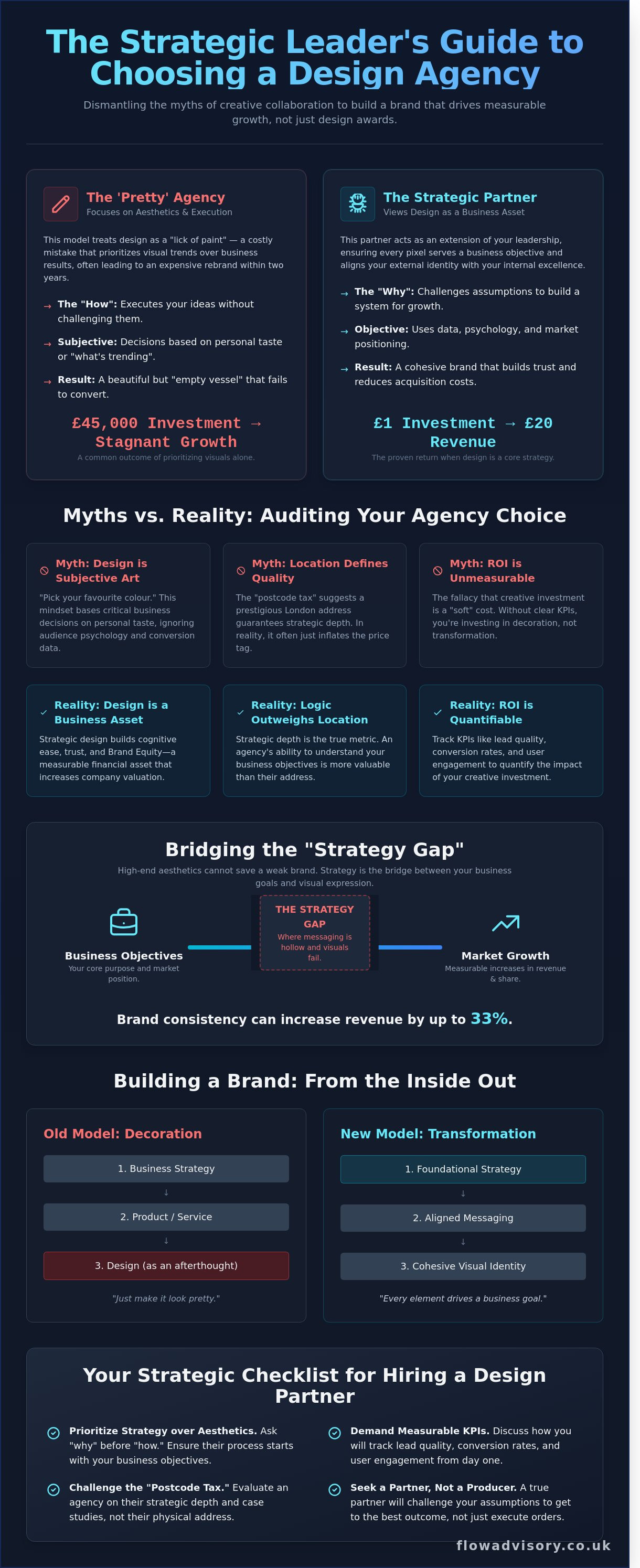
Design is often relegated to the final stage of a project, viewed as a decorative 'lick of paint' applied once the real work is finished. This mindset is a costly mistake. By 2026, simply 'looking good' has become the bare minimum for any brand entering the UK market. It's no longer a competitive advantage; it's the price of entry. When searching for a design agency london businesses often prioritise portfolios that dazzle the eye while ignoring the underlying commercial logic. At Flow Advisory, we see design as a foundational strategy where every pixel must serve a specific business objective.
There's a profound difference between a production-led studio that executes your ideas and a strategy-led consultancy that challenges them. A production studio focuses on the 'how', while a strategic partner focuses on the 'why'. Choosing a design agency london provides an opportunity to move beyond surface-level aesthetics and build a system that drives measurable growth. The Design Council's research suggests that for every £1 spent on design, businesses can expect a £20 increase in revenue, but this return only materialises when design is treated as a core business function rather than an afterthought.
Myth #1: Design is a Subjective Art Form
The belief that design is purely a matter of taste is one of the most damaging misconceptions in the corporate world. Effective visual identity isn't about what the CEO likes or which palette is currently trending on Instagram. It's a disciplined application of data, market positioning, and audience psychology. Your 'favourite colours' shouldn't dictate your brand's visual identity because your personal preferences don't pay the bills. Instead, we look at how specific hues and layouts influence user trust and conversion rates. For a deeper look at how these elements coalesce into a broader market position, explore our guide on What is a Branding Agency? to understand the mechanics of strategic perception.
The Reality: Design as a Business Asset
Strategic design functions as a high-yield business asset that works 24/7 to reduce customer acquisition costs. When a brand feels cohesive and intentional, it builds immediate cognitive ease, which is the psychological precursor to trust. In a crowded marketplace, this trust allows you to bypass the initial scepticism that usually plagues new sales cycles. This process is a vital component of modern brand management, ensuring that every touchpoint reinforces a singular, powerful promise to the client.
Visual consistency isn't just about repetition; it's about compounding your influence. Over time, this consistency builds significant equity that can be leveraged during expansions or pivots. Brand Equity is the financial value of a company’s reputation. By treating design as a rigourous business tool, you aren't just making things look better; you're actively increasing the valuation of your organisation.
The Strategy Gap: Why High-End Aesthetics Cannot Save a Weak Brand
Aesthetics often act as a seductive mask. Business owners in the UK frequently invest £25,000 or more in a visual overhaul, only to find their conversion rates remain stagnant six months later. This is the "Empty Vessel" syndrome. A website might look like a digital masterpiece, yet if the messaging is hollow or disconnected from the user's pain points, it won't resonate. High-end design without a foundation is merely decoration. It lacks the gravity required to pull a prospect through the sales funnel.
Before opening a design file, a brand must define its purpose and market position. Without this clarity, you're asking a design agency london to guess your identity. This guesswork is expensive. When a brand lacks a core "why," the creative output becomes a reflection of current trends rather than a timeless representation of the company's value proposition. Strategy is the bridge between business objectives and visual expression.
Why Visuals Alone Fail to Drive Growth
Inconsistent messaging confuses the buyer's journey. A 2023 report by Marq suggested that brand consistency can increase revenue by up to 33 per cent, yet many firms chase "award-winning" visuals that don't align with their internal culture. Following fleeting design trends is a dangerous game. If your visual identity is built on what's fashionable in Shoreditch this week, you'll likely face an expensive rebrand within two years. This cycle of "aesthetic chasing" drains capital and erodes market trust. True growth stems from a visual language that feels inevitable because it's rooted in strategic truth.
The Role of Brand Strategy in Creative Execution
A "Visual Narrative" is the art of telling your story through colour, typography, and imagery. It's not about what looks good; it's about what feels right for the specific market segment you're targeting. A robust brand portfolio strategy ensures that every sub-brand or service line contributes to the parent company's equity. This structural clarity allows for a cohesive experience across every touchpoint. From pitch decks to LinkedIn banners, the language must be identical. Achieving this requires stakeholder alignment during the strategy phase; every leader must agree on the brand’s direction before the creative team starts their work.
At Flow Advisory, we operate with a "strategy first, creative second" mindset. We don't view design as a standalone service but as a tool for solving complex business problems. Our Visual Identity Design Services serve as the tangible execution of a deep-rooted strategic foundation. When you partner with a design agency london, ensure they're asking about your five-year growth plan, not just your favourite hex codes. If you're looking for a partner that values depth over surface-level polish, you can learn more about our approach to integrated brand development.
Location vs Logic: Why Your Search for a 'Design Agency London' Might Be Misguided
Proximity is a legacy metric. For decades, the W1 or EC1 postcode served as a shorthand for quality, suggesting that the most innovative minds were concentrated within a five-mile radius of Charing Cross. This mindset is increasingly disconnected from the reality of modern business. Searching for a design agency london often stems from a desire for the "best," yet the highest intellectual calibre now frequently resides in consultancies that have shed the "postcode tax" of expensive central London real estate. When you pay for a premium London address, a significant portion of your budget covers their rent rather than your results.
Does Postcode Determine Performance?
Talent is no longer tethered to a single city. Data from the Office for National Statistics in 2023 revealed that approximately 44% of UK workers now engage in hybrid or remote work, allowing national firms to recruit the sharpest strategic minds from across the country. A national agency often provides a broader, more grounded perspective. This is vital for businesses serving a diverse UK-wide demographic rather than a London-centric bubble. Digital collaboration tools have removed the friction of distance; a strategic workshop via Miro or Zoom is often more efficient than a two-hour commute to a physical boardroom. Expertise is about the depth of thinking, not the physical square footage of an office.
Evaluating Agencies on Substance, Not Just Style
A "cool" office in Shoreditch with a vintage espresso machine doesn't solve complex business problems. When you learn how to choose a product design firm, you realise that the most critical factor is the agency's ability to integrate engineering, strategy, and design into a cohesive whole. You should look past the portfolio of "pretty" screens and interrogate their problem-solving process. Ask for case studies where design led to a specific 18% increase in user retention or a 22% uplift in lead quality. These are the metrics that define success, not the number of design awards on a shelf.
Cultural fit between your leadership team and the agency is the true driver of project velocity. You need a partner who understands the human dynamics behind your operations and can challenge your assumptions with confidence. At Flow Advisory, we believe that true expertise is found in the ability to create "flow" within complex systems. We prioritise intellectual depth and long-term business impact over the aesthetic trends that often dominate the design agency london scene. This approach ensures that your investment yields measurable results and sustainable growth, regardless of where your partner's desks are located.
The ROI Fallacy: Debunking the Idea That Creative Investment is Unmeasurable
Business leaders often hesitate when reviewing a proposal from a design agency london, fearing they are purchasing a subjective aesthetic rather than a commercial engine. This scepticism stems from the "ROI Fallacy": the mistaken belief that creative work lacks quantifiable impact. In reality, design is a high-yield asset. When a brand's visual and strategic identity aligns with its operational excellence, the results are visible on the balance sheet. Data from the Design Council indicates that for every £1 invested in design, businesses can expect over £20 in increased revenue. We don't view design as a cost; we view it as a catalyst for measurable growth.
To move beyond guesswork, you must track specific Key Performance Indicators (KPIs) after completing a project. These metrics provide the clarity needed to justify the spend:
- Conversion Rates: A refined user experience often leads to a 15 to 25 percent increase in lead generation or sales.
- Average Session Duration: Intuitive design keeps users engaged, reducing bounce rates by up to 40 percent.
- Lead Quality: Strategic branding filters out mismatched prospects, saving your sales team hundreds of hours.
Beyond the spreadsheets lies the "Intangible ROI," which is equally vital for long-term scalability. A cohesive brand identity fosters internal pride, turning employees into brand ambassadors. It also streamlines recruitment; 72 percent of candidates say a company's brand influence is a primary factor in their decision to apply. For those seeking funding, a professional veneer builds immediate investor confidence, signalling that the venture is mature and ready for the UK market. You can explore our About page to see how we define success by blending these hard metrics with human-centric outcomes.
Key Criteria for Selecting a Creative Partner
Success requires strategic alignment. Your chosen design agency london must demonstrate they understand your business goals before they pick up a stylus. Demand process transparency; they should clearly explain the journey from initial research to final execution. While sector experience provides comfort, a fresh perspective often prevents the "echo chamber" effect, allowing for true innovation that disrupts stagnant markets.
Red Flags in the Agency Selection Process
Be wary of agencies that present "visuals" or mood boards before asking about your revenue model or customer acquisition costs. This superficiality is a precursor to failure. Another warning sign is the absence of senior-level involvement in the daily workflow; your project shouldn't be a training ground for juniors. Finally, avoid those who promise "viral" results without a sustainable, data-backed growth plan to support the sudden influx of attention.
From Decoration to Transformation: Aligning Visual Identity with Business Strategy
The transition from identifying a commercial bottleneck to launching a refined visual identity marks the beginning of a brand's evolution, not its conclusion. Design isn't a coat of paint applied at the end of a project. It's the physical manifestation of a business's core intent. The most resilient brands in the UK market don't start with a mood board; they start with a mirror. They're built from the inside out, ensuring that the promise made on a billboard is kept by the person answering the phone. This alignment is what separates a fleeting trend from a lasting market presence.
When strategy, identity, and culture are in perfect sync, a company achieves what we define as Brand Flow. This state of operation removes the friction between what a company says and what it actually does. It creates a clarity of purpose that resonates with clients and stakeholders alike. Achieving this requires moving beyond the standard deliverables of a design agency London and looking towards a holistic integration of business goals and creative expression.
Bridging the Gap Between External Image and Internal Culture
A brand is only as strong as the people who live it every day. When a design agency London delivers a stunning new identity, the real work begins within the office walls. Data from Gallup indicates that only 41% of employees strongly agree that they know what their company stands for and what makes its brand different from competitors. This disconnect creates a "brand gap" that customers can sense immediately. Internal communications aren't just HR memos; they're the bridge that turns staff into brand ambassadors.
Flow Advisory helps align organisational behaviour with the new visual identity. We focus on the human dynamics that drive performance. When employees understand the "why" behind the "what," they become the most authentic expression of the brand. This internal alignment ensures that the external transformation is backed by a genuine cultural shift, making the brand promise a reality at every touchpoint.
Building a Sustainable Brand Ecosystem
- Scalability: Design systems that grow with your revenue targets.
- Consistency: Clear rules that empower your team rather than restricting them.
- Longevity: Avoiding "of-the-moment" aesthetics that require a rebrand every two years.
The journey to finding a creative partner should lead you to someone who looks beyond the screen. True transformation happens when design stops being a transaction and starts being a strategic pillar. If you're ready to move beyond aesthetic tweaks and build a brand that resonates with both your market and your people, it's time to seek a deeper collaboration. Explore our philosophy and approach at Flow Advisory. Strategic partnerships consistently outperform transactional agency relationships because they prioritise long-term value over short-term visual wins.
Aligning Your Brand for Sustainable Growth
Choosing a design agency london isn't merely an exercise in aesthetic preference; it's a critical investment in your organisation's structural integrity. Since Flow Advisory was founded as an independent consultancy in 2020, we've consistently seen that high-end visuals fail to bridge the strategy gap if they aren't rooted in rigorous business logic. You need a partner that understands how to translate complex internal communications and core values into a visual language that drives measurable ROI. Transformation requires moving beyond simple decoration to ensure every creative choice serves a specific commercial objective.
Our approach provides end-to-end solutions that align your visual identity with your broader business strategy. By prioritising measurable business impact over fleeting creative trends, UK brands can achieve a state of professional flow where external identity and internal operations move in perfect harmony. This systemic perspective ensures your investment delivers more than just a new coat of paint. It builds a resilient foundation for scalable success that resonates with both your clients and your team. Your brand's evolution starts with a single, deliberate choice toward clarity and purpose.
Discover how our strategic approach transforms UK brands
Frequently Asked Questions
What does a design agency in London typically cost compared to national firms?
London agencies typically charge day rates between £800 and £2,000, while regional firms often sit between £500 and £900. This 35% premium reflects the concentration of global talent and the higher operational costs of the capital. You aren't just paying for a logo; you're investing in a strategic partnership with a design agency london that understands the nuances of a high-stakes international market.
How do I know if I need a full rebrand or just a visual refresh?
You need a full rebrand if your business model has shifted by more than 25% or your core values no longer align with your audience. A visual refresh is sufficient if your strategy remains sound but your aesthetic feels dated compared to 2024 standards. If your internal culture has evolved beyond your current identity, a deeper strategic overhaul is necessary to restore organisational flow.
What is the difference between a design studio and a brand consultancy?
A design studio focuses on the craft of execution, delivering high-quality visual assets like websites and brochures. A brand consultancy operates at a higher level of abstraction, spending 60% of the project timeline on market positioning and internal alignment. Consultancies act as strategic partners, ensuring that every visual choice serves a specific business objective and supports long-term scalability.
Can a design agency help with my company's internal culture?
A design agency london can profoundly impact internal culture by articulating a shared purpose that resonates with your team. Research from 2023 indicates that 72% of employees feel more engaged when their company's visual identity accurately reflects its internal values. When employees see their daily contributions mirrored in a strong, professional brand, it fosters a sense of pride and collective momentum.
How long does a typical strategic design project take from start to finish?
A comprehensive strategic design project usually spans 12 to 24 weeks from the initial discovery phase to the final delivery. The first 4 weeks are dedicated to deep-dive research and stakeholder interviews to ensure the foundation is secure. This deliberate pace allows for the psychological transition required for leadership teams to embrace a new direction without feeling rushed.
What should I prepare before contacting a design agency for a quote?
You should prepare a clear business objective, a defined budget range starting from £15,000, and a list of 3-5 competitors you admire. Detail your specific pain points, such as a 15% drop in lead conversion or an outdated digital presence. Providing a realistic timeline and identifying your key internal decision-makers will help the agency provide a precise and actionable quote.
Is it better to hire a niche agency or one with broad sector experience?
Hiring an agency with broad sector experience often yields better results by bringing 30% more innovative ideas from outside your immediate industry. Niche agencies offer deep technical knowledge but can sometimes fall into repetitive patterns that lack a competitive edge. A partner with a diverse portfolio applies cross-industry insights to solve complex problems in ways your direct competitors won't anticipate.
How do I measure the success of a new visual identity?
Success is measured through a combination of hard metrics, like a 20% increase in website dwell time, and qualitative shifts in Net Promoter Scores. You should track brand recognition rates over a 12-month period to see how the new identity affects market penetration. Ultimately, the truest measure is the internal clarity and external confidence that allows your business to scale with less friction.