
United Kingdom Public Relations: 5 Costly Myths That Dilute Your Brand Reputation

Sending a generic press release to a national desk is no longer a strategy; it is a £5,000 gamble that rarely yields a meaningful return. You have likely experienced the frustration of watching significant budgets vanish into agency retainers that produce plenty of noise but very little measurable influence. In the sophisticated arena of united kingdom public relations, the distinction between mere visibility and genuine credibility has never been more critical. You understand that a brand's reputation isn't a coat of paint applied at the end, but a reflection of its internal integrity and strategic clarity.
This article dismantles the five most expensive myths currently diluting your market position and hindering your growth. We'll move past the "press release first" mentality to show you how to build a foundation for national influence that resonates with both stakeholders and shareholders. You will gain a clear framework for reputation management that aligns your internal culture with your external messaging. We'll explore how to secure sustainable brand equity by ensuring your communications are as disciplined and data-driven as your financial reporting.
Key Takeaways
- Move beyond the outdated "Rolodex" mentality to understand that modern influence is built on the substance of what you represent rather than just who you know.
- Learn how to navigate the evolving landscape of united kingdom public relations by prioritising integrated reputation management over simple press release distribution.
- Discover why a robust brand strategy is the essential foundation for PR execution, preventing costly messaging inconsistencies that dilute your market authority.
- Master the pre-PR checklist to ensure your internal culture and brand promises are fully aligned before seeking national visibility.
- Explore the "Brand Flow" approach to building a sustainable reputation that radiates from your organisational core to the external market.
Debunking the "Rolodex" Myth: What United Kingdom Public Relations Really Means in 2026
The era of the "connected" publicist holding the keys to the media kingdom has ended. By 2026, the value of a PR partner isn't measured by the size of their contact list, but by the strategic depth of the narratives they build. The UK media landscape has shifted away from a handful of dominant national broadsheets toward a constellation of niche authority hubs. In this environment, "who you know" has become secondary to "what you represent."
The noise-to-signal ratio in British media reached a breaking point in 2025. With journalists at major outlets receiving hundreds of automated pitches daily, the traditional gatekeeper model has collapsed. Modern united kingdom public relations requires an analytical approach that treats reputation as a complex organisational asset rather than a series of transactional mentions. Understanding What United Kingdom Public Relations Really Means involves recognising that journalists now prioritise data-backed insights and authentic brand values over personal friendships. The Rolodex Myth is the belief that access equals influence.
The Fallacy of Mass Distribution
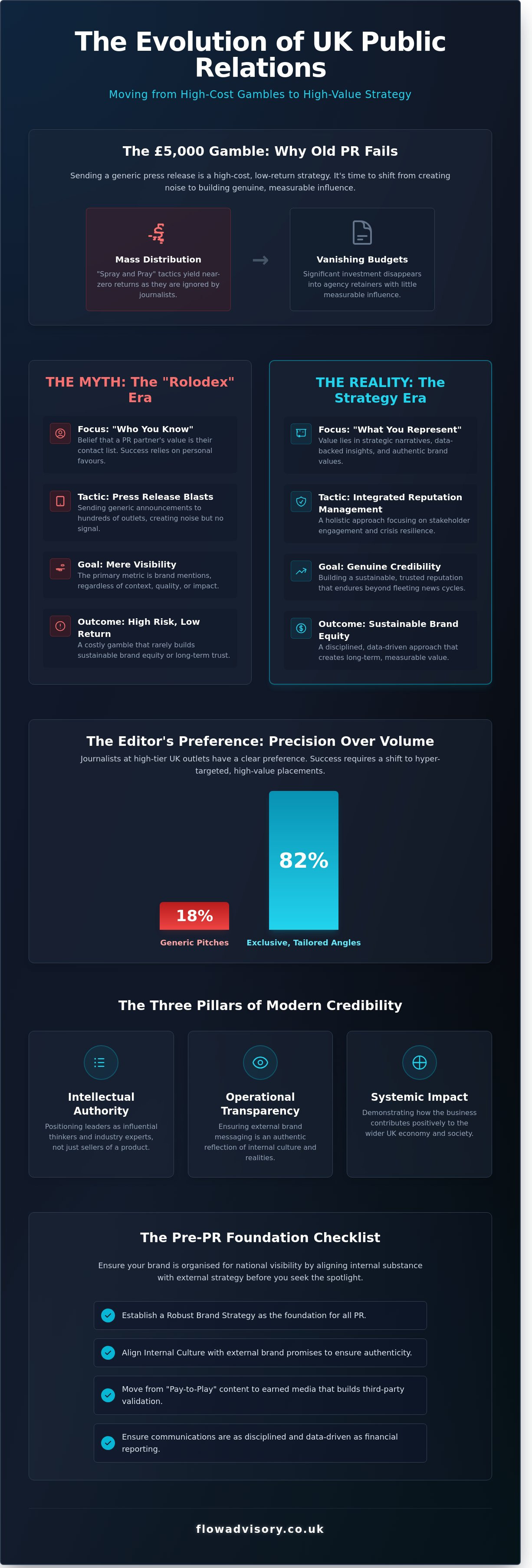
Sending a generic press release to 500 outlets is a wasted investment that yields a near-zero return. In the current UK market, 82% of high-tier editors prefer exclusive, tailored angles that speak directly to their specific audience segments. Success in 2026 requires a shift towards hyper-targeted, high-value editorial placements. It's about finding the "flow" between a brand's core mission and the specific needs of a niche community. We move beyond the "spray and pray" tactics of the past to focus on precision. This approach ensures that every communication serves a purpose and reaches an audience that actually matters to your bottom line.
The Role of Credibility in 2026
Modern PR in Britain follows the rigorous Royal Chartered standards set by organisations like the CIPR. Trust is the primary currency for UK businesses, especially as AI-generated content floods the market. There's a vital difference between "fame," which is often fleeting and shallow, and "reputation," which is a sustainable asset. A strategic approach focuses on building long-term equity. You can learn more about our philosophy on our about page, where we detail our commitment to professional excellence. Our focus remains on three core pillars of credibility:
- Intellectual Authority: Positioning leaders as thinkers, not just sellers.
- Operational Transparency: Aligning external messages with internal realities.
- Systemic Impact: Demonstrating how a business contributes to the wider UK economy and society.
The transition from a contact-based model to a strategy-based model isn't just a trend; it's a survival requirement. Businesses that rely on "favours" find themselves silenced when those contacts move on. Those who invest in united kingdom public relations as a discipline of reputation management build brands that endure. We help leaders find the calm within the media storm, ensuring their voice isn't just loud, but respected.
Beyond Press Releases: The Shift to Integrated Reputation Management
Modern PR isn't a megaphone; it's a mirror. The traditional model of blast-firing press releases into a crowded newsroom has lost its efficacy in the current united kingdom public relations landscape. Today, reputation is an organic byproduct of every digital and physical touchpoint. It requires a move towards Integrated Reputation Management, where the focus shifts from mere visibility to deep-seated stakeholder engagement and crisis resilience. This holistic approach ensures that your brand doesn't just survive the news cycle but builds a foundation of long-term trust.
Trust is the primary currency of the 2020s. According to the 2024 Edelman Trust Barometer, 61% of UK respondents expect CEOs to lead on societal changes. This expectation forces a transition from "pay-to-play" content, which often feels hollow, to "earned media" that carries genuine third-party validation. Your visual identity and digital assets serve as the first line of defence. If a media mention sparks interest but your digital ecosystem feels dated or disconnected, the trust gap widens instantly. Authentic PR is about ensuring your brand behaviour matches the public's perception at every level of the organisation.
The Multi-Channel Reputation Ecosystem
A brand's narrative is only as strong as its weakest digital link. Your media claims must be validated by a cohesive digital presence, making strategic business website design and development a core component of modern PR. When a journalist or potential partner investigates your brand, they look for consistency. Thought leadership plays a vital role here. By publishing insightful, data-driven content, you establish national authority that transcends simple advertising. It's about creating a flow between what you say and how you appear, ensuring every asset reinforces your strategic focus and professional precision.
Purpose-Led Communications
UK consumers are increasingly scrutinising corporate values with a level of intensity not seen a decade ago. A 2023 study found that 73% of UK shoppers consider a brand's ethical track record before making a purchase. Articulating your purpose requires a delicate balance. You must avoid the "greenwashing" trap by ensuring your brand strategy is rooted in authentic storytelling and measurable action. Brand behaviour and public perception are now inextricably linked. If the internal culture doesn't match the external message, the resulting friction can be costly. To understand how to align your internal dynamics with your external reputation, you might explore our approach to organisational growth and culture.
Brand Strategy vs. PR Execution: Why One Cannot Thrive Without the Other
Strategy is the architect; PR is the builder. In the landscape of united kingdom public relations, many firms rush into media outreach without a blueprint. This "PR-first" approach creates a fundamental disconnect between what a company claims to be and how the market perceives it. When execution precedes strategy, you risk diluting your brand’s value through inconsistent messaging. A 2023 report from the Content Marketing Institute indicated that nearly 40% of B2B organisations operate without a documented strategy, which inevitably leads to fragmented communication and wasted budget.
A clear brand strategy acts as the primary filter for every press release, LinkedIn post, and keynote speech. It simplifies the PR agency’s job by providing a "north star" for storytelling. Without this, you're paying for activity rather than impact. We often advocate for the "Strategic Pause." It’s the decision to stop all media pitching until your market position is ironclad. This brief silence prevents the waste of thousands of pounds on campaigns that don't resonate with your core values or long-term business goals.
The Foundation Gap
A brand lacking a strategic centre usually displays clear symptoms: high customer churn, confused employees, and a "jack of all trades" reputation. These issues can't be fixed by a single feature in the Financial Times. Effective visual identity design services must support the narrative you're trying to earn in the press. If your visual language feels outdated while your PR claims you're an innovator, the audience senses the friction. PR without strategy is like a ship without a rudder.
Measuring What Matters
The era of Advertising Value Equivalency (AVE) is over. Modern united kingdom public relations requires a shift toward measuring brand equity and market position. The Brand Strategy vs. PR Execution balance is best maintained by following the professional standards set by the CIPR. Instead of merely counting clippings, leaders should track how PR moves the needle on strategic alignment. For instance, a 15% improvement in stakeholder trust, measured through annual sentiment surveys, provides more long-term value than a fleeting viral moment. Success is found when your public expression perfectly mirrors your internal strategic intent.
The Pre-PR Checklist: How to Organise Your Brand for National Visibility
Visibility without a stable foundation is a strategic liability. Before committing resources to united kingdom public relations, a brand must undergo a rigorous internal audit to ensure the reality of the business matches the projected image. This preparation prevents the "reputation gap" where external promises outpace internal delivery; a misalignment that 63% of UK consumers say leads them to lose trust in a brand permanently.
The most effective campaigns are built on a "Brand Truth." This is not a slogan or a mission statement. It is a verifiable, unique narrative that journalists at national broadsheets like The Times or The Guardian find compelling. In a 2023 Cision report, 68% of UK journalists stated that they prioritised pitches containing original data or unique insights over standard corporate announcements. Your checklist must begin with identifying this core value proposition.
Step 1: Internal Alignment
Employees represent the most powerful ambassadors for your reputation. If your staff don't embody the brand values, any external PR effort will feel hollow and transactional. A cohesive brand story starts within the office walls, ensuring every team member understands the "why" behind the business. This alignment creates a natural flow of communication that extends to clients and stakeholders alike.
At Flow Advisory, we believe that organisational culture is the bedrock of sustainable growth. When internal communications are transparent and purposeful, the external narrative becomes an authentic extension of the company's daily operations. This psychological safety and clarity allow leaders to speak with genuine authority during media interviews, as they aren't merely reciting a script; they're sharing a lived reality.
Step 2: Asset Readiness
Media opportunities often move at a pace that catches unprepared brands off guard. Your website serves as the primary landing page for your reputation; journalists will vet your digital presence within seconds of receiving a pitch. Ensure your visual identity is refined, consistent, and reflects a premium advisory standard. High-quality collateral is a non-negotiable requirement for national coverage.
- Professional Imagery: Provide high-resolution, candid headshots of leadership and "behind-the-scenes" photography that avoids the sterility of stock images.
- Data and Case Studies: Prepare white papers or internal data sets that prove your impact. Statistics from the last 12 to 18 months are most relevant for current news cycles.
- Thought Leadership Pillars: Identify three specific areas where your CEOs can offer expert commentary on UK market trends or regulatory changes.
Preparation transforms a brand from a passive participant into a proactive industry leader. To ensure your organisation is truly ready for the national stage, explore how we align internal culture with strategic visibility.
The Flow Advisory Perspective: Why We Prioritise Strategy Over Noise
Reputation isn't a facade. It is the organic result of internal clarity meeting external consistency. At Flow Advisory, we believe that true influence starts long before a press release reaches a journalist's inbox. Many businesses treat united kingdom public relations as a megaphone to amplify whatever they have at hand, but this often leads to "noise" rather than meaningful resonance. We focus on building reputation from the inside out, ensuring that every external message is anchored in a firm's operational reality.
We help UK businesses define their "Brand Flow" before they step into the market spotlight. This process identifies the unique rhythm of an organisation, aligning its core values with its commercial objectives. When a company understands its own flow, its communication becomes effortless and authentic. We've transitioned from being a tactical PR provider to a strategic business advisory because we recognise that a brand's health depends on more than just media hits. It requires a synergy between visual identity, digital presence, and the nuanced ways the public perceives your leadership.
A Holistic Approach to Influence
Modern branding often suffers from the "Purpose Gap." This happens when a company's marketing promises an experience that its internal culture cannot deliver. According to the 2024 Edelman Trust Barometer UK report, 61% of UK consumers now buy or advocate for brands based on their values and beliefs. We bridge this gap by acting as a unified creative and strategic partner. By aligning your visual storytelling with your long-term business goals, we create a resilient brand image. For those ready to evaluate their external partnerships, our guide on Choosing the Best PR Companies London offers a framework for selecting a partner that values depth over simple publicity.
Your Next Strategic Move
Transitioning from reactive PR to proactive brand building is a defining moment for any leader. It requires moving away from "fire-fighting" communications and toward a model where every piece of content serves a specific strategic purpose. In the competitive environment of united kingdom public relations, success is measured by the quality of influence, not just the volume of mentions. Choosing an independent consultancy allows for a more intimate understanding of your specific market challenges. You can learn more about our philosophy on our about page, where we detail our commitment to systemic growth. Reputation is what people say about you when you leave the room; strategy is what you give them to talk about.
Securing a Future-Proof Reputation in the UK Market
Building a brand that resonates across the country isn't a matter of luck or simply having the right phone numbers. By 2026, the landscape of united kingdom public relations will have shifted entirely toward integrated reputation management where strategy leads every tactical move. You've seen how the old "Rolodex" myth fails to protect modern brands. Success now depends on how well you align your internal culture with your external identity before seeking national visibility. Since 2020, our independent UK consultancy has focused on this exact intersection of narrative and visual identity.
Strategy must always precede execution to prevent your message from becoming mere background noise. When you prioritise a systems-thinking approach, your brand becomes an organic, living entity that commands respect. It's time to move beyond the press release and start building a foundation that supports sustainable growth and authentic connection. We're here to help you navigate this transition with clarity and professional precision.
Discover how our brand strategy services create the foundation for national influence.
Your journey toward a more meaningful and impactful presence starts with a single, well-planned step. We look forward to helping you find your flow.
Frequently Asked Questions
What is the difference between PR and marketing in the UK?
Marketing focuses on driving direct sales and lead generation through paid and owned channels, while public relations manages reputation and builds trust via earned media. In the UK, the 2023 State of the Profession report by the CIPR highlights that PR focuses on strategic relationship management. Marketing usually asks for a direct transaction. PR seeks to cultivate a sustainable environment where that transaction feels natural and earned.
How much does a United Kingdom public relations campaign usually cost?
A standard monthly retainer for a mid-sized UK agency typically ranges from £3,000 to £10,000 depending on the project scope. According to PRCA data from 2023, project-based fees for a national product launch often start at £5,000. These costs reflect the strategic expertise required to navigate the complex united kingdom public relations landscape. Smaller boutique firms might offer packages starting at £1,500 per month for targeted local outreach.
Can a small business benefit from a national PR strategy?
Small businesses can certainly leverage national PR if they possess a unique, data-driven narrative or a founder story that aligns with current UK news cycles. A 2022 study by the Federation of Small Businesses found that 40% of SMEs see increased brand authority after appearing in national titles like The Guardian or The Times. It's about finding the intersection between your niche expertise and the national conversation to create genuine resonance.
How do I know if my brand is ready for a PR agency?
Your brand is ready for an agency when you've established a clear value proposition and have the internal capacity to handle increased enquiries. Agencies require a "news engine" within your company to function effectively. If you've reached £1 million in annual turnover, you likely have the structural maturity to support a sustained united kingdom public relations effort. Without a solid foundation, PR only accelerates the discovery of your brand's existing flaws.
What are the most common PR mistakes UK startups make?
UK startups often fail by prioritising quantity over quality, such as sending generic pitches to every journalist at the BBC or Financial Times. Data from Muck Rack's 2023 survey shows that 74% of journalists reject pitches because they're irrelevant to their specific beat. Another error is neglecting the long-term nature of reputation building. Many founders expect instant viral success instead of focusing on the slow, deliberate cultivation of industry trust.
How has digital media changed public relations in the United Kingdom?
Digital media has shifted the focus from traditional print clippings to SEO-driven authority and real-time engagement. By 2024, over 90% of UK journalists use social media to source stories, making a digital presence a non-negotiable asset for any brand. This evolution means PR now integrates deeply with backlink profiles and search visibility. It's no longer just about who reads the morning paper, but who finds your brand through an authoritative digital mention.
What is earned media and why is it so valuable?
Earned media is any publicity gained through editorial influence rather than paid advertising. It's the most valuable form of exposure because it carries the third-party validation of a trusted source. According to a 2021 Nielsen report, 83% of consumers trust recommendations from people they know, and 66% trust editorial content. This organic endorsement builds a level of credibility and psychological safety that paid media simply cannot replicate for a growing brand.
Does Flow Advisory offer mass-market press release distribution?
Flow Advisory doesn't offer mass-market press release distribution because we believe "spray and pray" tactics dilute brand prestige. Our approach focuses on bespoke, high-impact placements that align with your strategic growth objectives. We prioritise meaningful connections over vanity metrics. This ensures every piece of communication serves a purpose, fostering deep resonance with your specific audience rather than generating noise in a crowded marketplace.