
Creative Studios in 2026: A Strategic Guide to Choosing the Right Brand Partner

By 2026, the bloated, slow-moving agency model will finally be obsolete. This shift is driven by a 2024 McKinsey study revealing that 70% of senior executives now prefer lean, specialised creative studios over large-scale firms. You've likely felt the friction of paying for heavy overheads while your brand messaging becomes diluted across different digital platforms. It's frustrating to find that the senior partner who sold you the dream has vanished, leaving your vision in the hands of juniors who don't grasp your commercial objectives.
You deserve a partnership that operates with the same precision and flow as your own organisation. This guide provides the framework to identify partners who master the intersection of rigorous business strategy and high-end aesthetics. We'll examine how a senior-led collaborative model can reduce your project timelines by 30% while increasing brand resonance. By the end of this article, you'll have the tools to select a partner who doesn't just design logos, but builds a cohesive visual system designed for long-term growth and measurable ROI.
Key Takeaways
- Understand the metamorphosis of creative studios into strategic consultancies that prioritise long-term business logic over mere aesthetic output.
- Identify the critical differences between brand strategy and visual identity specialists to align your partnership with your organisation’s current stage of growth.
- Analyse how leaner overhead structures and direct creative access in studios prevent the dilution of vision often found in traditional agency hierarchies.
- Master the 'Chemistry Test' and portfolio depth analysis to find a partner that resonates with your internal culture and strategic ambitions.
- Learn how to integrate high-level strategic consultancy with creative excellence to ensure your brand remains resilient and relevant in the 2026 UK landscape.
The Evolution of Modern Creative Studios in 2026
The British business environment has shifted. Success no longer depends solely on the volume of output, but on the precision of the strategy behind it. Creative studios have undergone a fundamental transformation, moving away from being mere production houses to becoming essential strategic partners for the UK's most resilient brands.
The Evolution of Modern Creative Studios reflects a broader economic trend where the creative sector contributes over £108 billion annually to the UK economy. This growth isn't driven by traditional advertising alone. It's fuelled by a systemic integration of design thinking into every layer of business operations. Modern studios now function as intellectual laboratories where psychology, data, and aesthetics converge to solve complex organisational challenges.
Beyond the Recording Room: A New Era of Design
The traditional dictionary might still suggest a studio is a room for painters or musicians, but for a business in 2026, this definition is obsolete. We've seen a definitive move toward multi-disciplinary teams that seamlessly blend brand identity with digital infrastructure. A strategic studio acts as a hub for both creative thinking and technical execution, bridging the gap between abstract vision and tangible results. This evolution ensures that a rebrand isn't just a fresh coat of paint; it's a structural reinforcement of the company’s core purpose.
Why National Brands are Moving Toward the Studio Model
Agility is the new currency of the UK market. Large, traditional agencies often struggle with bureaucratic layers that stifle the flow of innovation. In contrast, the boutique studio model offers direct access to founders and lead designers, bypassing the friction of junior account managers. This proximity allows for faster iteration cycles and a deeper understanding of the client's internal culture.
- Direct collaboration with senior experts ensures that 100% of the creative energy is focused on the problem, not on navigating agency hierarchies.
- Advanced digital asset creation pipelines now allow for real-time brand deployment across diverse platforms, reducing time-to-market by up to 40% compared to 2023 benchmarks.
- The focus has shifted from simple deliverables to long-term outcomes, prioritising scalability and internal team alignment.
By leveraging technology such as AI-driven workflow automation and high-fidelity digital prototyping, these smaller teams are outperforming their larger counterparts. They don't just provide a service; they act as a strategic partner, much like the approach we take at Flow Advisory, where we focus on the harmony between business systems and human potential. This shift represents a move toward a more conscious, efficient, and impactful way of building brands in a digital-first world.
Navigating the Landscape: Types of Studios and Their Specialisms
Clarity precedes creativity. Choosing a partner for a rebrand isn't merely about finding someone who can draw; it's about finding a team that understands the systemic nature of your business. The UK creative market is diverse, and understanding the Types of Studios and Their Specialisms helps leaders avoid the friction of mismatched expectations. To find the right fit, you must distinguish between the various disciplines available:
- Brand Strategy Studios: These partners focus on the "why" before the "what". They act as architects, ensuring the foundations of your business can support future scaling and internal alignment.
- Visual Identity Studios: These teams craft the aesthetic and sensory elements. They translate your internal culture into a visual language that the market instinctively understands.
- Digital and Web Design Studios: They build high-performance online platforms. Their focus remains on the flow of the user journey and the technical precision required for modern SEO and conversion.
- Content and Communication Studios: These specialists manage the narrative and internal messaging. They ensure that every word spoken by your team aligns with your core brand promise.
Brand and Design Studios: More Than Just Visuals
Visuals are the final expression of a much deeper process. Effective studios begin with rigorous market research and positioning. They don't just create icons; they build systems. A 2023 report by the Design Council found that companies putting design at the heart of their strategy outperform the FTSE 100 by 200%. When you invest in visual identity design services, you're buying a strategic asset that must last for a decade. This longevity only happens when the aesthetic is rooted in a robust brand strategy. Design without strategy is just decoration; it's the difference between a passing trend and a lasting legacy.
Specialist vs. Generalist Studios
Deciding between a niche specialist and a broad creative partner depends on your specific growth stage. A property marketing studio might understand the nuances of £500,000 residential developments, but a generalist partner often brings fresh perspectives from outside your immediate industry. For brands driven by social impact, a "Society Agency" approach offers a unique framework. It's worth exploring what is a society agency to see how purpose-led brands are evolving to meet the demands of 2026. These studios prioritise collective value over simple profit, aligning your business goals with wider societal needs to create deep, authentic connections with your audience.
If you're seeking a partner that understands the intersection of strategy and human dynamics, you can learn more about our philosophy and how we approach organisational flow.
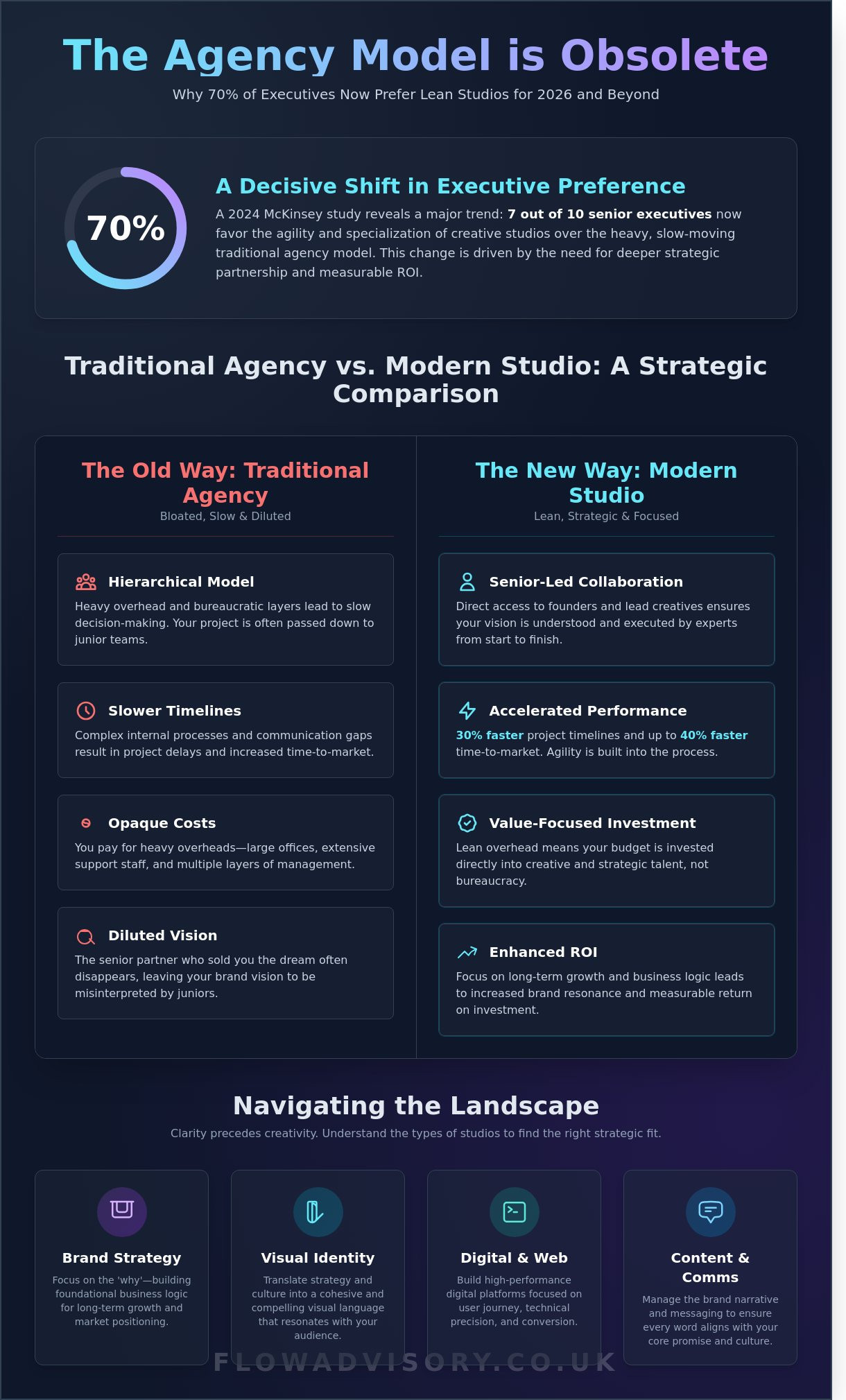
Creative Studio vs. Traditional Agency: A Strategic Comparison
Choosing the right partner for a rebrand involves more than just reviewing portfolios; it requires an honest assessment of where your investment goes. In many traditional agencies, up to 40% of your fee pays for non-creative overheads, such as account management layers and expensive city-centre office space. Smaller, specialised studios operate with a different logic. They direct the majority of your budget toward the actual design and strategy work, ensuring that you're paying for talent rather than infrastructure.
The hierarchy within large agencies often creates a "dilution effect." A vision that begins with a senior creative lead might pass through three or four layers of junior staff before it reaches your desk. This process risks softening the edges of a bold brand strategy. In contrast, studios typically keep the decision-makers on the tools. This proximity preserves the integrity of the original concept, making the final output more potent and aligned with your business goals.
Financial structures also differ significantly. While agencies often push for ongoing retainers that can cost between £3,000 and £15,000 per month, studios frequently prefer project-based fees. This model offers better transparency for businesses undergoing a specific transformation, as every pound spent is tied to a tangible milestone or deliverable. It's a more surgical approach to budget allocation that prioritises results over long-term contractual obligations.
Agility, Access, and the flow of Collaboration
Efficiency in a rebrand depends on how quickly ideas can move between teams. When you work with a studio, your primary contact is often the person actually leading the creative work. This direct access removes the friction created by account managers who act as gatekeepers. Communications become more fluid; feedback is integrated in real-time rather than being lost in a chain of emails. Small, focused teams handle internal dynamics better because they operate with a shared consciousness, reacting to your needs with a speed that larger organisations simply cannot match.
Technical Excellence and the Role of the Artworker
A beautiful concept fails if it cannot be executed across multiple platforms. High-end studios maintain rigorous standards for technical execution, often surpassing those of larger agencies where details might slip through the cracks. This is where the role of the artworker becomes vital for brand consistency. An artworker ensures the creative vision is technically viable for national production. They bridge the gap between a digital mock-up and a physical asset, ensuring that your new identity remains sharp, whether it's on a business card or a large-scale outdoor advertisement.
How to Evaluate and Select the Ideal Studio Partner
Choosing a partner for a rebrand is a high-stakes decision that influences your organisation's trajectory for the next five to ten years. It isn't merely about aesthetic preference. You're looking for a team that can translate complex business objectives into a visual and verbal language that resonates with your specific market. The most successful partnerships are built on a foundation of intellectual curiosity and shared values rather than just a signature style.
Assessing Portfolio Depth and Strategic Narrative
A polished portfolio can be deceptive if it lacks substance. High-calibre studios demonstrate how their work moved the needle on specific KPIs, such as a 20% increase in lead quality or a 15% improvement in employee retention post-rebrand. You need to see evidence that they can handle the anthology of assets required for a modern, multi-channel presence. Ask how they arrived at their conclusions. Did they conduct stakeholder interviews? How did they define the brand's unique value proposition? A studio that cannot explain the strategy behind a logo is merely a decorator, not a consultant. Look for cases where they solved problems similar to yours, whether that's navigating a merger or entering a new international market.
The Importance of Cultural and Operational Fit
A successful rebranding process relies on radical candour and mutual respect. Your chosen partner should feel like a natural extension of your leadership team. This is particularly vital when managing internal communications and securing buy-in from diverse departments. At Flow Advisory, we believe a team-first philosophy is the only way to ensure the new brand identity is adopted internally with genuine enthusiasm. If the studio doesn't understand your internal culture, the final result will likely feel like a borrowed suit that doesn't quite fit.
Transparency in the discovery to delivery phase prevents budget creep and missed deadlines. Demand a clear roadmap. A 2023 report by the Design Council found that 64% of UK businesses that integrated design into their strategy saw an immediate impact on turnover; however, this only happens when the process is rigorous. Ensure the studios you interview provide:
- Detailed project milestones with specific sign-off points.
- A clear breakdown of how they handle feedback loops and revisions.
- A methodology for measuring the success of the rebrand after the first six months.
- Evidence of how they manage stakeholder alignment in complex organisations.
Operational clarity is often the difference between a project that flows and one that falters. When you find a partner who balances creative excellence with structured delivery, you've found the catalyst for your business's next chapter.
Flow Advisory: Elevating Brands Through Strategic Studio Excellence
Rebranding isn't a surface-level exercise. It's a deep-rooted transformation that requires a bridge between high-level business logic and tactical creative execution. We don't just design logos; we build systems that allow national UK businesses to scale without losing their soul. Our role is to act as the strategic link between your boardroom's vision and the technical output of creative studios, ensuring that no detail is lost in translation. Many businesses fail in their rebranding efforts because their strategy exists in a vacuum, disconnected from their visual reality. We solve this by ensuring every decision aligns with your commercial objectives and operational capacity.
The Flow Advisory promise centres on clarity and consistency. Recent data from the UK's Design Council suggests that businesses that prioritise strategic design are 21% more likely to see an increase in turnover. By aligning your internal culture with your external image, we create a measurable path toward growth. This isn't about following fleeting trends. It's about establishing a market position that feels both inevitable and unique. We treat your business as a living organism; when one part changes, the whole system feels the ripple. Our process ensures that your brand strategy isn't a static document gathering dust on a server, but a dynamic framework that informs how your teams communicate.
Our Approach to Visual Identity and Brand Narrative
Every project begins with a rigorous audit of your current market position. We look at the data, the competitors, and the underlying human dynamics of your industry. This foundation allows us to organise brand assets for long-term scalability. Whether it's a new pitch deck or business website design and development, every touchpoint must serve a purpose. We focus on creating marketing collateral that actually converts, moving beyond aesthetics to drive genuine engagement. By working closely with specialised design studios, we ensure the technical execution matches the intellectual depth of our initial consultancy phase.
Partnering for the Long Term
A brand launch is the beginning, not the end. Market conditions in the UK are fluid, and your identity must be resilient enough to evolve. We support our partners well beyond the initial reveal, acting as guardians of brand integrity through shifting economic climates. This partnership ensures that as your business grows, your message remains sharp and your operations stay in flow. We don't just deliver a brand; we help you manage it as a strategic asset. If you're ready to redefine your presence and move toward a more integrated future, you can enquire about our brand strategy services to begin the conversation.
Defining Your Brand's Next Chapter
Success in 2026 requires moving beyond the rigid structures of legacy agencies to find agility in specialised studios. You've seen how the landscape prioritises deep technical specialism over broad, diluted services. Choosing a partner today means looking for a strategic match that understands both your external visual identity and your internal organisational alignment. It's about finding a team that doesn't just deliver assets but integrates into your business flow.
Flow Advisory has been at the forefront of this shift since our founding in 2020. We focus on high-level national brand strategy, helping leaders translate complex goals into clear visual identities and digital asset libraries. Our expertise extends into internal communications, ensuring your team remains motivated and aligned with your long-term vision. We don't believe in surface-level fixes; we believe in building resilient brands through professional precision and human-centred design. It's time to move past the noise and focus on what truly drives your business forward.
Discover how our strategic studio can transform your brand and help you achieve the sustainable growth your business deserves.
Frequently Asked Questions
What is the main difference between a design studio and a branding agency?
Design studios often focus on the aesthetic craft and visual execution of specific assets, whereas branding agencies typically manage the overarching market positioning and strategic architecture. While many studios now integrate strategic thinking, their core remains the translation of ideas into tangible visual elements. Choosing between them depends on whether your business requires a specific visual overhaul or a fundamental shift in how it's perceived by the market.
How much do creative studios usually charge for a full rebrand in the UK?
A comprehensive rebrand for a small-to-medium enterprise in the UK typically starts between £10,000 and £30,000 according to industry benchmarks from the Design Business Association. Larger corporate projects involving complex brand architecture often exceed £100,000. These figures reflect the depth of research, strategy, and implementation required to ensure the new identity resonates across every physical and digital touchpoint.
Can a small creative studio handle a national marketing campaign?
Small creative studios frequently manage national campaigns by leveraging agile structures and specialist networks. Unlike larger agencies with high overheads, these boutique teams focus on high-level strategy and collaborate with specific experts for execution. This model ensures that 90% of your budget goes directly into creative output rather than administrative layers, providing a more intimate and responsive partnership than traditional firms.
What should be included in a creative studio’s brand strategy phase?
A robust strategy phase must include deep-dive market research, competitor benchmarking, and the definition of your unique value proposition. It's the stage where the team uncovers the purpose behind your business, ensuring the visual identity isn't just aesthetic but serves as a functional tool for growth. Without this foundational work, any rebranding effort remains a superficial change rather than a strategic evolution that drives long-term value.
How long does a typical visual identity project take with a studio?
A standard visual identity project generally spans 12 to 24 weeks from the initial discovery session to the final delivery of assets. This timeline allows for a thorough exploration of concepts, multiple feedback loops, and the meticulous crafting of brand guidelines. Rushing this process risks overlooking the subtle nuances that define a truly enduring and scalable brand, leading to inconsistencies later in the business lifecycle.
Do I need a studio for internal communications or just external marketing?
Partnering with external experts for internal communications is essential because a brand's external promise must align with its internal culture. If your employees don't embody the new values, the rebrand will feel hollow to your customers. Strategic partners help translate the brand essence into internal workshops and culture books, ensuring your team becomes the most authentic advocates for the business during the transition.
How do I know if my business is ready to partner with a strategic studio?
Your business is ready when your current visual identity no longer reflects your operational reality or when you're entering a new market segment. If your conversion rates have plateaued despite increased traffic, it's often a sign that your brand narrative lacks the necessary resonance with your audience. A strategic partnership provides the clarity needed to bridge the gap between your current position and your future growth targets.
What are the benefits of choosing a UK-based studio for a national brand?
Choosing a UK-based team ensures your brand navigates local cultural nuances and consumer expectations with precision. These professionals understand the specific psychological triggers of the British public and are well-versed in local advertising standards and regulations. This proximity fosters a deeper collaborative flow, allowing for real-time adjustments and face-to-face workshops that a remote, international firm might struggle to provide effectively.