
How Much to Build a Business Website in the UK 2026: The Strategic Cost Guide

What if the £500 bargain website you're considering is actually the most expensive mistake your business will make this year? It's a common frustration for UK leaders who receive conflicting quotes ranging from £1,500 to £50,000 without a clear explanation of the underlying value. You likely feel the weight of technical obsolescence and the fear of investing in a digital storefront that looks professional but fails to drive real human connection. Understanding how much to build a business website UK 2026 requires means looking beyond the initial invoice toward a sustainable digital ecosystem that supports your long-term vision.
We're moving past the surface level to offer a clear budgeting framework that treats your website as a strategic asset rather than a static expense. Industry reports indicate that 42% of UK businesses face unexpected technical debt within eighteen months, usually because they prioritized a low entry price over scalable architecture. This guide breaks down the true investment tiers for 2026, explores the tangible ROI of human-centered design, and helps you avoid the common traps of hidden costs. You'll gain the clarity needed to align your digital presence with your organization's internal rhythm and growth ambitions.
Key Takeaways
- Understand the transition from static "brochureware" to dynamic brand hubs, where 2026 market investments typically range from £3,000 to over £50,000.
- Identify which of the four distinct investment tiers aligns with your organizational maturity and specific strategic objectives.
- Discover precisely how much to build a business website UK 2026 requires by evaluating the critical interplay between brand positioning and technical complexity.
- Learn why a modern digital headquarters is never "finished," requiring a proactive approach to security standards and continuous evolution.
- Shift your perspective from viewing web development as a transactional expense to treating it as a strategic asset that integrates brand identity with internal communications.
Understanding Business Website Costs in the UK 2026
The digital landscape of the United Kingdom has matured. In 2026, the question of how much to build a business website UK 2026 doesn't have a single answer, but it does have a clear range. For a professionally engineered platform, businesses should anticipate investments between £3,000 for foundational builds and £50,000 or more for complex, enterprise-level ecosystems. We've moved past the era of "brochureware," where a site was merely a digital business card. Today, your website is a dynamic brand hub. It's the primary engine for growth and the heartbeat of your digital operations.
The traditional "cost per page" model is obsolete. It failed because it focused on volume rather than impact. A high-performing site in 2026 is measured by "Flow." This represents the seamless reduction of friction throughout the customer journey. If a user encounters a hurdle, you lose revenue. A site built with flow in mind ensures that every interaction feels intuitive, moving the visitor closer to a decision without cognitive load. This approach treats the website as a living organism rather than a static document.
The Three Pillars of Website Pricing
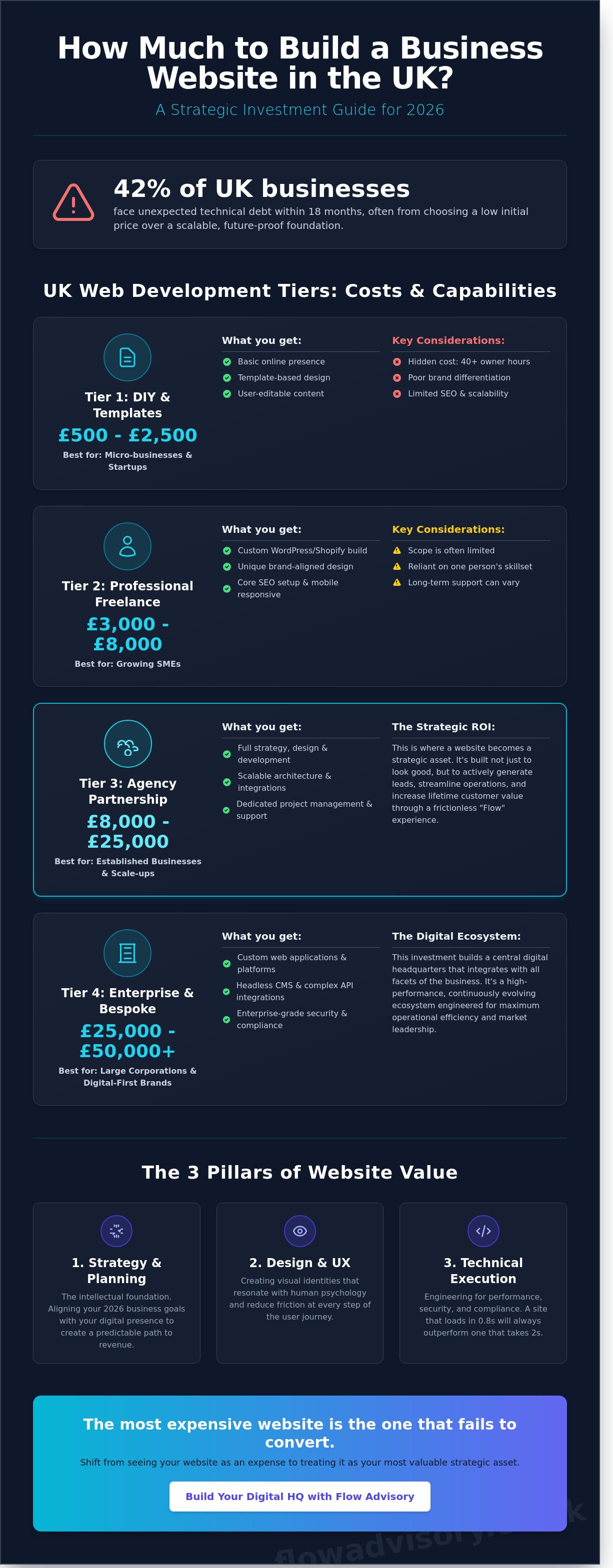
Investment is distributed across three critical areas that define the project's success. First is Strategy and Planning. This is the intellectual foundation where we align your digital presence with your 2026 business goals. Second is Design and User Experience (UX). By understanding the fundamentals of web design, agencies create visual identities that don't just look good but actually resonate with human psychology. Finally, Technical Execution covers performance, security, and compliance with 2026 standards. A site that loads in 0.8 seconds will always outperform one that takes 2 seconds, and the price reflects the engineering required to achieve that speed.
Why Price vs. Value Matters More Than Ever
A "cheap" website often carries a hidden tax. In 2025, industry data suggested that a 1-second delay in page load time could reduce conversions by 7 percent. By 2026, user patience has thinned even further. A poorly built site results in lost leads and lasting brand damage. Conversely, a professional build acts as your most reliable 24/7 sales consultant. It never sleeps, it doesn't miss a lead, and it represents your values perfectly every time. When calculating how much to build a business website UK 2026, you aren't just paying for code; you're paying for a predictable path to revenue.
Strategic ROI in web development is the measurable increase in lifetime customer value and operational efficiency gained through a frictionless digital experience.
At Flow Advisory, we believe that the most expensive website is the one that fails to convert. By shifting the focus from "what it costs" to "what it creates," leaders can build platforms that don't just exist but actively scale their influence in a competitive market.
UK Web Development Tiers: Comparing Costs and Capabilities
The digital landscape in 2026 demands more than a static online presence; it requires a high-functioning ecosystem that mirrors your internal maturity. Understanding how much to build a business website UK 2026 involves looking beyond the initial quote. Costs have shifted upward by approximately 12% since 2024, driven by the necessity for AI-integrated security and more complex data privacy compliance. We see the UK market divided into four distinct investment levels, each serving a different stage of the business lifecycle.
Level 1: DIY and Entry-Level Templates (£500 - £2,500)
Micro-businesses and startups often begin here. Platforms like Squarespace or Wix offer accessible entry points, yet the hidden costs reside in the business owner's time. Spending 40+ hours on design is 40 hours away from strategic growth. These templates often struggle with brand differentiation, as they rely on shared structures that limit unique visual storytelling. According to Forbes' 2026 website cost guide, while entry-level options remain affordable, they frequently lack the SEO depth required to compete in saturated UK markets. This tier is a functional starting point, but it rarely scales with a growing organization.
Level 2: Professional Freelancers and Small Studios (£3,000 - £8,000)
This level introduces customised WordPress or Shopify builds tailored to specific operational needs. You're paying for technical proficiency and a cleaner aesthetic. Most UK freelancers in 2026 focus on "the build" rather than the broader business architecture. While you receive a professional site, the common pitfall is a lack of long-term strategic support. These projects often focus on the immediate launch, sometimes neglecting the deeper psychological triggers that turn visitors into loyal clients. It's a solid choice for established small businesses that have outgrown templates but don't yet require complex systems integration.
Level 3: Strategic Brand & Digital Agencies (£10,000 - £30,000)
At this tier, the conversation shifts from "building a site" to "engineering a growth engine." Agencies at this level integrate your brand strategy with custom UX/UI design rooted in user psychology. Every button and transition is intentional, designed to foster a sense of trust and flow. You aren't just buying code; you're investing in high-converting marketing collateral and content that speaks to the human dynamics of your audience. This level of investment ensures your digital presence is an extension of your organisational culture, creating a seamless experience for both your team and your customers. For mid-sized firms, this is often where the highest ROI is found, as the site becomes a scalable asset rather than a recurring expense.
The final tier, Enterprise Solutions, often exceeds £50,000 and involves bespoke software development and deep API integrations. Choosing the right tier requires an honest assessment of your current business maturity and your three-year growth projections. Investing too little creates technical debt, while over-investing can lead to unnecessary complexity that stifles your team's agility.
The Hidden Factors Influencing Your 2026 Website Budget
A business website in 2026 isn't a digital brochure; it's a living organ of your organizational ecosystem. When calculating how much to build a business website UK 2026, many leaders overlook the layers beneath the interface. A site's true cost is dictated by its role in your internal culture and its ability to handle the sophisticated 2026 tech stack. This includes deep AI integrations for real-time customer intelligence and rigorous data privacy frameworks that exceed current GDPR standards. These aren't optional extras. They're the foundation of a resilient digital presence that scales with your ambition.
Your budget must account for the silent work of integration. If your website doesn't talk to your CRM, your internal communication tools, or your inventory systems, it's a liability rather than an asset. In the UK market, where efficiency is a primary competitive driver, the cost of manual data entry or fragmented user journeys is too high to ignore. A site that mirrors your internal "flow" requires a higher initial investment but delivers a 40% reduction in long-term operational friction.
Brand Strategy and Visual Identity Integration
The discovery phase often reveals what we call a "Purpose Gap." This happens when a business's internal mission doesn't align with its outward face. Bridging this gap requires a deep dive into your strategic focus before a single line of code is written. Investing in Visual Identity Design Services ensures your website communicates authority and calm. Expect to allocate 15% to 25% of your total budget to this strategic alignment. It prevents the costly mistake of a premium brand being housed in a generic, uninspired template.
Content Strategy and Creation
Content is the most frequent cause of project stagnation. Launching with "empty boxes" or placeholder text dilutes your premium positioning and hurts your search rankings immediately. High-quality assets, including cinematic video and bespoke photography, are essential for building trust in a crowded UK market. If your sector requires niche storytelling, such as partnering with a travel and tourism content firm, these specialized costs must be integrated early. Professional copywriting alone can account for £2,000 to £8,000 of the total investment, depending on the complexity of your service offering. When considering how much to build a business website UK 2026, remember that content isn't just what you say, it's the intellectual value you provide to your visitor.
- Strategic Discovery: Aligning internal culture with digital presence.
- AI Readiness: Budgeting for clean data structures and API connectivity.
- Visual Language: Moving beyond logos to a cohesive digital design system.
- Content Depth: Investing in high-production value assets that convert.
Ongoing Costs: Maintaining Your Digital Headquarters
Launching your platform is the beginning of a journey, not the destination. A website functions as a living organism within your business ecosystem; it requires consistent nourishment and technical refinement to remain effective. In 2026, hosting and security standards for UK businesses have moved beyond simple server space. High-performance managed cloud hosting, which ensures data sovereignty and rapid load times, typically costs between £50 and £180 per month. This isn't just about storage. It's about maintaining a secure perimeter through real-time threat monitoring and automated failover systems that protect your brand's reputation.
Software updates and third-party integration fees form the pulse of your monthly outgoings. Many UK firms now rely on complex API connections for CRMs, payment gateways, and inventory management. These licenses can range from £30 to £250 monthly. When you calculate how much to build a business website UK 2026, these recurring costs must be integrated into your three-year total cost of ownership. Ignoring these figures leads to technical debt, where the cost of fixing an outdated system eventually exceeds the price of a total rebuild.
Technical Maintenance vs. Strategic Growth
There's a critical distinction between "keeping the lights on" and iterative improvement. Technical maintenance is reactive; it involves patching plugins and ensuring server uptime. Strategic growth is proactive. It involves dedicated time for monthly or quarterly reviews where you analyze user heatmaps and conversion funnels. UK businesses that budget £600 to £2,000 per quarter for these strategic adjustments see a 40% higher retention rate compared to those who let their sites stagnate. This proactive management prevents your digital presence from becoming a legacy liability.
The ROI of Ongoing SEO and Content
Organic search remains the most resilient and high-value traffic source for the UK market. By 2026, the complexity of search algorithms means that a "set and forget" approach to SEO is no longer viable. Monthly retainers for professional SEO and content strategy in the UK generally start at £1,500, focusing on topical authority and user intent. This investment is what makes the engine move. It connects your site performance directly to your broader business website design and development goals, ensuring that your initial capital expenditure translates into long-term market share.
When assessing how much to build a business website UK 2026, remember that the most expensive website is the one that no one visits. A site that doesn't evolve is a site that's slowly disappearing from the digital consciousness of your audience.
To understand how we help leaders bridge the gap between technical infrastructure and human-centric growth, explore the vision behind Flow Advisory.
Building for the Future: The Flow Advisory Approach
A website isn't a static digital brochure; it's the nervous system of a modern enterprise. At Flow Advisory, we've moved past the era where web design was a one-off transaction. We view your digital presence as a living extension of your company's DNA. When you consider how much to build a business website UK 2026, the true calculation must include the cost of misalignment. If your external platform doesn't mirror your internal culture, the friction will eventually erode your ROI. Our methodology integrates brand strategy, internal communications, and digital asset management into a singular, cohesive flow.
We believe that a premium digital presence requires a systemic approach. It's not enough to have a site that looks professional. It must function as a tool for organizational growth. This involves aligning your leadership's vision with the user's journey. We act as the bridge between these two worlds, ensuring that your market position is defended by robust technology and inspired design. This isn't just about code; it's about creating a sense of calm and confidence for your clients as they navigate your brand.
The Consultancy Advantage
Choosing a partner is different from hiring a vendor. A vendor delivers a product; a strategic partner delivers a future. We immerse ourselves in your business processes to understand the human dynamics that drive your success. This depth allows us to build websites that don't just sit on a server but actively solve operational bottlenecks. Whether it's streamlining lead generation or automating client onboarding, our focus remains on measurable efficiency. You can explore our philosophy and team dynamics to see why we prioritize depth over surface-level aesthetics. We invite you to learn more About Flow Advisory and our commitment to professional excellence.
Defining Your 2026 Digital Roadmap
Preparation is the foundation of a successful launch. To determine exactly how much to build a business website UK 2026 for your specific needs, you must first define your strategic requirements. A well-prepared brief reduces revisions and keeps costs predictable. Before your discovery session, consider these elements:
- Internal Alignment: Does your team have a unified vision of your brand's core values?
- Asset Audit: What high-quality content, data, and imagery do you currently own?
- Scalability Goals: Where do you expect your business to be in three years?
- Integration Needs: Which CRM, ERP, or internal tools must the website communicate with?
We don't believe in aggressive sales tactics. We prefer intellectual dialogue and shared vision. If you're ready to move beyond the standard template and build a platform that truly represents your organization's potential, we're here to guide the way. The first step toward a balanced, high-performing digital ecosystem is a conversation. Book a strategic consultation with Flow Advisory today to begin your journey.
Designing for Impact Beyond the 2026 Horizon
Understanding how much to build a business website UK 2026 requires a shift from viewing web development as a one-off expense to seeing it as a strategic investment in your brand's legacy. We've analyzed how professional builds for small businesses now typically require budgets starting from £5,000, while complex, enterprise-level ecosystems frequently surpass £40,000 to meet modern security and performance standards. Success depends on aligning these costs with a clear purpose-led strategy that serves both your operational needs and your audience's experience. Since our founding in 2020, Flow Advisory has championed brand-led growth for partners in complex sectors, moving beyond the surface to address the deep human dynamics of business.
Our team provides comprehensive end-to-end creative solutions that ensure your digital headquarters remains resilient in a shifting market. We don't just build sites; we craft environments where your vision can truly flourish through technical precision and intentional design. It's time to move past the technical noise and focus on what creates genuine, sustainable value for your organization. Elevate your digital presence with a strategic website build from Flow Advisory. We're ready to walk this path with you, turning your 2026 digital goals into a living, breathing reality.
Frequently Asked Questions
How much should a small business spend on a website in the UK in 2026?
A small business should budget between £3,000 and £8,000 to build a business website UK 2026 requires for true market competitiveness. This investment covers a professional design that aligns with modern accessibility standards and basic AI driven customer interactions. While cheaper options exist, this range ensures your digital presence acts as a high performing asset rather than a static brochure.
Why are agency quotes so much higher than DIY platforms?
Agency quotes reflect the cost of strategic expertise and bespoke architecture rather than just the software itself. DIY platforms provide the tools, but agencies provide the psychological insight and technical precision needed to convert visitors into loyal clients. You're paying for a dedicated team that handles user experience research and complex integrations that off the shelf templates simply can't replicate.
What are the typical ongoing costs for a UK business website?
You can expect to spend between £500 and £2,500 annually on essential maintenance and hosting. This figure includes secure UK based hosting, SSL certificates, and periodic security patches to protect your data. High traffic sites or those requiring monthly technical support will sit at the higher end of this bracket to maintain peak performance and site speed.
How long does it take to build a bespoke business website?
A bespoke build typically requires 8 to 16 weeks from the initial discovery phase to the final launch. This timeline allows for deep strategic planning, custom design iterations, and rigorous testing across multiple devices. Rushing this process often compromises the underlying structure; we recommend allowing four months for a truly refined digital experience.
Does the cost of a website include SEO and content creation?
Standard development quotes usually cover technical SEO foundations but exclude ongoing content strategy and copywriting. Most UK agencies charge an additional £1,500 to £4,000 for professional content creation that resonates with your specific audience. It's vital to clarify these boundaries early to ensure your budget covers both the technical build and the narrative that drives engagement.
Can I upgrade my website tier later as my business grows?
You can certainly upgrade your site if it's built on a scalable framework such as WordPress or a headless CMS. Choosing a flexible architecture at the start allows you to add features like e-commerce or client portals without rebuilding from scratch. This modular approach ensures your digital infrastructure evolves alongside your organizational growth, maintaining a consistent flow in your business operations.
What is the most expensive part of a website build?
The strategic discovery phase and custom functional integrations typically represent the largest portion of the total cost. Developing unique tools, such as bespoke booking systems or complex API connections, requires extensive engineering hours. These elements are often the most valuable; they create the efficiency and seamless user experience that distinguish premium brands from their competitors.
Is a custom-built website better for ROI than a template?
Custom websites generally deliver a higher return on investment because they're tailored to your specific conversion goals and brand identity. While templates have lower initial costs, they often suffer from bloated code and limited flexibility, which can hinder long term performance. A custom build offers the technical precision needed to improve search rankings and provide a frictionless journey for your users.