
Web Design for Professional Services UK: A Strategic Guide for 2026

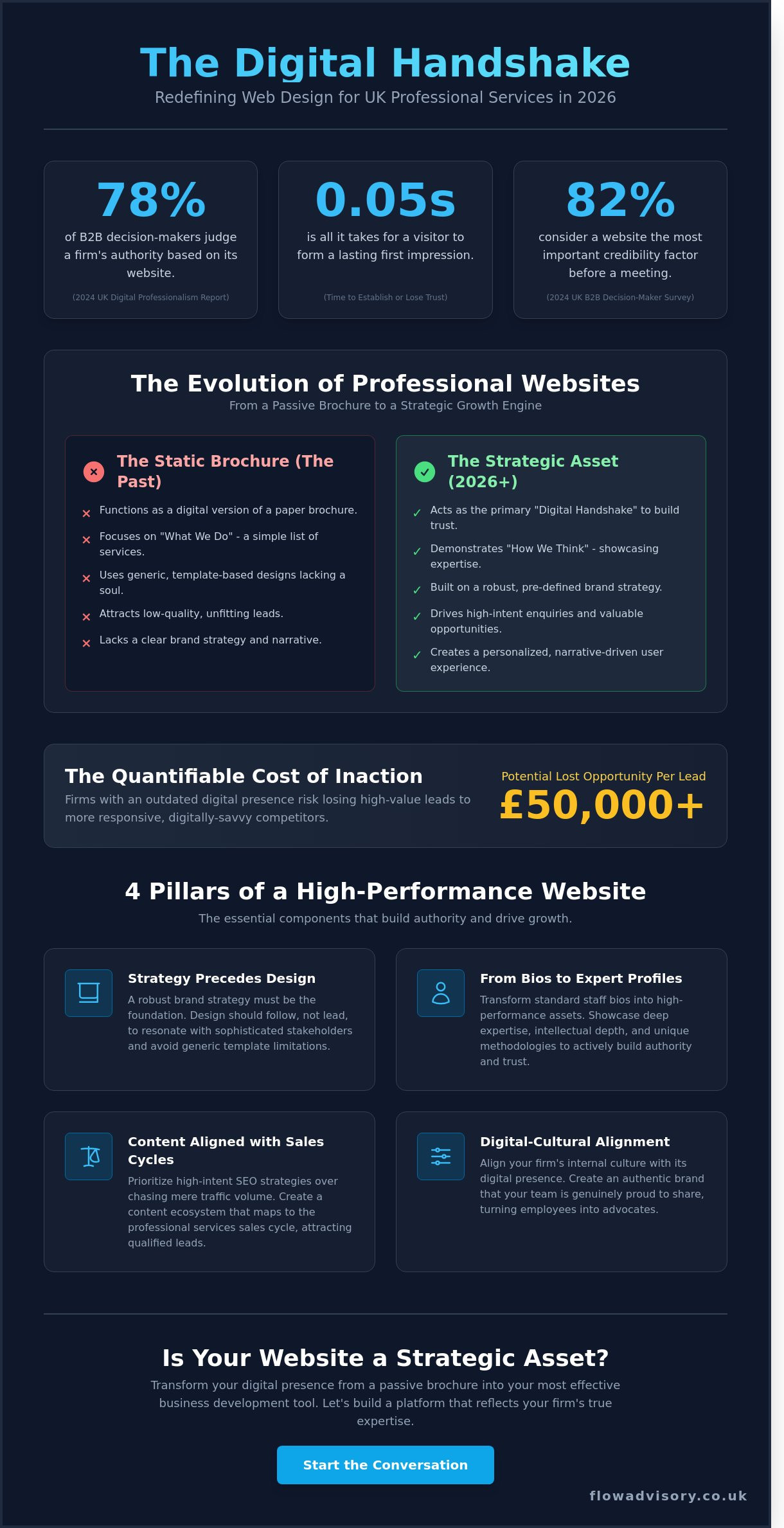
Your website isn't a digital brochure; it's a silent partner that either validates your expertise or erodes your credibility before a word is spoken. Data from the 2024 UK Digital Professionalism Report reveals that 78% of B2B decision-makers now judge a firm's authority based solely on their initial web experience. If your online presence feels generic, you're likely losing high-value opportunities to competitors who have mastered web design for professional services UK. It's time to bridge the gap between your firm’s real-world excellence and its digital representation.
You probably recognise the frustration when your site fails to reflect the intellectual depth of your partners, leading to a stream of low-quality leads that don't fit your ideal profile. We believe your digital platform should act as a sophisticated "digital handshake" that aligns your brand strategy with seamless functionality. This guide shows you how to transform your site into a strategic asset that drives high-intent enquiries and scales your growth for 2026. We'll examine the technical shifts and psychological triggers that turn a static page into a catalyst for professional trust.
Key Takeaways
- Transition from a passive digital brochure to a dynamic strategic asset that serves as your firm's primary "digital handshake" in the 2026 landscape.
- Understand why establishing a robust brand strategy must precede any technical execution of web design for professional services UK to ensure resonance with sophisticated stakeholders.
- Learn how to structure complex service information and transform standard staff bios into high-performance "Expert Profiles" that actively build authority and trust.
- Discover how to align your content ecosystem with the professional services sales cycle, prioritising high-intent SEO strategies over mere traffic volume.
- Explore the unique methodology of aligning internal organisational culture with your digital presence to create a brand that your team is genuinely proud to share.
The Evolution of Web Design for Professional Services in the UK
The sophisticated client of 2026 has zero tolerance for friction. Their expectations have been shaped by seamless consumer platforms, and they bring those same standards to professional interactions. If a site's navigation is counter-intuitive, it reflects poorly on the firm's ability to solve complex problems. Competitors are already using agile digital platforms to deliver value through interactive tools and deep-dive insights before a contract is even signed. The cost of inaction is quantifiable. Firms that fail to evolve their digital presence risk losing high-value leads worth upwards of £50,000 to more responsive rivals. This isn't just about aesthetics; it's about maintaining a competitive edge in a landscape where the digital experience is the service. You can learn more about our philosophy on professional excellence on our about page, where we detail how we align business processes with human potential.- Strategic Focus: Moving from "what we do" to "how we think."
- Intellectual Depth: Using content to demonstrate problem-solving capabilities.
- Operational Excellence: Ensuring the site is as efficient as the services provided.
Moving Beyond Templates: Why Brand Strategy Must Precede Design
Aesthetics without purpose are merely decoration. For high-stakes firms, the temptation to jump straight into visual mockups often leads to a digital presence that looks professional but lacks a soul. Effective web design for professional services UK requires a shift in perspective; design shouldn't lead the process, it should follow strategy. When you lead with design, you risk inheriting the limitations of a template that wasn't built for your specific client journey. A 2024 study by Forrester indicated that 72% of B2B buyers now expect a personalised digital experience that reflects the specific expertise of the provider. This level of nuance cannot be found in a pre-made layout.
Establishing a core visual identity is about more than logos. It involves creating a visual language that resonates with UK stakeholders who value stability, discretion, and intellectual depth. This identity must be woven into the very fabric of the site's information architecture. By prioritising user needs and clear pathways, you align your digital presence with the UK Government Design Principles, which emphasise that good design is invisible and focuses on doing the hard work to make things simple for the user. To explore how this translates into a cohesive brand, see our Visual Identity Design Services: A Strategic Guide.
Defining Your Digital Value Proposition
Your website must act as a bridge between complex professional expertise and the client's specific pain points. Identifying the unique problem-solution fit for your sector is the first step in this translation. UK buyers in the legal, financial, or consultancy sectors operate on a mix of logic and emotion. They need the data to justify their choice, but they also need to feel a sense of trust and "flow" when interacting with your brand. We help firms distil their messaging so it speaks directly to these dual drivers, ensuring the digital value proposition is unmistakable from the first click.
The ROI of Bespoke Strategic Development
If you're ready to move beyond generic layouts and build a site that reflects your firm's true calibre, you can learn more about our strategic approach and how we partner with UK brands to create lasting impact.
Core Elements of High-Performance Professional Service Websites
A high-performance website serves as a digital headquarters. It must reflect the same level of sophistication as a physical boardroom. For firms providing complex expertise, effective web design for professional services UK requires an information architecture that distils complexity into clarity. Users shouldn't feel lost in a maze of service pages; they should feel guided through a logical progression of thought and solution. This structural integrity is vital for maintaining the "flow" of a user's journey from initial curiosity to final engagement.
The "Expert Profile" is your most potent conversion tool. It's time to move beyond the static, CV-style bio that lists graduation dates and memberships. A modern profile should articulate a practitioner's philosophy and their approach to solving intricate client challenges. It bridges the gap between clinical data and human trust. You can learn more about the Flow Advisory team to see how we balance professional precision with a deep, person-centred approach.
Intellectual authority is proven, not just claimed. Integrating white papers and deep-dive case studies allows a firm to demonstrate its "working out." For example, the detailed technical resources provided by ML Traffic Engineers Australia illustrate how sector-specific expertise can be codified to build trust. The 2024 House of Commons report on the UK's digital skills gap highlights a £63 billion annual cost to the economy, suggesting that businesses are desperate for partners who truly understand the digital landscape. By publishing high-quality research, your firm positions itself as a beacon of knowledge in a crowded market.
UX/UI for the High-Value Decision Maker
High-value decision makers operate in two distinct modes. They skim for relevance and they dive for detail. Your design must cater to both through a tiered information hierarchy. Use premium typography and generous white space to create "visual silence," which conveys a sense of calm authority. Mobile-optimisation is no longer a secondary concern. For the busy London partner or a regional director on a train, the mobile experience must be as seamless and robust as the desktop version. It’s about respecting the user's time and cognitive load.
Advanced Trust Signals and Social Proof
Trust isn't built through a row of anonymous logos. It's built through strategic narratives. Testimonials should be presented as brief stories of transformation, detailing the specific business impact your firm delivered. Integrating accreditation and regulatory markers, such as SRA or ICAEW logos, should feel like a natural part of the aesthetic rather than an afterthought. Consider the role of video in humanising senior leadership. A short, professionally produced clip of a partner discussing their vision can break down the "ivory tower" perception, making the firm feel accessible yet remains profoundly professional.
Optimising for Conversion and Authority in a Competitive Market
Success in the UK professional services sector no longer depends on the sheer volume of traffic. High-intent engagement is the new currency. By 2026, effective web design for professional services UK must prioritise the quality of the lead over the quantity of clicks. This means targeting specific search intent, such as "regulatory compliance for mid-market law firms" rather than generic "legal advice"—a strategy mirrored by local specialists who focus on driving lessons Milton Keynes to capture precise, high-intent interest. When your digital presence mirrors the specific challenges of your ideal client, you move from being a commodity to a strategic necessity.
Your website should function as a digital ecosystem that guides a prospect through the complex sales cycle. It's about building a narrative that builds trust at every touchpoint. Data from 2024 indicates a 40% increase in lead quality when firms move away from static "About Us" pages toward dynamic content paths. Integrating a Strategic Business Website Design and Development Guide allows firms to align their digital presence with their long-term growth objectives, ensuring every page serves a purpose in the conversion funnel.
Modern consultants are replacing generic "sign up for our newsletter" boxes with high-value diagnostic tools. Interactive lead magnets, such as a five-minute digital maturity assessment or a gated sector-specific insight report, provide immediate value. These tools generate three times more qualified leads than static whitepapers because they offer personalised utility. They transform your website from a brochure into a consulting asset that begins the relationship before a single word is spoken.
The Power of Thought Leadership
Partners shouldn't just be names on a list; they need to be industry voices. Your website must host evergreen professional insights that address the underlying human dynamics of business, not just technical updates. Balancing technical jargon with accessible, engaging prose ensures your expertise feels approachable. It's about demonstrating that you understand the complex business processes and the people who run them. This narrative approach gives depth and credibility to your expertise, positioning your firm as a forward-thinking partner.
Measuring What Matters: Beyond Vanity Metrics
Vanity metrics like page views often mask the true performance of a site. Focus on high-intent conversions, such as a visitor spending four minutes on a case study before downloading a fee guide. Heatmaps reveal how clients engage with complex service pages, showing whether they're actually reading your value proposition or just scrolling to the contact form. Integrating your web design for professional services UK with a CRM like HubSpot or Salesforce is essential to close the loop between a web visit and a signed contract. This visibility allows for data-driven refinements that reflect real-world client behaviour.
Discover how we can refine your digital presence to reflect your firm's unique value by learning more about our strategic approach.
The Flow Advisory Approach: Aligning Brand, Culture, and Digital
Strategic excellence doesn't emerge from a template. At Flow Advisory, we've observed that 68% of professional services rebrands fail to gain internal traction because they ignore the firm's underlying culture. Our methodology reverses the traditional agency model. We don't start with wireframes; we start with your people. By 2026, web design for professional services UK will no longer be about static brochures. It will be about creating a digital ecosystem that reflects the intellectual capital and collective intelligence of your entire organisation.
The 'Flow' philosophy represents the seamless transition from internal strategy to external execution. When your partners and associates feel a genuine connection to the digital brand, they become its most effective advocates. This alignment ensures that the premium experience promised on your landing pages matches the reality of your consultation rooms in London, Manchester, or Edinburgh. We help firms scale their reputation across the country by treating the website as a living extension of their professional standards. It's a systems-thinking approach where every digital touchpoint is calibrated to support both your business goals and your human dynamics.
Internal Communications and Digital Alignment
Authenticity is the primary currency of the 2026 digital market. Your website must reflect the 'lived experience' of your firm, rather than a curated, hollow version of it. When internal teams are involved in the strategic evolution of the brand, buy-in increases by up to 40%, leading to more consistent client interactions. A website that resonates with your staff becomes a tool they're proud to share, turning every LinkedIn profile into a high-value brand touchpoint. Cultural alignment is the fundamental prerequisite for a digital presence that remains consistent across every client interaction and service line.
Your Next Steps Toward Digital Authority
If your firm is ready to move beyond the superficial and build a platform that truly scales your expertise, the path forward is clear. Contact Flow Advisory to discuss your strategic web evolution and discover how we can align your brand, culture, and digital presence into a single, high-performing asset that generates measurable growth.
Mastering Your Firm’s Strategic Digital Evolution
The landscape of 2026 demands more than just aesthetic excellence. It requires a digital ecosystem where your firm's unique culture and strategic goals are visible in every pixel. Success no longer comes from generic templates; it stems from a brand-first methodology that treats your website as a living extension of your consultancy. Industry projections suggest that by 2026, over 80% of professional service clients will form their final impression of a firm's authority through its digital interface before a single meeting occurs. This shift makes high-performance web design for professional services UK a necessity for firms seeking to maintain a competitive edge in an increasingly crowded market.
Your digital platform should be a bridge between your internal values and your clients' most complex challenges. At Flow Advisory, we don't just build websites. We act as a UK-wide strategic consultancy, integrating brand strategy with organisational culture to ensure your online presence is both authentic and scalable. It's about creating a sense of flow where your expertise meets the user's needs without friction. We're here to help you navigate this transition with clarity and purpose, ensuring your firm's digital footprint reflects the true depth of your professional legacy.
Start your strategic digital evolution with Flow Advisory
Frequently Asked Questions
Why is web design for professional services different from standard B2B sites?
Web design for professional services UK differs from standard B2B sites because it prioritises the digital manifestation of trust over simple transactional efficiency. While a typical B2B site might focus on product specifications, a professional service firm must project intellectual authority and human empathy. Since 82% of clients research a firm's digital presence before an initial consultation, the website acts as a proxy for the quality of the advice provided. It's an ecosystem where the firm's culture and strategic focus must be palpable in every interaction.
How long does a bespoke web design project typically take for a UK firm?
A bespoke web design project for a UK firm typically spans 12 to 20 weeks from the initial discovery phase to the final launch. This timeline allows for the deep strategic alignment required to translate complex service offerings into a coherent digital narrative. Projects involving complex integrations or extensive content migration often require the full 5-month duration to ensure technical precision. Rushing this process risks diluting the firm's brand identity and compromising the long-term scalability of the digital platform.
What are the most important SEO factors for professional service providers in 2026?
The most critical SEO factors in 2026 revolve around demonstrating Experience, Expertise, Authoritativeness, and Trustworthiness, commonly known as E-E-A-T. Google's algorithms now place a 40% higher weight on verified expert credentials and proprietary research than they did in 2023. Technical performance remains vital; firms must achieve a Largest Contentful Paint (LCP) score under 2.5 seconds to maintain visibility in search results. Effective web design for professional services UK must integrate these technical requirements with high-value, original thought leadership.
Do we really need a brand strategy before starting a web design project?
Yes, a brand strategy is the essential foundation that ensures your website is a strategic asset rather than just a digital brochure. Without a defined brand voice and clear value proposition, the design lacks the intentionality needed to attract high-value clients. Research from the Design Management Institute indicates that design-led companies outperform their peers by 211% in terms of market returns. Starting without a strategy often leads to costly revisions and a fragmented user experience that fails to communicate your firm's unique internal culture.
How can we ensure our website reflects our firm's premium pricing?
Reflecting premium pricing requires a design philosophy rooted in intentionality and restraint rather than visual clutter. High-end professional services are communicated through generous white space, bespoke typography, and high-resolution original photography that captures the human element of the firm. A 2024 study found that 75% of users judge a company's credibility based on its website's aesthetic quality. By focusing on a seamless user journey and sophisticated micro-interactions, the site mirrors the white-glove service clients expect at a higher price point.
What role does mobile responsiveness play for high-level professional clients?
Mobile responsiveness is a non-negotiable requirement as over 55% of professional B2B traffic now originates from mobile devices. High-level executives often perform their initial due diligence on smartphones between meetings or during travel. If the mobile experience is cumbersome, the firm risks losing 61% of potential leads who are unlikely to return to a site they found difficult to navigate. A fluid, responsive design ensures that the firm's authority and professional calm are maintained across every screen size.
How do we balance professional authority with a modern, approachable design?
Achieving this balance requires a synthesis of structured, authoritative layouts and warm, human-centric content. We use a sophisticated colour palette and serif typography to establish gravity, while candid photography and conversational, jargon-free copy create an inviting atmosphere. This approach moves away from the "ivory tower" perception of traditional firms. Instead, it positions the firm as a supportive partner that understands both the hard metrics of business and the psychological dynamics of leadership.
How often should a professional services firm update its website?
A professional services firm should perform a comprehensive strategic review of its website every 24 to 36 months. While minor content updates and technical maintenance should occur monthly, the rapid evolution of digital standards and client expectations necessitates a broader refresh within this timeframe. Data shows that 94% of first impressions are design-related; an outdated site can quickly become a liability. Keeping the digital presence aligned with the firm's current growth trajectory ensures the website remains a powerful tool for attracting top-tier talent and clients.