
Strategic Indicators: 7 Signs You Need a Rebrand to Realign Your Business

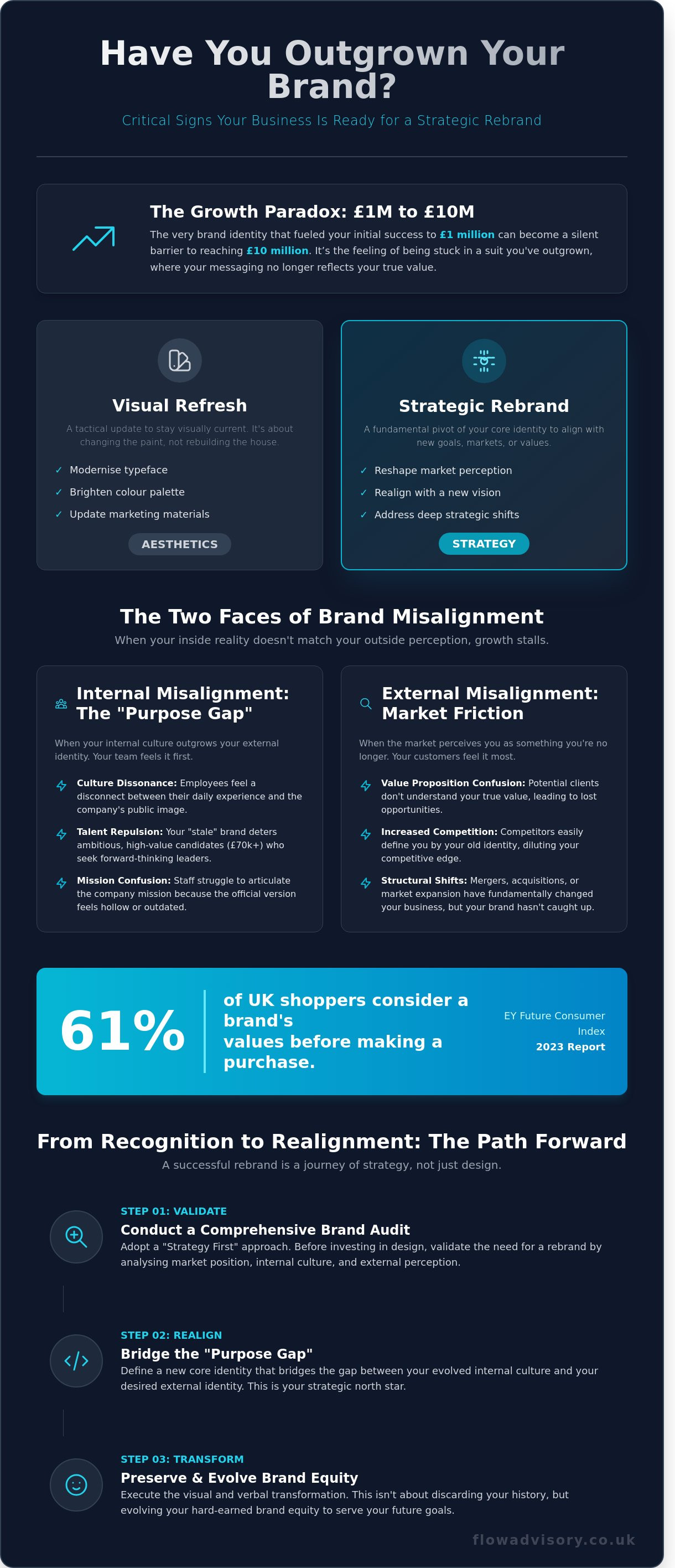
What if the very identity that facilitated your initial £1 million in turnover is now the silent barrier preventing you from reaching £10 million? It's a frustrating paradox to maintain operational excellence while feeling an intangible sense of being stuck. You've likely felt the friction when your messaging feels like a suit you've outgrown, or when potential clients seem confused about your true value proposition. Identifying the clear signs you need a rebrand isn't about chasing aesthetics; it's about ensuring your strategic focus and organisational culture are in perfect harmony with your market position.
We believe that a brand is a living system that must evolve alongside your business objectives. This article will help you discover the strategic and cultural indicators that suggest your current brand no longer serves your long-term goals. You'll gain a clear framework for evaluating your brand health, allowing you to decide with confidence whether a transformation is the right investment for your next stage of growth.
Key Takeaways
- Learn to distinguish between a surface-level visual refresh and a deep strategic realignment that preserves and evolves your hard-earned brand equity.
- Discover how to bridge the "Purpose Gap" when your internal organisational culture outgrows your external identity, hindering your ability to attract premier UK talent.
- Identify the critical external signs you need a rebrand, such as market friction, competitor confusion, or a fundamental shift in your target audience’s behaviour.
- Navigate the complexities of structural evolution, ensuring your brand maintains its integrity during mergers, acquisitions, or the transition to a national market leader.
- Adopt a "Strategy First" approach by conducting a comprehensive brand audit to validate your evolution before investing in visual design.
Understanding the Strategic Shift: Is It Time for a Rebrand?
The Difference Between Refreshing and Rebranding
A visual refresh is a tactical update. You might modernise a typeface or brighten a colour palette to stay relevant in a digital-first environment. However, these minor tweaks don't solve deep-seated issues with market positioning. A rebrand is a strategic pivot of a company’s core identity and external perception. It's necessary when your current brand equity is tied to a version of the business that no longer exists. If you've shifted from a product-based model to a consultancy, or if you've entered a completely different sector, a simple facelift won't suffice. You need a total realignment to ensure your 2026 objectives aren't held back by 2018's messaging.
The Psychology of Brand Evolution
Internal Misalignment: When Your Culture Outgrows Your Identity
Growth often happens quietly within the walls of an office before it ever reaches the public eye. Your team evolves, your internal processes mature, and your collective ambition expands. Yet, many businesses find themselves trapped in a visual and verbal shell that represents who they were five years ago, not who they are today. This creates a "Purpose Gap." It's the moment your employees look at the company website and feel a sense of cognitive dissonance because the vibrant, innovative culture they experience daily is nowhere to be found in your marketing materials. Recognising these internal shifts is one of the most critical signs you need a rebrand.
When your internal culture and external identity drift apart, consistency suffers. Your staff might struggle to articulate the company mission because the official version feels hollow or outdated. This friction doesn't just stay in the boardroom; it bleeds into client interactions and service delivery. Leaders often explore various rebranding strategies to close this gap, ensuring that the energy felt inside the business is precisely what the market sees outside.
Attracting and Retaining Premium Talent
The UK job market remains fiercely competitive for high-level talent. Modern professionals, particularly those in the £70,000+ salary bracket, prioritise organisational culture and shared values as much as financial compensation. A "boring" or "stale" brand acts as a silent deterrent for ambitious candidates who want to work for forward-thinking industry leaders. According to data from Oxford Economics, the average cost of replacing a mid-level manager in the UK is approximately £30,000, including recruitment fees and lost productivity. An outdated brand identity increases these costs by making it harder to attract the right fit initially. A strategic rebrand serves to re-energise your existing workforce, boosting morale by giving them a professional identity they can carry with pride.
Bridging the Purpose Gap
Authenticity is the currency of the modern business world. If there's a disconnect between what you do and how you're perceived, trust begins to erode. Your "Why"—the fundamental reason your business exists beyond profit—must be the heartbeat of your brand. If your founding visual identity was built on a different set of priorities, it will eventually feel like a constraint rather than a catalyst. Strategic visual identity design services must be rooted in this internal truth to be effective. This alignment ensures that every touchpoint, from an internal slide deck to a public-facing campaign, feels like a natural extension of your company's soul. If your team no longer recognises the business described on your "About Us" page, it's time to consider a strategic realignment that reflects your current reality.
Market Friction: Identifying External Signs of Brand Decay
Brand decay doesn't usually happen with a bang. It's a quiet erosion of clarity that eventually creates a visible gap between who you are and how the world sees you. You might notice your sales team struggling to explain why a £10,000 engagement is superior to a £1,500 alternative. This friction is one of the most pressing signs you need a rebrand. When your visual and verbal identity no longer mirrors your internal excellence, you've lost the ability to command the room before you even speak.
If prospects focus entirely on your price list rather than your strategic impact, your brand is failing to frame the conversation. Data from the Design Council indicates that businesses that invest in strategic brand alignment can see a 125% increase in their ability to sustain premium pricing. Without this alignment, you're effectively forcing your team to work twice as hard to overcome a "generic" first impression. At Flow Advisory, we see this as a systemic issue where the brand’s outer shell has become too small for the growing organism within.
- Your value proposition requires a ten-minute monologue to be understood.
- Prospects frequently confuse your service offering with a lower-tier competitor.
- The "vibe" of your marketing materials feels like a legacy of a previous leadership era.
- Referrals are surprised when they see your website because it doesn't match your reputation.
Competitive Irrelevance and Market Saturation
The UK professional services landscape is currently crowded with "minimalist" aesthetics that have become the new wallpaper. If your brand hasn't evolved since 2019, you risk being perceived as a legacy firm in an era that demands tech-forward agility. Looking "dated" isn't just an aesthetic flaw; it's a signal to the market that your methodology might be stagnant too. A 2024 survey of UK B2B buyers showed that 74% of decision-makers conduct over half of their research online before making contact. If your visual language doesn't radiate contemporary authority, you're being filtered out before the first meeting.
Audience Disconnect and Shifting Demographics
Your original customer base has likely matured. Their priorities have shifted from aggressive scaling to sustainable legacy or operational flow. Meanwhile, a new generation of leaders is entering the C-suite with entirely different expectations regarding transparency and purpose. By 2026, market misalignment will be the leading driver for corporate restructuring in the UK. Speaking to multiple generations with a single, outdated voice creates a diluted message that resonates with no one. Rebranding allows you to recalibrate your frequency to match the exact demographic you intend to serve in the coming decade. To ensure your new direction is grounded in reality, you can learn more about Human Instinct and their data-driven insights for brand evolution.
Structural Evolution: Rebranding During Business Growth
Rapid growth often outpaces the visual and narrative framework that supported a business in its infancy. When your organisational structure shifts, the identity that once felt like a perfect fit can quickly become a constraint. This misalignment is one of the most significant signs you need a rebrand to ensure your external image matches your internal reality.
Technical Brand Debt accumulates when a company scales through rapid, uncoordinated bursts. You might find yourself with three different logo versions across various departments or a website that doesn't reflect your current service tier. By 2024, many UK enterprises found that this fragmentation wasn't just an aesthetic issue; it actively hindered operational efficiency. A total overhaul of your visual identity becomes essential when entering a new sector, as it signals a fundamental shift in capability and intent to the market.
Mergers and Acquisitions: Creating a Unified Front
A unified identity respects the heritage of both entities while pointing toward a shared future. Success here depends on a rigorous brand strategy that acts as a bridge between disparate company cultures. It's about finding the common denominator in your values and articulating it through a fresh, authoritative voice that resonates across the newly formed organisation.
Scaling Beyond Your Original Niche
Moving from a local specialist to a national market leader requires a shift in how you're perceived. If your name or logo is tied to a specific geography or a single, narrow service, it will inevitably limit your expansion. In 2024, approximately 35% of scaling UK SMEs reported that their original "founder-led" branding became a barrier when pitching for larger, corporate contracts.
Transitioning to a scalable corporate identity involves moving the focus from an individual's personality to a robust institutional system. Consider the trajectory of a regional consultancy that rebrands to compete on a national stage. They don't just change their logo; they evolve their entire communication style to reflect the sophistication and reliability expected by Tier 1 clients. You can learn more about how we facilitate these transitions on our about page, where we detail our commitment to systemic growth.
Growth demands clarity. If your current identity feels like a suit you've outgrown, it's time to redefine your presence in the market. Explore how our strategic approach can unify your expanding business.
From Recognition to Realignment: The Strategic Path Forward
Launching a rebrand without losing customer loyalty requires transparency and a narrative that includes them in the journey. You aren't discarding the past; you're honouring the foundation while building a structure that better serves your clients' evolving needs. When you communicate the "why" behind the change, you transform a potentially jarring shift into an invitation to grow alongside you. This transition is about maintaining the flow of trust while upgrading the vessel that carries it.
The Rebranding Roadmap
The first step involves deep-dive stakeholder interviews and an internal culture assessment. You can't project a new identity if your team doesn't live it. Research shows that 80 percent of successful corporate transformations succeed because of high internal engagement. Once the internal pulse is understood, you define your new strategic position and brand voice. This creates the intellectual framework for Step 3: executing the visual and digital transformation. Every design choice must serve a strategic purpose, ensuring the new look isn't just modern, but functional and aligned with your 2025 growth targets.
Integrating Brand into Digital Growth
Your rebrand must live and breathe through your business website design and development. In the UK market, where 82 percent of B2B buyers research a company online before ever speaking to a representative, your website is your most powerful brand ambassador. It's the primary touchpoint where your new messaging meets user experience. Consistency across all marketing collateral and digital touchpoints is non-negotiable. If your LinkedIn profile speaks one language and your website another, the resulting friction kills the flow of your sales funnel. A rebrand isn't a cost to be managed; it's a strategic investment in the next decade of your business’s flow and its ability to scale with grace.
Restoring Clarity to Your Strategic Path
Your brand's visual and strategic identity shouldn't act as a tether to the past. It's a living system that must evolve alongside your organisational culture and market position. Recognising the signs you need a rebrand is the first step toward resolving the friction that occurs when your internal growth outpaces your external presence. Whether you're navigating a structural shift or correcting a misalignment between your team's values and your visual identity, the goal is to restore a sense of effortless flow to your operations.
Flow Advisory is a strategic consultancy founded on the principle of business flow. We are specialists in visual identity for national UK firms, providing end-to-end creative development that spans from high-level strategy to website implementation. We've seen how a precise realignment can transform a company's trajectory, turning market friction into a sustainable competitive advantage for businesses scaling across the United Kingdom. It's time to ensure your external image matches your internal excellence.
Discover how Flow Advisory can realign your brand with your strategic vision and begin the journey toward a more cohesive, future-proof identity. Your business deserves a partner that understands the deep dynamics of growth.
Frequently Asked Questions
Is rebranding expensive for a mid-sized UK business?
Rebranding represents a significant strategic investment that typically costs between £20,000 and £100,000 for mid-sized British firms. According to data from the Design Council, every £1 invested in design can return up to £20 in increased revenue over time. It's helpful to view these costs as a recalibration of your market position rather than a simple business expense.
How long does a typical strategic rebranding process take?
A comprehensive transformation usually takes between 4 and 9 months to execute with precision. This duration allows for a deep discovery phase, internal cultural alignment, and a phased creative rollout. Rushing this timeline often results in a superficial change that fails to address the underlying organisational dynamics or the complexities of your business model.
Will a rebrand confuse my existing customers?
Transparent communication prevents confusion; in fact, 86% of consumers prefer brands that are authentic about their evolution. If you clearly explain the purpose behind your change, you invite your clients into the journey. This process strengthens the relationship by showing that your business is growing and adapting to better serve their changing needs.
What is the difference between a rebrand and a brand refresh?
A brand refresh is a tactical update to visual elements like colours or fonts, whereas a rebrand is a fundamental shift in your strategic focus. Think of a refresh as a new coat of paint for a building. A rebrand is a complete architectural renovation that changes how the entire space functions and how people experience it.
Can I rebrand my business myself or do I need an agency?
How do I know if my logo is just old or if the whole brand is the problem?
You can identify the root cause by examining your conversion rates and the level of internal motivation within your team. If your visuals look dated but your message still converts, you likely only need a refresh. However, when your staff feels a disconnect between their work and the company's mission, these are clear signs you need a rebrand to restore organisational flow.
What happens if we rebrand and it doesn’t work?
Failure usually stems from a lack of data; 60% of unsuccessful rebrands fail because they didn't account for existing brand equity or market reality. If a rollout misses the mark, we conduct a diagnostic audit to find where the strategy diverged from the customer experience. It's about finding the balance between your internal values and the external perceptions of your market.
How often should a company consider a rebrand?
Most organisations evaluate their brand every 7 to 10 years to ensure they remain relevant in a shifting economy. This isn't a fixed rule, but rather a rhythm that allows for natural growth and maturation. You should consider a change whenever your business model evolves significantly or when you notice the signs you need a rebrand in your competitive landscape.