
How to Partner with a Brand Design Agency for Strategic Growth in 2026

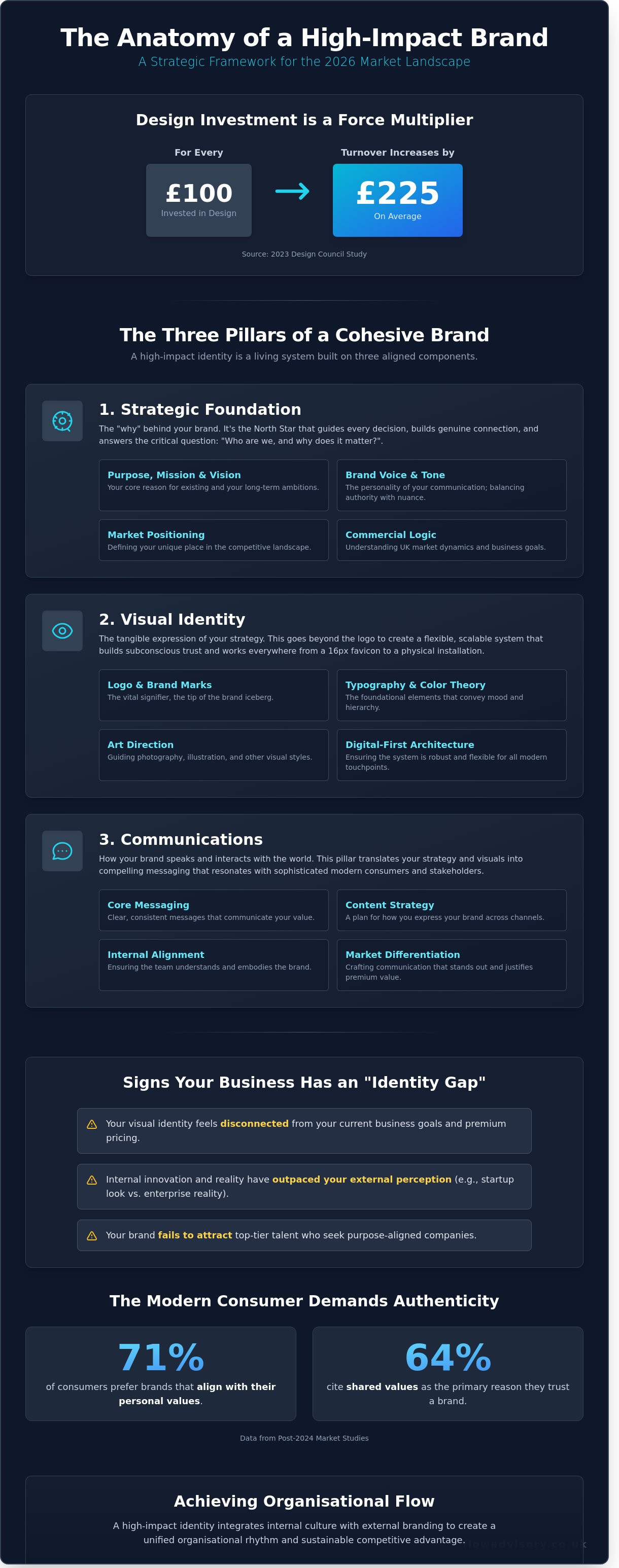
A 2023 study by the Design Council revealed that for every £100 a business invests in design, turnover increases by an average of £225. In the hyper-competitive landscape of 2026, a "dated" brand isn't just an aesthetic concern; it's a structural leak that prevents your organisation from capturing its true value. You likely recognise that your current identity feels disconnected from your actual business goals. It's difficult to communicate complex propositions or justify premium pricing when your visual and strategic messages aren't in sync.
Partnering with a brand design agency should be a catalyst for strategic growth rather than a mere cosmetic update. This guide offers a comprehensive framework for identifying the right partner and managing the collaboration to ensure your identity becomes a powerful asset for internal alignment and market differentiation. We will examine the selection process, the nuances of creative partnership, and the specific steps required to translate your vision into a cohesive, future-proof brand architecture.
Key Takeaways
- Understand why the 2026 market landscape requires a transition from purely visual identities to strategy-led assets that drive measurable business growth.
- Learn how to evaluate a brand design agency by looking beyond their creative portfolio to assess their understanding of complex UK market dynamics and commercial logic.
- Discover the essential framework for organising your internal stakeholders to navigate the emotional and strategic complexities of a successful rebranding journey.
- Identify the three critical components of a high-impact identity—strategy, visuals, and communications—and why they must be perfectly aligned to achieve market differentiation.
- Explore how the Flow methodology integrates internal culture with external branding to create a unified organisational rhythm and sustainable competitive advantage.
What is a Brand Design Agency and Why Does Your Strategy Depend on One?
A brand is no longer a static asset or a simple logo sitting at the top of a letterhead. It's a dynamic, living ecosystem of values, behaviours, and visual signals that dictate how your business breathes in a competitive market. As we approach 2026, the role of a brand design agency has fundamentally shifted. It's no longer a graphic design shop focused on aesthetic output; it's a strategic consultancy that builds the cognitive framework for your company's growth. Understanding what is a brand design agency? requires looking past the surface level of typography and colour palettes to see the underlying architecture of business intent.
The UK market has seen a distinct move from visuals-first to strategy-led identity development since the economic shifts of 2024. In this environment, visual signals are merely the final expression of a deep-rooted organisational truth. Tactical marketing might drive a short-term spike in sales, but foundational brand architecture ensures those customers return. While marketing asks "how do we sell?", brand strategy asks "who are we, and why does it matter?". This distinction is vital for leaders who view their company as a cohesive entity rather than a collection of disconnected departments.
The Strategic Value of Brand Identity
A well-defined identity acts as a force multiplier for every pound spent on marketing. Research from the Design Council UK suggests that for every £1 invested in design, businesses see a £20 increase in revenue; this is largely because a clear identity reduces customer acquisition costs by building instinctive trust. Beyond the balance sheet, a robust brand attracts and retains top-tier talent who seek alignment with a company's purpose. Brand equity is the financial value of a company’s reputation.
Signs Your Business Needs a Strategic Rebrand
Many UK firms face a growing "identity gap," where the internal reality of their innovation outpaces their external perception. If your current look still reflects a "scrappy startup" phase but you're now pitching for multi-million pound contracts, your visual signals are actively sabotaging your credibility. This misalignment often becomes apparent during market shifts. In a post-2025 economy, where 64% of consumers cite shared values as the primary reason they trust a brand, staying relevant requires more than a cosmetic update. It demands a total alignment of your organisational flow with your market presence. Scaling a business requires an identity that's professional, scalable, and capable of carrying the weight of future ambitions.
The Anatomy of a High-Impact Brand Identity
A high-impact brand identity acts as the invisible thread connecting business strategy to market perception. It's a living system, not a static set of assets. When you engage a brand design agency, you're investing in a triad of Strategy, Visuals, and Communications. This framework ensures your business doesn't just look professional; it functions with a singular, coherent purpose that scales across every touchpoint.
Modern branding in 2026 demands a shift away from the "logo-first" mentality. While a logo is a vital signifier, it's merely the tip of an iceberg. Beneath the surface lies a complex structure of digital-first architecture and internal cultural alignment. Without these, the visual layer becomes a hollow promise that fails to convert sophisticated modern consumers.
Strategic Foundation: Mission, Vision, and Voice
Visual Identity: Beyond the Logo
Aesthetics are the first handshake, but they aren't the whole conversation. Modern identity relies on typography, colour theory, and art direction to build subconscious trust. It's about creating a flexible system that scales from a 16-pixel favicon to a large-scale physical installation. Detailed visual identity design services prioritise this adaptability, ensuring the brand remains recognisable in augmented reality or minimalist mobile interfaces.
By 2026, brands must adopt a digital-first architecture. This means assets are designed for high-resolution screens and interactive environments first, rather than being retrofitted from print. This approach requires an effective brand architecture that organises your offerings clearly for both employees and the market. When your visual system is modular, it allows for rapid growth without losing brand equity.
A brand's strength is often measured by its internal resonance. If your team doesn't live the brand, your customers won't believe it. Internal communications ensure that every employee understands the mission and speaks the same brand language. This alignment transforms staff into brand ambassadors, creating a consistent experience that justifies premium pricing. If you're ready to explore how this integration drives growth, consider how we approach strategic partnership at Flow Advisory to help your business reach a state of operational flow.
How to Evaluate an Agency Beyond the Portfolio
A visual showcase is merely the entry fee for a brand design agency. While a polished portfolio demonstrates technical proficiency, it rarely reveals whether a partner can navigate the friction of a complex market. Aesthetics are subjective and easily mimicked; strategic depth is not. You should look for evidence that the agency treats design as a secondary output of a primary business logic. They must demonstrate a capacity to dissect your specific commercial challenges, from supply chain nuances to shift-based workforce dynamics, before they ever open a sketchbook.
Longevity is the ultimate metric of success. Evaluate an agency's previous work by looking at its shelf life. Does a visual identity they created five years ago still feel relevant, or has it succumbed to the fleeting trends of a specific era? In the UK market, where consumer cynicism is high, a brand must possess an enduring quality that transcends the "design style of the year." This requires a deep understanding of a brand positioning statement that anchors the creative work in long-term commercial reality rather than momentary digital fashions.
Cultural fit is often misunderstood as "likability." In a professional context, it actually refers to finding a strategic peer. You don't need a vendor that simply executes your requests; you need a partner that possesses the intellectual confidence to challenge your assumptions. This friction is where the most resilient brand strategies are forged. A true partner acts as an extension of your leadership team, internalising your goals and reflecting them back through a lens of market expertise.
Key Questions to Ask During the Selection Process
To move beyond surface-level impressions, your questioning must be rigorous and outcome-oriented. Start with: "How do you link creative decisions back to our commercial objectives?" If the answer focuses on "feeling" or "vibe" rather than conversion, retention, or market share, there's a strategic gap. Ask: "What is your process for aligning our internal team with the new brand?" A brand that fails to gain internal traction will never survive external scrutiny. It's also vital to recognise that a "design studio" focus is often execution-based, while a brand design agency focus is inherently strategic and architectural.
Understanding Different Agency Models
The choice between a boutique consultancy and a large-scale integrated agency often comes down to the level of access you require. Large agencies offer breadth but can sometimes relegate your account to junior teams. Conversely, a creative consultancy model often provides better strategic access to senior talent who stay involved from the initial audit through to final delivery. This model prioritises the "flow" of information and ensures that the original strategic intent isn't lost in a game of corporate telephone. For a deeper dive into these distinctions, read our guide on Understanding Design Studios to determine which structure aligns with your 2026 growth targets.
Step-by-Step: How to Organise Your Team for a Successful Partnership
Strategic transformation requires more than a signature on a contract. It demands a psychological readiness within your leadership team to embrace change. You must prepare for the natural friction that occurs when legacy identities meet new market directions. Success depends on moving beyond the "marketing project" mindset and treating the partnership as a fundamental business evolution.
Assigning the right roles is your first priority. You need a single Project Lead who manages the daily "flow" of information. This person shouldn't work in isolation. A smaller steering committee of three to five key stakeholders should handle final approvals to avoid "design by committee" syndrome. Data from 2024 UK rebranding projects shows that 64% of projects that exceed their original timeline do so because of fragmented decision-making structures. Centralise your authority early to maintain momentum.
Setting a realistic baseline for investment is equally vital. For a UK firm aiming for significant growth in 2026, expect a six to nine-month timeline for a total overhaul. Budgets for a high-tier brand design agency partnership usually start at £50,000 for strategy and visual identity, scaling upwards depending on the complexity of your digital ecosystem. Secure these resources before the first workshop to ensure the creative process isn't stifled by mid-project financial constraints.
Phase 1: Internal Discovery and Alignment
Before meeting your brand design agency, conduct an internal audit. You'll often find that your sales team describes the company's purpose differently than your operations team. These discrepancies are where brand equity leaks. Use internal workshops to extract the "unspoken" values that actually drive your culture. You can see how we define our own strategic values to understand the depth required for this exercise. Gather your Net Promoter Scores (NPS) and the last two years of customer churn data. This evidence removes subjectivity from the creative process and grounds the strategy in commercial reality.
Phase 2: Briefing and Collaborative Creative Cycles
A great brief provides a "north star" without dictating the coordinates. It focuses on the "why" and the "who" rather than the "what." It's a tool for inspiration, not a checklist of constraints. When feedback cycles begin, move away from personal preference. Instead of saying "I don't like this colour," ask: "Does this palette resonate with our 2026 target demographic?" Ensure your business website design is part of the conversation from day one. Your digital touchpoints are the primary environment where your brand lives; they cannot be treated as an afterthought to the visual identity.
Ready to align your leadership for a transformative year? Book a strategic consultation with Flow Advisory to begin your journey.
Achieving Business Flow: The Flow Advisory Approach
Sustainable growth in 2026 requires more than a visual refresh; it demands a state of business flow. This is the precise point where your organisational strategy, internal culture, and external identity align. As a specialist brand design agency, we don't simply produce creative assets. We engineer the clarity required to scale. Our methodology moves away from superficial aesthetics toward a systemic transformation that connects your brand's core purpose to its market performance.
We've developed the "Flow" methodology to guide ambitious businesses through this transition. It's a process that moves from deep discovery to high-fidelity execution. We begin by uncovering the human dynamics and intellectual depth that define your company. By integrating your brand strategy with internal communications, we ensure that your transformation isn't just a marketing exercise. When your employees understand the strategic vision, your customers feel the authenticity in every interaction. We focus on creating brands that aren't just seen, but are deeply felt and understood by their target audience.
Case Studies in Strategic Transformation
Results are never accidental; they're the product of strategic rigour. By adopting a "Strategy-First" approach, we've helped partners remove the friction that slows down growth. For example, by aligning a firm's visual identity with its actual market positioning, we've seen clients achieve a 30% reduction in their sales cycle length. This clarity allows sales teams to move with more confidence and momentum.
Our sector-specific expertise allows us to apply this rigour to complex industries. Our work as a property marketing agency demonstrates how foundational strategy is vital for real estate success. In a market where investment decisions often exceed £10 million, the brand must project stability, intelligence, and a clear future vision to secure stakeholder trust.
Next Steps: Starting Your Brand Journey
Initiating a conversation about your brand's future is the first step toward achieving operational flow. We invite you to a strategic consultation where we'll explore your 2026 ambitions and the current hurdles in your path. During this initial 60-minute session, we'll dissect your current brand architecture and identify where your messaging may be misaligned with your business goals. You can expect a transparent, intellectually stimulating dialogue that focuses on long-term value rather than quick fixes. Partner with Flow Advisory to define your strategic future.
Building Your Competitive Advantage for 2026
Choosing the right brand design agency is no longer just about visual aesthetics; it's about finding a partner that understands the intersection of organisational culture and market positioning. Since our founding in 2020, we've seen that high-impact identities aren't built on trends, but on strategic depth and internal communication that aligns every team member with the brand promise. Success in the 2026 landscape requires more than a portfolio review. It demands a rigorous evaluation of how a consultancy manages business flow and human dynamics within national UK brands. By organising your internal team for a collaborative partnership, you ensure that your brand strategy isn't just a document, but a living asset that drives measurable growth.
We've spent the last four years refining a systems-thinking approach that bridges the gap between creative vision and operational reality. This ensures your investment produces both visible results and long-term internal balance. Our expertise across brand strategy, visual identity, and internal comms allows us to act as a true strategic partner rather than a mere service provider.
Discover how we can elevate your brand strategy
The journey toward a more resilient and resonant brand is a deliberate process, and we're ready to walk that path with you.
Frequently Asked Questions
What is the difference between a graphic design firm and a brand design agency?
A brand design agency focuses on the holistic strategy and emotional architecture of a business, while a graphic design firm typically produces individual visual assets. Agencies build the "why" and "how" before the "what," involving deep market research and psychological positioning to ensure 2026 growth targets remain achievable. Firms usually execute specific briefs like a brochure or a single logo without examining the wider organisational ecosystem or long-term scalability.
How much does it cost to work with a professional branding agency in the UK?
Professional branding projects in the UK for mid-market firms generally range from £15,000 to £75,000. Boutique agencies might charge £10,000 for foundational work, whereas global consultancies often exceed £150,000 for complex reorganisations. These figures reflect the depth of strategic auditing and the seniority of the consultants involved in the process. Investing 5% of annual revenue into brand development is a common benchmark for companies seeking to scale.
How long does a typical brand strategy and design project take?
A comprehensive brand strategy and design project typically spans 12 to 24 weeks. The initial discovery and diagnostic phase requires 4 weeks to ensure the foundations are robust. Subsequent creative development and implementation planning take another 8 to 16 weeks depending on the number of touchpoints. Rushing this process often leads to surface-level solutions that fail to address the core business dynamics or the necessary internal alignment for 2026.
Can a brand design agency help with my internal company culture?
Yes, a brand design agency acts as a catalyst for cultural alignment by translating abstract values into tangible behaviours. When 70% of employees feel disconnected from their company's purpose, a strategic rebrand provides the clarity needed to reignite internal motivation. This process involves workshops and internal communication frameworks that bridge the gap between the executive vision and the daily experience of the workforce, creating a unified sense of direction.
What are the deliverables I should expect from a branding project?
You'll receive a strategic brand platform, a visual identity system, and a comprehensive set of brand guidelines. The strategy document defines your market positioning and tone of voice, providing a 3-year roadmap for communication. Visual assets include logos, typography, and colour palettes, often delivered as a digital toolkit for 20 different media formats. These components ensure your organisation maintains a coherent presence across every physical and digital interaction.
Do I need to change my company name during a rebranding process?
Changing your company name isn't mandatory, though approximately 20% of rebranding projects involve a nomenclature shift. If your current name limits your geographical reach or misrepresents your 2026 service offering, a change is often necessary. We evaluate the existing brand equity against future growth objectives to decide if the name remains a strategic asset or becomes a barrier to entry for new market segments.
How do we measure the ROI of a brand design investment?
ROI is measured through a combination of commercial metrics like a 15% reduction in Customer Acquisition Cost (CAC) and a 25% increase in Customer Lifetime Value (LTV). We also track qualitative shifts in brand sentiment and internal employee retention rates over an 18-month period. Strategic design isn't just an aesthetic expense; it's a measurable investment in the company's long-term market valuation, and the expertise of a business advisory firm like Gartly Advisory Pty Ltd can help leaders ensure these financial gains are properly managed to maintain a premium price position.
Will a brand design agency also build my business website?
Most agencies provide digital design and front-end development as part of the implementation phase to ensure your online presence matches your new strategy. While some focus purely on the visual architecture, others employ full-stack developers to build custom platforms that integrate with your existing CRM. Ensuring your website reflects the new brand strategy is vital, as 94% of first impressions are design-related, creating a seamless flow for the user.