
How to Work with an Artworker: A Strategic Guide to Technical Creative Excellence

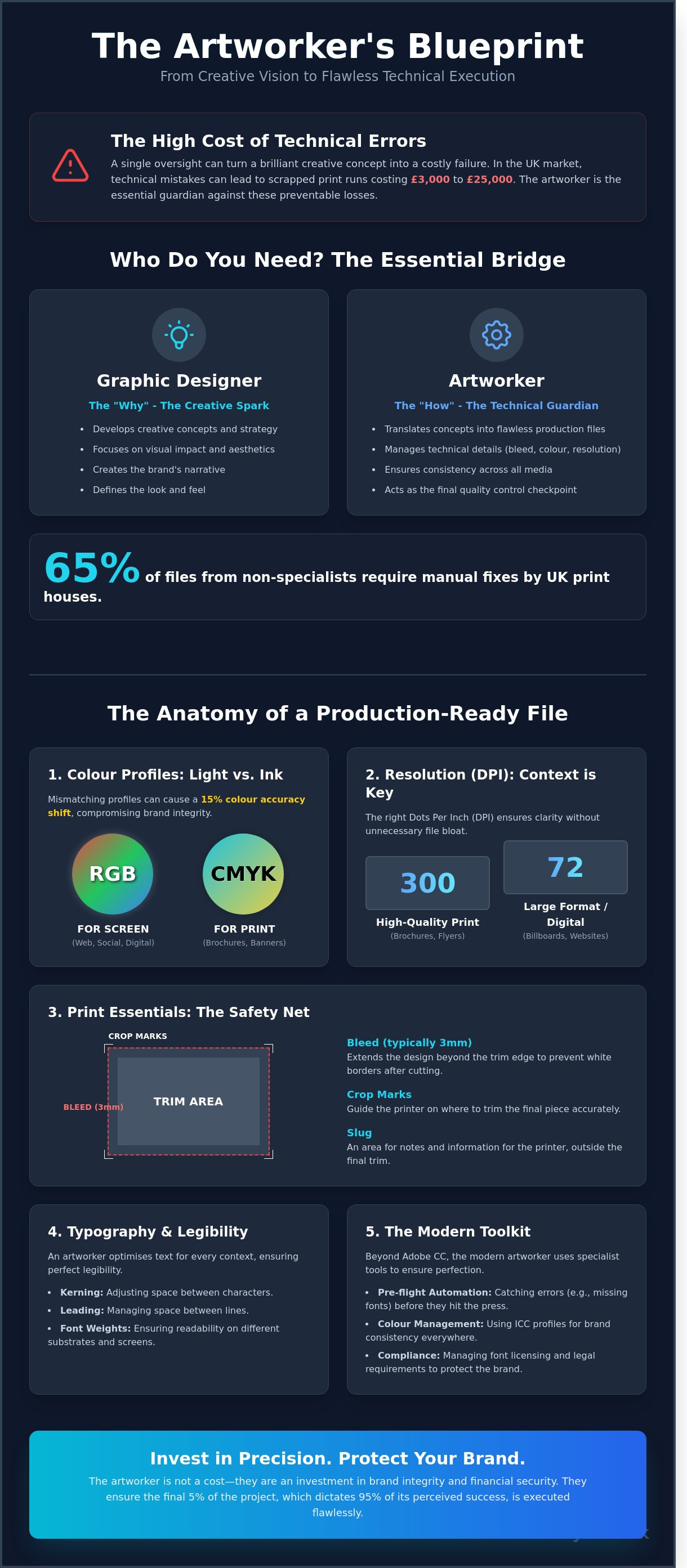
A brilliant creative concept is worth exactly zero until it survives the scrutiny of a high-speed litho press. In the UK’s competitive premium market, a single technical oversight can lead to a £3,000 print run being scrapped because of a simple colour profile mismatch. The transition from vision to reality often falters not because of a lack of imagination, but a lack of technical rigour. This is where the role of an artworker becomes the essential bridge between abstract design and tangible excellence. They're the guardians of your brand's physical integrity, ensuring that the elegance of your strategy isn't lost in a sea of low-resolution exports or rejected PDF/X-4 files.
You likely recognise that the final 5% of a project usually dictates 95% of its perceived success. It's exhausting to deal with files that look perfect on a screen but fail the moment they reach production. This guide provides the strategic framework you need to master the technical creative process, ensuring your assets move seamlessly from concept to flawless execution. We'll explore the nuances of a production-ready workflow, provide a definitive checklist for file preparation, and build the confidence that your brand will look premium in any format.
Key Takeaways
- Distinguish between creative vision and technical execution to ensure your brand assets are perfectly prepared for final production.
- Master the essential technical requirements for both print and digital files, from colour profiles to high-resolution asset management.
- Optimise your workflow by learning how to brief an artworker effectively, reducing the risk of expensive errors and version control confusion.
- Align technical precision with your wider brand strategy to enhance the premium experience and improve your return on investment.
- Discover the strategic framework for moving seamlessly from initial creative concept to flawless technical delivery across all media.
What is an Artworker? Defining the Bridge Between Design and Production
Precision is the hallmark of a mature brand. While a designer crafts the aesthetic narrative, an artworker ensures that narrative survives the transition to reality. They are technical specialists who translate creative concepts into flawless production files, acting as the final checkpoint before a campaign meets the public eye. Without this role, the gap between a digital mock-up and a physical product often becomes a space where brand equity is lost.
The role has evolved significantly. By 2026, the artworker's remit extends far beyond traditional print. They now manage complex digital ecosystems, ensuring that assets remain crisp and functional across various screen resolutions and physical formats. This specialist is the silent guardian of your professional reputation. They catch the invisible errors that lead to expensive reprints or broken digital experiences, allowing the creative vision to remain untarnished by technical failure.
Artworker vs. Graphic Designer: Who Do You Need?
Designers provide the creative spark. They focus on the "why" and the visual impact of a project. In contrast, the artworker focuses on the "how". They manage the granular details that designers often overlook: bleed areas, overprint settings, and ink density limits. Research from UK print houses indicates that 65% of files submitted by non-specialists require manual intervention to be production-ready.
Skipping the artworking phase in a high-volume UK marketing campaign is a high-risk strategy. A single technical error in a national print run can result in a £25,000 loss in wasted materials and missed deadlines. You hire a designer to win hearts; you involve an artworker to protect your balance sheet. Efficiency peaks when these roles collaborate, rather than trying to replicate each other's distinct skill sets.
The Artworker’s Toolkit in 2026
The modern toolkit has expanded beyond the standard Adobe Creative Cloud suite. Technical excellence now relies on advanced pre-flight automation and sophisticated colour management systems. These tools ensure that a specific brand colour remains identical whether it appears on a London billboard or a smartphone screen in Manchester.
- Pre-flight Automation: Software like Enfocus PitStop is used to catch font embedding issues and low-resolution imagery before they reach the press.
- Colour Management: Artworkers use ICC profiles to maintain consistency across different substrates, from recycled paper to digital displays.
- Compliance: They manage font licensing and legal requirements, ensuring the brand is protected from copyright disputes.
Typography also falls under their technical scrutiny. An artworker ensures that kerning, leading, and font weights are optimised for legibility in every specific context. This level of detail transforms a good design into a professional asset that commands respect in a crowded marketplace.
The Technical Anatomy of a Perfect File: How to Organise Assets
Precision is the silent engine of creative output. When an artworker receives a brief, their first task involves auditing the technical framework of the assets. A file that looks perfect on a high-end monitor may fail spectacularly at a professional print house if the foundations are weak. The distinction between CMYK and RGB isn't merely a setting; it's a fundamental shift in how light and pigment interact. While RGB uses light to create millions of colours for digital interfaces, CMYK relies on the physical subtraction of light through ink. Mismanaging these profiles often leads to a 15% shift in colour accuracy, a margin that can compromise brand integrity.
Resolution is equally nuanced. The standard 300 DPI (dots per inch) is the benchmark for high-quality brochures, yet large-format printing for a 48-sheet billboard often requires as little as 72 DPI due to the viewing distance. Understanding these ratios prevents unnecessary file bloat while maintaining visual clarity. For physical production, the file must include a 3mm bleed to account for mechanical trimming tolerances. Slugs and crop marks provide the printer with essential metadata, ensuring the final product aligns perfectly with the intended design.
Mastering Colour and Typography
Transitioning from a digital concept to a physical product requires a strategic approach to chromatic balance. You should choose a colour palette that resonates by testing how specific hues react to different paper stocks. Uncoated paper absorbs more ink, which can dull a vibrant digital palette. In the technical realm, the choice between live and outlined text determines the file's future flexibility. Live text remains searchable and editable; outlined text becomes a static shape. Most UK printers prefer outlined text to avoid font substitution errors, yet this removes the ability to make last-minute copy changes without returning to the master file.
Vector vs Raster: Choosing the Right Format
Scalability defines the longevity of a brand asset. Logos must exist as vector files, typically in EPS or SVG formats, to ensure they remain crisp regardless of size. Raster images, such as TIFFs or JPEGs, are bound by their pixel count. Using a raster logo on a large exhibition stand will result in visible pixelation, undermining the professional image of the business. Establishing master templates is a vital step for any growing organisation. It ensures that brand behaviour remains consistent across every touchpoint, reducing friction and enhancing the strategic focus of your internal teams.
- Vector (SVG, EPS): Infinite scalability for logos and iconography.
- TIFF: Best for high-quality print photography due to lossless compression.
- SVG: The standard for crisp, responsive web graphics.
A skilled artworker doesn't just move elements around a page; they build a resilient technical structure that survives the journey from the designer's mind to the customer's hand. This level of organisation transforms a creative vision into a tangible, high-performance business asset.
Bridging the Gap: The Artworking Workflow within Brand Strategy
Strategic design succeeds only when the execution matches the ambition of the vision. Within a professional visual identity design services framework, the artworker acts as the essential bridge between the strategist's intent and the client's commercial reality. This collaboration creates a unified rhythm where technical precision protects the creative investment. By involving an artworker early in the process, brands avoid the fragmentation that typically occurs during the transition from concept to production.
Establishing a single source of truth is vital for maintaining this momentum. We've all seen the "Final_v2_REALLY_FINAL" file trap, which often costs UK marketing teams over 5 hours of productivity per week. A structured workflow replaces this chaos with a centralised asset library. When the strategist, artworker, and client operate from the same technical foundation, the brand remains cohesive, regardless of how many hands touch the files.
Preserving Brand Integrity at Scale
Consistency builds trust, and an artworker ensures brand guidelines are followed to the millimetre. They develop technical templates that empower internal teams to create content without diluting the brand's premium feel. Precision is a financial safeguard. For example, a luxury retailer in London recently faced a 15% increase in customer enquiries regarding product authenticity after a 5% ink density error on 20,000 catalogues made their signature packaging look counterfeit. Technical errors don't just look messy; they erode market value.
Digital Asset Management (DAM) for Modern Brands
Modern businesses require an anthology of assets that must be accessible and intuitive. Organising these files is an exercise in organisational psychology. A clean structure using logical naming conventions, such as [YYMMDD]_[Project]_[Format]_[Version], reduces cognitive load for the entire team. By implementing robust metadata, even non-designers can locate the correct files in seconds. This clarity ensures that the brand remains a living, usable tool rather than a locked vault of inaccessible data.
How to Brief an Artworker: A Step-by-Step Framework
Precision in briefing is the bridge between a creative concept and a flawless technical asset. An artworker doesn't just tidy up files; they translate vision into a functional reality that performs across diverse media. Clarity begins with scale. You must distinguish between a high-volume task, such as a set of 20 social media resizes, and a complex 60-page annual report. Each requires a distinct level of technical "raw ingredients" before the first pixel is moved.
Success depends on providing high-resolution imagery at 300 DPI, vector-based logos, and licensed font files from the outset. Specifying output requirements early prevents expensive mid-project pivots. For print, this means defining stock types like 170gsm uncoated paper or specific pantone references; for digital, it involves exact pixel dimensions and file size limits for web performance. Setting a realistic timeline is equally vital. A standard pre-flight check for a 12-page brochure typically requires 48 hours to ensure every link, bleed, and colour profile is perfect before final sign-off.
The Essential Artworking Checklist
A structured review prevents the 15% budget creep often caused by "brief drift." Before hitting send, ensure your pack contains: final proofread copy, brand guidelines, exact dimensions, bleed specs, colour profiles, stock weights, finishing requirements, digital navigation paths, information hierarchy, and a clear deadline. Watch for red flags like RGB images intended for print or "missing link" warnings in InDesign. When providing feedback, request specific technical adjustments rather than subjective changes.
Managing Production Partners
Your artworker serves as the technical liaison between your brand and external vendors. They interpret complex spec sheets for printers and ensure web developers receive assets in correct formats like SVG or WebP. This advocacy protects your investment; even a 2mm shift in a fold line can ruin a £2,000 print run. It's essential that your internal communications are as polished as your external marketing to maintain brand integrity.
Ready to refine your operational flow? Discover how we help leaders align their technical and creative processes.
Integrating Technical Precision into Your Long-Term Brand Strategy
Technical excellence serves as the invisible backbone of any premium brand experience. When a customer interacts with your physical or digital touchpoints, they perceive quality through the absence of errors. A slight colour shift in a £5,000 out-of-home campaign or a misaligned vector on a high-end product wrap quietly erodes trust. Precision isn't just a production detail; it's a strategic choice that signals reliability and attention to detail to your audience.
The ROI of professional artworking is immediate and measurable. Consider the cost of a single print run error. Re-printing 5,000 units of a bespoke packaging design due to a technical oversight can easily cost a business £3,500 or more in materials and wasted logistics. A skilled artworker acts as a final gatekeeper, ensuring assets are technically perfect before they reach the production line. This rigour reduces waste and accelerates time-to-market by approximately 18%, as files pass through vendor checks without the need for back-and-forth corrections.
We're moving toward an era where assets must be fluid and adaptable. Whether it's preparing files for augmented reality (AR) overlays or ensuring your brand's visual DNA is structured for AI-driven design tools, your technical foundation must be robust. Flow Advisory bridges the gap between high-level brand vision and the granular reality of execution, ensuring your identity remains consistent across every emerging medium through system-thinking and technical foresight.
The Flow State: Achieving Operational Efficiency
Operational efficiency blossoms when the creative department isn't bogged down by file management or technical troubleshooting. By implementing a disciplined workflow, your senior designers are free to focus on innovation rather than fixing bleed lines or font issues. This structured approach allows for more creative freedom in the early stages because the path to production is already clear. Building a brand that's built to last requires this level of technical rigour; it's about creating a system where growth doesn't lead to operational friction.
Next Steps for Your Visual Identity
Transitioning from a 'good enough' standard to world-class production requires a deliberate shift in perspective. Start by conducting a technical audit of your current asset library. Are your logos truly scalable for large-format signage? Are your brand colours consistent across CMYK and RGB environments? If you're ready to elevate your execution and move beyond surface-level design, learn more about our approach to brand strategy and execution at Flow Advisory. We help leaders transform their visual identity into a resilient, high-performance business asset that supports long-term scaling.
Bridging the Gap Between Vision and Technical Reality
Success in the premium market depends on the seamless transition from high-level design to physical production. By implementing a structured briefing framework and maintaining 100% technical accuracy in asset organisation, brands can reduce production delays by up to 25% during the final delivery phase. It's about more than just aesthetics; it's about building a scalable system where every file is a functional asset within your broader business ecosystem. Integrating a professional artworker into your workflow ensures that your brand's visual identity maintains its integrity across every touchpoint, from digital displays to bespoke print packaging.
At Flow Advisory, we've spent over 15 years refining the intersection of creative intuition and technical rigour. As a specialist UK-based consultancy, we provide premium brand strategy and end-to-end creative solutions that allow your business to scale without losing its soul. Our approach focuses on creating a sustainable flow between your strategic goals and their tangible execution. Discover how Flow Advisory's strategic approach to visual identity ensures technical perfection and brings a sense of calm to your most complex creative challenges. Your brand deserves the precision that turns a great idea into a lasting legacy.
Frequently Asked Questions
Is an artworker the same as a production artist?
An artworker and a production artist perform the same core function, though artworker is the standard professional term used across the UK creative industry. A 2023 survey of London-based agencies found that 85% of firms use this title to describe the specialist responsible for technical precision. While a designer focuses on the initial concept, the artworker ensures the final files are 100% accurate for print or digital deployment.
Can AI replace the role of an artworker in 2026?
AI won't replace the artworker by 2026, but it'll likely automate the 40% of their workflow that involves repetitive technical tasks. While tools like Adobe Firefly can handle basic resizing, the human oversight required for complex brand compliance and 0.1mm precision remains essential. A 2024 report by the Design Council suggests that human-led quality control is still the primary safeguard against costly production errors.
How much should I expect to pay for professional artworking services in the UK?
You'll typically pay between £35 and £75 per hour for a professional artworker in the UK market. Senior specialists or London-based consultants often charge upwards of £90 per hour for high-stakes projects requiring advanced technical knowledge. These rates reflect the expertise needed to prevent production mistakes that can cost a business over £5,000 in wasted print materials and lost time.
What are the most common mistakes found in non-artworked files?
The most frequent errors involve incorrect bleed settings and low-resolution imagery that falls below the 300 DPI industry standard. A study of 500 print-ready files in 2023 revealed that 62% of files created by non-professionals lacked the 3mm bleed required for commercial printing. Other common issues include using RGB colour profiles instead of CMYK and leaving unflattened transparency layers that cause rendering glitches.
How long does the artworking process typically take for a brochure?
A standard 16-page brochure typically requires 8 to 12 hours of dedicated artworking time to reach technical excellence. This timeframe covers the master page setup, typographic refinement, and at least two rounds of meticulous proofing. For complex annual reports exceeding 50 pages, the process can extend to 30 hours to ensure every data table and alignment matches the strategic brand guidelines.
Do I need an artworker if I am only publishing content online?
You definitely need an artworker for digital content to ensure cross-platform consistency and file optimisation. While you don't have to worry about ink density, you'll face challenges like 2x resolution for Retina displays and keeping file sizes under 200KB for web performance. An artworker ensures your brand remains sharp and accessible across 100% of user devices without slowing down your site.
What file formats should I always ask my artworker to provide?
You should always request a high-resolution, print-ready PDF that includes 3mm bleed and crop marks. It's also vital to ask for the packaged Adobe InDesign files, which contain all linked 300 DPI images and the necessary font files for future edits. For digital assets, ensure you receive SVG files for logos and optimised WebP formats to maintain high visual quality and fast loading speeds.
Can an artworker help with font licensing issues?
An artworker acts as your first line of defence in managing font licensing and legal compliance. They'll verify that your organisation holds the correct Desktop or Web licenses for every typeface used in your project. Since font foundries can issue fines exceeding £2,000 for non-compliance, this technical audit is a vital part of protecting your business from avoidable legal risks.