
Understanding Design Studios: A Strategic Guide for Modern Businesses

A brand's visual identity isn't just a coat of paint. It's a structural asset that dictates whether a 50 million dollar market expansion succeeds or fails. Most leaders intuitively understand that aesthetics matter, yet a 2018 McKinsey study revealed that companies in the top quartile of design performance, often led by specialized design studios, outperformed their peers by nearly two to one in revenue growth. It's understandable if you've felt that creative spending is a black hole where 40% of the budget vanishes into subjective "fluff" without clear business metrics. You likely want a partner who respects your internal culture as much as your bottom line.
This guide explores how modern creative partners function as strategic consultants rather than just visual executors. You'll discover how a design studio transforms abstract business goals into resonant visual identities and seamless brand experiences that truly scale. We'll provide a clear framework for categorizing creative partners and show you how to select a long-term consultant who understands the deep connection between design and business strategy.
Key Takeaways
- Understand how a design studio functions as a collaborative hub of experts to bridge the gap between abstract business goals and resonant visual identities.
- Learn to navigate the landscape of design studios by identifying which archetype—Specialist, Full-Service, or Strategic—aligns with your unique organizational needs.
- Discover why strategic design should be viewed as a high-impact investment that enhances operational flow and scalability rather than a mere aesthetic expense.
- Master the art of selecting the right creative partner by prioritizing strategic depth and portfolio logic over subjective visual preferences.
- Explore how a living brand evolves alongside your market, serving as a seamless extension of your leadership team to ensure sustainable growth.
What is a Design Studio? Redefining the Creative Partnership
Design studios represent a deliberate shift toward strategic partnership and intentional craft. Unlike a traditional agency that often prioritizes high-volume output and broad market reach, a studio environment fosters a focused, artisan-led approach. To truly understand what a studio is in a professional context, we must look past the physical space and toward the intellectual rigor applied to every project. It's a collaborative hub where a small, specialized team of 5 to 15 experts works in a tight loop with clients to solve complex problems through visual logic.
The role of these entities has changed significantly over the last decade. In 2014, a business might have hired a designer for a standalone logo; in 2024, they partner with design studios to architect an entire brand ecosystem. This evolution marks the transition of design from a decorative afterthought to a fundamental business tool. According to the 2018 McKinsey report "The Business Value of Design," companies that excelled in design saw 32% higher revenue growth than their industry peers. Design is no longer about making things look better; it's about making businesses perform better through clarity and strategic focus.
The Core Functions of a Modern Studio
A modern studio doesn't just produce assets; it defines the visual language of an organization. This process begins with strategic positioning, where designers identify the "white space" in a market where 54% of consumers feel overwhelmed by generic branding. By translating abstract corporate values into a unique visual identity, the studio creates a tangible representation of the brand's soul. This extends into digital asset creation, ensuring that every touchpoint, from a mobile app to a pitch deck, maintains a consistent and professional rhythm that builds recognition over time.
Why Businesses Seek Design Expertise
Clarity is the ultimate currency in a crowded market. Businesses seek design expertise because they need to distill complex communication challenges into intuitive visual signals. Trust is built in milliseconds; research from Stanford University indicates that 75% of users judge a company’s credibility based on its website's aesthetic and functional design. Beyond mere credibility, design studios help foster an emotional connection that transcends the transactional. When a brand's visual presence aligns perfectly with its internal values, it creates a sense of safety and professional excellence that encourages long-term customer loyalty and internal pride.
The Different Archetypes of Design Studios
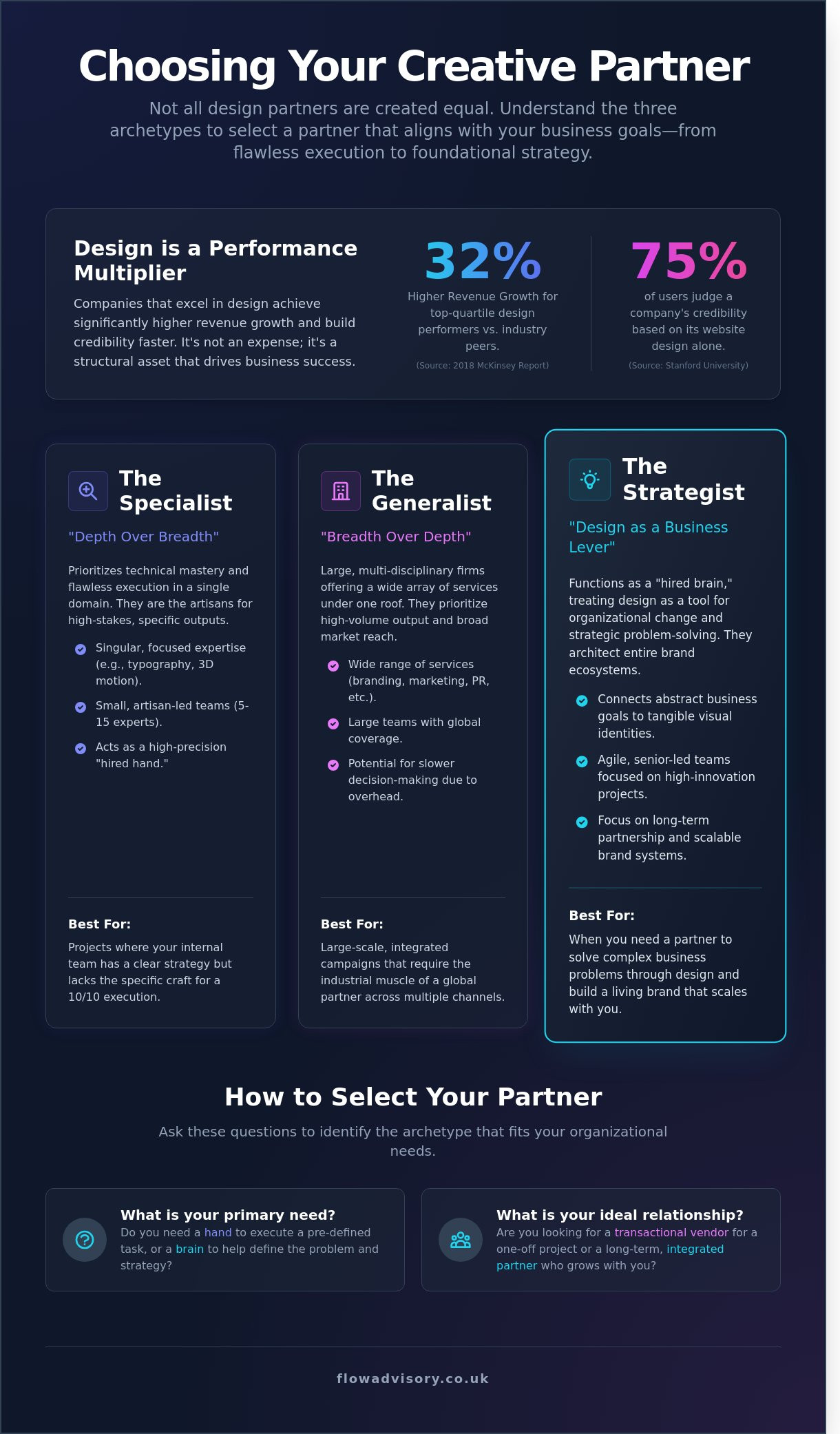
Design studios aren't monolithic entities. They function as distinct ecosystems tailored to specific organizational needs. Businesses often choose between the intimate expertise of a boutique shop and the industrial muscle of a global agency. While large firms provide 24/7 coverage across multiple time zones, they often struggle with the creative overhead that slows down decision-making. Boutique studios, conversely, offer direct access to senior talent. Data from 2023 industry surveys suggests that 65% of CMOs now prefer the agility of smaller teams for high-innovation projects where speed is a competitive advantage.
The choice of partner depends on whether you need a hand to execute a task or a brain to solve a problem. High-performing design studios bridge the gap between pure aesthetics and commercial utility. They ensure that every visual choice serves a measurable objective. This balance is critical because design without a strategy is just decoration, while strategy without design remains invisible to the market.
Specialist Studios: Depth Over Breadth
These environments prioritize technical mastery over horizontal service offerings. You hire a specialist when the project requires a singular, high-stakes output like a custom typeface, complex 3D motion graphics, or niche interior architectural branding. Within these highly technical environments, the artworker plays a vital role. They aren't just production staff; they're the technical gatekeepers who ensure the creative vision survives the transition to high-resolution reality without losing its soul. It's best to hire a specialist when your internal team has the strategy but lacks the specific craft to execute a 10/10 result.
Strategic Consultancies: The Flow Advisory Perspective
Modern enterprises are moving away from transactional relationships. They're seeking partners who treat design as a lever for organizational change rather than a final coat of paint. Research continues to prove the business value of design, with a 2018 McKinsey study showing that companies in the top quartile of design performers increased their revenues and total returns to shareholders substantially faster than their industry counterparts. This archetype focuses on the "why" before the "how."
Success in this model starts with understanding the company's story and its underlying human dynamics. Strategic studios don't just look at market trends; they analyze the internal culture and long-term business goals to ensure the brand remains healthy for years, not just for a single campaign burst. They act as an advisory partner, aligning the creative process with the company's scaling needs and operational efficiency. If you're ready to move beyond surface-level fixes, it's time to reimagine your creative strategy with a partner who values depth as much as you do.
Beyond Aesthetics: The ROI of Strategic Design
Design is frequently misclassified as an aesthetic expense. It's actually a core driver of capital. According to the McKinsey Design Index, companies that prioritize design see 32% higher revenue growth than their peers over a five-year period. This isn't about choosing the right shade of teal; it's about engineering a system that reduces friction. When a business treats design as a strategic investment, it moves from superficial decoration to structural optimization.
Strategic design studios focus on the "flow" of information and processes. When a workflow is designed intuitively, employees spend 20% less time searching for information or correcting errors. This operational efficiency translates directly to the bottom line. It's the difference between a company that struggles with its own weight and one that scales with grace. High-level design creates a bridge between complex business logic and the human experience.
Impact on External Perception and Market Position
First impressions are formed in 50 milliseconds. Professional design isn't vanity. It's a trust signal that shortens the sales cycle. Research from Stanford University indicates that 75% of consumers judge a business's credibility by its visual presence. When a brand uses specific geometries, like rounded edges to convey approachability or sharp angles for precision, they're tapping into subconscious cognitive biases. Consider how a tech firm might pivot from a "startup" look to a "legacy" feel through a 2023 rebrand, instantly justifying a 15% price premium in the eyes of enterprise clients. This psychological alignment ensures the market perceives the value you actually provide.
Internal Alignment: The Forgotten Benefit
A cohesive visual identity does more than attract customers; it anchors the workforce. When employees see a clear, professional brand, they're 27% more likely to feel aligned with the company's mission. Design studios provide an "outside-in" perspective that internal teams often lack. They identify where internal communication is breaking down. By mapping out the employee journey, they help reduce turnover. A well-designed internal ecosystem creates a culture where people don't just work; they belong. This clarity reduces the mental load on leadership, allowing the organization to focus on growth rather than internal friction.
How to Evaluate and Select the Right Design Studio
Selection is a strategic exercise, not a beauty contest. It begins with internal clarity. You must define the specific business outcome you seek before the first introductory meeting. For example, a fintech startup aiming for a 22% increase in mobile conversion rates requires a different partner than a legacy manufacturer seeking cultural transformation. Without these benchmarks, you're merely shopping for decorations. True partnership requires intellectual alignment; you're looking for a team that understands your P&L as well as they understand typography.
Reading Between the Lines of a Portfolio
Look beyond the surface of the pixels. A diverse portfolio indicates a studio can think beyond its own aesthetic preferences. If every project looks identical, the studio is likely imposing a "house style" rather than solving unique problems. Analyze the "why" behind their previous work. Did a 2023 rebrand actually help that client enter a new market, or was it just a fresh coat of paint? Consistency across digital, print, and physical touchpoints proves the studio understands the complexity of modern brand ecosystems. High-performing design studios demonstrate how their work moved a specific metric, such as a 14% rise in brand equity scores over an 18-month period.
The Discovery Phase: A Critical Filter
The initial consultation reveals the studio's intellectual depth. Pay attention to the questions they ask. A partner that challenges your assumptions is far more valuable than one that simply agrees with your initial brief. High-quality design studios provide transparent proposals that link creative output to measurable business growth. Red flags include vague timelines or a refusal to explain their methodology. If the process feels like a "black box" where you lose visibility for weeks, the collaboration will likely fail. You need a partner that invites you into the flow of the creative process, ensuring that the final solution is deeply rooted in your organizational reality.
Scalability is the final filter. A solution that works for a team of 12 might break when you reach 200 employees. Ensure the studio builds systems, not just assets. This long-term perspective ensures that your investment continues to yield returns as your organizational dynamics evolve. A studio that considers your internal culture during the design process creates tools that your team will actually use and champion.
Discover how we bridge the gap between creative vision and strategic organizational growth.
Achieving Brand Flow: The Future of Creative Partnership
The most effective design studios operate as a natural extension of your leadership team. They don't just deliver static assets; they integrate into your strategic core to ensure every visual and verbal touchpoint reflects your long-term vision. This partnership moves beyond the transactional. It creates a "living brand" that remains agile. According to a 2023 study by McKinsey, companies that prioritize design-led growth outperform their peers by 32 percent in revenue growth. This isn't about a one-time logo update. It's about building a system that breathes and adapts as your market shifts.
At Flow Advisory, we believe true success requires a harmony between external market results and internal organizational health. We call this achieving Brand Flow. When your creative output aligns perfectly with your internal culture, you eliminate the friction that slows down scaling. This balance ensures that your growth is not just rapid, but sustainable and meaningful for every stakeholder involved.
The Shift Towards Purpose-Led Branding
Modern consumers are discerning. The 2023 Edelman Trust Barometer highlights that 71 percent of employees believe it's critically important for their CEO to respond to climate change and social issues. Design studios translate these complex ESG goals into narratives that feel human rather than corporate. A successful brand must prove its ethical alignment through every pixel. This requires a deep understanding of strategic development and creative flow to ensure the message remains authentic while driving commercial interest.
Next Steps: Starting Your Journey
Preparation defines the outcome of any creative partnership. Before reaching out to design studios, align your internal stakeholders on the specific "why" behind the project. Expect a comprehensive rebranding process to span 12 to 24 weeks, depending on the complexity of your ecosystem. Your first conversation should focus on chemistry and methodology rather than just portfolio pieces. Use this final checklist to prepare for your project initiation:
- Define the primary objective: Are you solving a visibility problem or a cultural misalignment?
- Audit your current assets: Collect all existing brand materials to identify gaps and inconsistencies.
- Set a realistic investment: Premium strategy typically requires a budget of 5 to 15 percent of annual marketing spend for mid-market firms.
- Identify the "Flow" factor: Ask potential partners how they will ensure the new brand resonates with your internal team as much as your customers.
Choosing a partner is an intellectual investment in your company's future. When you find a studio that understands both the mechanics of business and the nuances of human psychology, you move from simply managing a brand to leading a movement.
Mastering the Architecture of Your Creative Future
Success in today's market isn't about isolated creative wins; it's about systemic alignment. The Design Management Institute's 10-year study revealed that design-centric companies outperformed the S&P 500 by 211%. This data proves that your selection of design studios acts as a fundamental business decision rather than a simple procurement task. You're not just buying a logo. You're investing in a strategic framework that connects your internal values with your external market presence. When these elements align, the friction that usually slows down scaling begins to vanish.
True brand flow emerges when your visual identity and organizational culture speak the same language. At Flow Advisory, we've developed comprehensive visual identity frameworks that focus on this exact intersection. Our expert strategic consulting helps leaders eliminate the 30% of operational waste typically caused by brand misalignment. We'll help you build a brand that doesn't just look better, but works better from the inside out. By focusing on deep internal and external brand alignment, we ensure your growth remains sustainable and authentic.
Discover how Flow Advisory can organise your brand for growth
The path to sustainable growth is clearer when every element of your business moves in harmony.
Frequently Asked Questions
What is the difference between a graphic design studio and a branding agency?
A graphic design studio focuses primarily on the visual execution of specific assets, while a branding agency manages the entire strategic positioning of a company. A 2023 industry report indicates that branding agencies dedicate 40% of their project scope to market research and psychological profiling. Studios prioritize the aesthetic translation of established ideas into tangible formats like layouts or digital assets.
How much does it typically cost to work with a professional design studio?
Professional design studios usually charge between $5,000 and $50,000 for a comprehensive strategic project. Mid-market firms often set a baseline of $15,000 for foundational identity packages that include core visual elements. These costs reflect the studio's seniority and the depth of the diagnostic process required to ensure long-term scalability.
How long does a full visual identity project usually take to complete?
A full visual identity project typically requires 8 to 12 weeks to move from the initial discovery phase to final delivery. This timeline accounts for three structured rounds of revisions and deep strategic alignment sessions. Rushing this process often leads to a 30% increase in brand inconsistency costs during the first year of implementation.
Do I need a design studio if I already have an in-house marketing team?
External design studios provide a fresh perspective that in-house teams often lose after 18 months of focused internal work. They act as strategic partners who challenge existing biases and bring specialized technical skills for high-stakes product launches. Data from the Design Management Institute shows that companies leveraging external expertise see a 211% higher return on their design investments.
What should be included in a design studio's initial proposal?
A professional proposal must include a detailed project roadmap, specific milestones, and a transparent pricing structure. It's essential that the document also outlines intellectual property rights and provides 2 case studies of similar business transformations. Without these 5 core elements, the partnership lacks the clarity needed for a high-level strategic collaboration.
Can a design studio help with my business's internal culture and communications?
Strategic studios directly influence internal culture by translating abstract corporate values into visual systems that employees engage with daily. A 2022 Gallup study found that clear internal branding increases employee engagement by 23% on average. By designing cohesive internal newsletters and workspace environments, the studio helps synchronize the team's mindset with the company's external market promise.
Is it better to hire a local studio or a national consultancy?
The choice depends on whether your target audience is geographically concentrated or spread across multiple regions. Local firms often possess a 15% better understanding of regional cultural nuances and community expectations. National consultancies provide the scalability and cross-industry insights required for businesses operating across 3 or more distinct national markets.
How do I measure the success of a design project after it has launched?
Success is measured through specific KPIs like a 20% increase in brand recognition or a 15% improvement in digital conversion rates. You should track these metrics over a 6-month period to capture the true impact of the strategic shift. Quantitative data combined with direct customer feedback provides the most accurate view of the project's effectiveness and long-term value.