
What is a Branding Agency? A Strategic Guide for UK Business Leaders

Your logo isn't your brand; it's merely the signature on a much deeper promise. Many UK business leaders overlook the fact that a strategic branding agency should function as a systemic architect rather than a simple design shop. You've likely felt the friction when your external marketing says one thing, but your internal culture feels like another. It's a disconnect that leaves your team misaligned and your business invisible in an increasingly crowded national market.
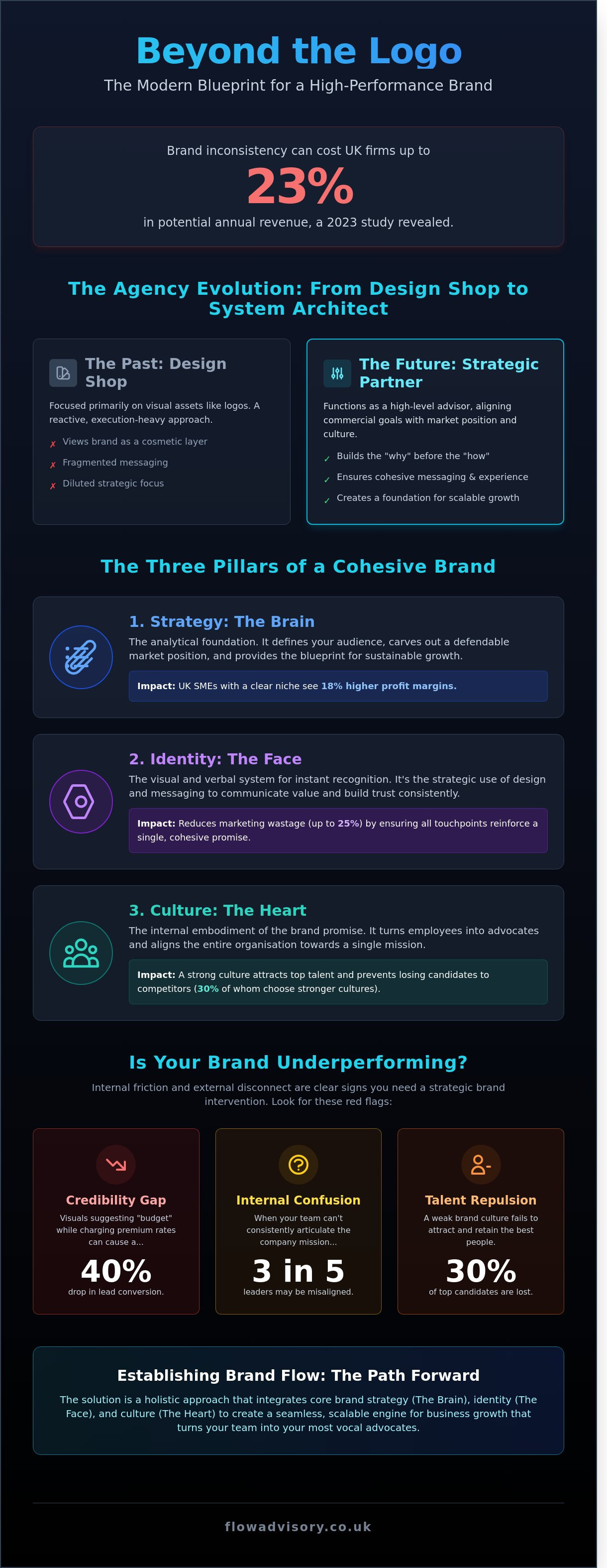
A 2023 study revealed that brand inconsistency can cost UK firms up to 23% in potential annual revenue. You deserve a visual and strategic identity that flows naturally from your core values into every digital touchpoint. This guide explains how to transform your company's identity into a measurable engine for growth and long-term cultural alignment. We'll examine the roadmap to achieving a cohesive five-year direction that turns your employees into your most vocal advocates.
Key Takeaways
- Recognise the evolution of the modern branding agency from a creative studio into a strategic consultancy that aligns your commercial goals with market positioning.
- Master the three-dimensional framework of strategy, identity, and culture to ensure your brand resonates as deeply with your internal team as it does with your external audience.
- Avoid the common pitfall of visual-first branding by establishing a research-led strategic foundation before committing to aesthetic changes.
- Learn how to evaluate potential partners based on their strategic rigour and process rather than simply judging their visual portfolio.
- Discover how the "Flow" approach integrates core brand strategy with digital development to create a seamless, scalable engine for business growth.
What is a Branding Agency? Defining the Strategic Partner in 2026
A branding agency isn't a factory for logos; it's a strategic architect for your company's future. In the 2026 UK business environment, the role has evolved from simple graphic design into a high-level advisory function. Leaders now recognise that visual assets are merely the tip of the iceberg. Beneath the surface lies a complex system of values, market positioning, and psychological triggers that define how a business breathes and grows. This shift is vital. While a graphic designer might create a beautiful brochure, a branding agency ensures that every interaction reinforces a singular, cohesive promise.
It acts as the north star for your organisation. Without this clarity, marketing spend often results in a 25% wastage rate due to fragmented messaging and inconsistent brand application. A specialist brand consultancy focuses on this deep-rooted strategy, whereas a full-service agency might dilute its focus across execution-heavy tasks like SEO or PPC. Choosing a specialist means prioritising the "why" before the "how," ensuring your foundation can support rapid scaling without cracking under the pressure of competition.
The Core Responsibilities of a Modern Agency
A modern partner manages three critical pillars to ensure your business remains resilient in the UK's shifting economy. These aren't just creative tasks; they're business imperatives.
- Market positioning: This involves identifying the "white space" in your industry. In a 2024 study of UK SMEs, firms with a clearly defined niche saw 18% higher profit margins than those competing on price alone.
- Visual identity: Beyond aesthetics, this is about cognitive recognition. It's the strategic selection of colours and typography that signals premium value before a single word is read.
- Strategic messaging: This is the narrative engine. It ensures your story resonates with a specific audience, moving away from generic corporate speak toward authentic connection.
Signs Your Business Needs Professional Branding
Identifying the need for a branding agency often comes from internal friction rather than external aesthetics. If your visual identity suggests a budget service while you're charging premium London rates, you've hit a credibility gap. This misalignment can lead to a 40% drop in lead conversion during the final stages of the sales funnel because the "feeling" of the brand doesn't match the price point.
Internal confusion is another red flag. When 3 out of 5 department heads describe the company mission differently, your operational efficiency suffers. Finally, if your HR department reports that 30% of top-tier candidates are choosing competitors with "stronger cultures," your brand isn't just failing your customers; it's failing your growth potential. A professional intervention aligns these disparate elements into a single, high-performance machine.
The Three Pillars of a Cohesive Brand: Strategy, Identity, and Culture
Many business leaders view branding as a cosmetic layer applied at the end of a project. This is a mistake. True branding is a three-dimensional discipline that integrates the brain, the face, and the heart of your organisation. When you partner with a specialist branding agency, the goal is to harmonise these three elements to create a resilient, high-performing business asset.
Brand Strategy: The Foundation of Every Decision
Strategy is the analytical "brain" of your business. It moves beyond aesthetics to define your target audience and the specific emotional triggers that drive their purchasing habits. In the UK’s competitive professional services market, worth over £50 billion annually, you can't afford to be vague. Strategy carves out a defendable territory where your competitors cannot follow. It ensures your positioning is rooted in market data rather than executive intuition. Brand strategy is the definitive blueprint for sustainable commercial growth.
Visual Identity: Creating Instant Recognition
Your visual identity acts as the "face" of the company. While a logo is often the most visible element, it's merely the starting point of a much larger visual system. This system includes everything from typography and colour palettes to the specific style of photography used in your annual reports. In British professional services, the psychology of colour is vital; deep navy tones often communicate stability and heritage, while clean, minimalist layouts suggest modern efficiency. Consistency across your digital presence and physical marketing collateral isn't just about looking good; it's about building a reliable reputation. If you're looking to refine your market presence, you might consider how a strategic partner can help align your visuals with your long-term goals.
Internal Communications: Branding from the Inside Out
Culture represents the "heart" of the brand. It's the internal reality that must match your external promise. Your team members are your most influential brand ambassadors, and their daily interactions with clients define your reputation more than any advert ever could. Effective internal communications reduce operational friction and can increase productivity by as much as 21% according to recent engagement data. When a team is unified by a shared purpose, the brand becomes an organic, living entity. You can observe the impact of a purpose-led team by exploring Flow Advisory’s about page, which highlights how internal values translate into external excellence. A branding agency that ignores culture is only doing half the job; the most successful brands are built from the inside out.
Beyond the Logo: Why Visual-First Branding Often Stalls Growth
Aesthetics alone cannot carry the weight of a scaling business. Many UK directors mistakenly view branding as a cosmetic exercise, yet a 2023 study by Lucidpress revealed that while consistent brand presentation can increase revenue by 23%, visual appeal without strategic substance leads to rapid stagnation. Investing in a premium visual identity before defining your market position is a structural risk. It's the equivalent of applying a fresh coat of paint to a building with a fractured foundation. If your messaging fails to articulate how you solve a specific £50,000 problem for your client, a £15,000 website will still suffer from bounce rates exceeding 65%.
Trust isn't built through a clever colour palette; it's forged through the elimination of friction. When a branding agency focuses purely on the surface, they ignore the cognitive load placed on your customers. Fragmented messaging across LinkedIn, pitch decks, and service delivery creates a "trust tax" that slows down the sales cycle. Every inconsistency forces a prospect to pause and re-evaluate your legitimacy. Over time, this erosion of confidence doesn't just hurt monthly targets. It actively devalues the business. Data from Reuters suggests that brand equity can account for up to 30% of a company’s total market valuation, meaning a disjointed brand is a direct drain on your long-term exit or investment potential.
The Misalignment Gap
Brand friction occurs when your marketing promises a Michelin-star experience but your operational delivery feels like a budget franchise. This gap is where most UK mid-market firms lose their competitive edge. A professional branding agency performs a deep audit to identify where these promises break down. They look at the 12% of touchpoints where customers feel abandoned. Fixing these gaps ensures that the external "gloss" matches the internal reality, turning your brand into a reliable promise rather than just an expensive mask.
Branding as a Business System
Strategic branding functions as an operating system for growth, not a one-off design project. It creates a repeatable framework that reduces the cost of customer acquisition by making your value proposition instantly recognisable. This systemic approach is particularly vital for attracting capital. Investors look for a "flow" between culture, product, and perception. A cohesive brand identity signals that the leadership team has a clear, long-term vision, which significantly boosts investor confidence during funding rounds. You can learn more about our approach to integrated strategy on our about page.
How to Select the Right Branding Agency for Your Business Goals
Selecting a branding agency is a significant capital allocation decision that extends far beyond aesthetic preferences. It’s an investment in your company’s intellectual property and market positioning. To find the right fit, you must first articulate your primary objective. Are you launching a new venture into a competitive UK market, or are you seeking to resolve a cultural disconnect following a merger? According to a 2023 report by the Design Council, businesses that prioritise strategic design are 21% more likely to see turnover growth than those that don't. This growth stems from clarity, not just a new logo.
You should scrutinise an agency's strategic process rather than just browsing their portfolio. A visually stunning deck is meaningless if it isn't anchored in commercial reality. Ask to see the "messy middle" of their previous projects: the research, the rejected iterations, and the data that informed the final direction. A high-calibre partner understands the nuances of the UK business environment, from the regulatory requirements of the FCA to the specific cultural expectations of British consumers in 2024.
Chemistry determines the longevity of the partnership. You aren't hiring a vendor for a one-off transaction; you're inviting a strategic partner into your inner circle. This requires a shared intellectual language and a mutual commitment to transparency. Look for multi-disciplinary expertise that covers internal communications and digital infrastructure. A brand that lives only on a business card but fails to translate to your website or your employee handbook will eventually fracture.
Questions to Ask During the Discovery Call
Success in branding is rarely accidental. Ask potential partners how they measure the impact of their work. Do they look at brand equity scores, employee retention rates, or lead quality? Inquire about their method for aligning internal teams; a rebrand fails if your staff don't embody the new values. Finally, ask them to explain the strategic "why" behind a recent project. If they can't link a creative choice to a business outcome, they aren't the right branding agency for a growth-focused leader.
Understanding Agency Pricing and Value
Price and value are often conflated in the creative industry. A commodity design service might offer a visual identity for £2,000, but this rarely includes the deep-tissue strategic work required for market shifts. Strategic consultancy from a premium branding agency typically starts at £15,000 for SMEs and can exceed £100,000 for complex organisations. The "cheap" option often results in a 45% higher cost over three years due to the need for total re-work when the initial design fails to scale or attract high-value clients. True ROI is found in a brand that commands a price premium and reduces your cost per acquisition.
If you are ready to move beyond surface-level design and build a brand with strategic depth, learn more about our approach to business transformation.
Establishing Brand Flow: The Flow Advisory Approach to Creative Consultancy
True resonance happens when your internal culture reflects your external promise. At Flow Advisory, we define this as Brand Flow. It's the point where strategy, identity, and culture move in unison. When a branding agency focuses solely on aesthetics, they often miss the underlying mechanics of business growth. We treat your brand as a living system. This means we integrate website development directly into your core brand strategy. Your digital presence shouldn't just look modern; it must function as a high-performance tool that converts high-value leads in the UK market.
Maintaining a premium presence requires high-quality marketing collateral that feels intentional. Whether it's a bespoke pitch deck or a physical annual report, every touchpoint reinforces your authority. We also focus heavily on the internal communications framework. Research suggests that 80% of successful brand transitions fail because of poor employee buy-in. We solve this by ensuring your team understands and embodies the brand's DNA before it ever reaches the public. This internal alignment is a primary growth driver for scaling firms.
Our End-to-End Creative Process
Our process begins with deep-tissue research. We analyse the 12-month trajectory of your competitors and identify gaps in the current market landscape. From the initial discovery phase to the final digital asset rollout, we maintain a singular thread of logic. This ensures your message stays consistent across LinkedIn, your website, and your internal board meetings. You can learn more about our philosophy and expertise to see how we bridge the gap between abstract vision and tangible results.
Your Next Steps to a Cohesive Brand
The first step toward clarity is a comprehensive brand audit. This diagnostic tool identifies exactly where your current identity is leaking value or confusing your audience. An external perspective provides the objectivity that's often lost when you're immersed in the day-to-day operations of a £5 million plus turnover business. We help you see what you've become too close to notice. It's time to move your business from a state of stagnation into a state of strategic flow.
Choosing the right branding agency is about finding a partner that understands the complexity of your British business landscape. We don't just deliver a logo; we deliver a system for sustained performance and market leadership.
Align Your Strategy for Sustainable UK Growth
Sustainable growth requires more than a visual refresh. A logo alone won't bridge the gap between your 2024 objectives and your 2026 expansion goals. Real success stems from the three pillars of strategy, identity, and culture. When these elements align, your organisation moves with a clarity that attracts both premium clients and top-tier talent. Stagnation often occurs when visual branding lacks a strategic foundation, leaving businesses unable to scale effectively in competitive British markets.
Since 2020, Flow Advisory has helped UK leaders navigate this complexity through a systems-thinking approach. We provide end-to-end solutions that transition seamlessly from high-level strategic consultancy to technical website development. Selecting the right branding agency is a decision that defines your company's trajectory for the next decade. Our expertise in internal communications ensures your brand isn't just a facade; it's a living culture that motivates every employee and aligns with your core values. We focus on the human dynamics behind the data to ensure your business operates as one cohesive, living organism.
Discover how Flow Advisory can establish your brand flow
Your business deserves a partner that values depth over decoration as you move toward your next milestone.
Frequently Asked Questions
What is the difference between a branding agency and a marketing agency?
A branding agency focuses on the fundamental identity and long-term strategy of your business, while a marketing agency handles the tactical execution of promoting your products or services. Branding is about defining who you are; marketing is about how you tell people you're there. A 2023 study by the Brand Finance Institute suggests that companies with a clearly defined brand strategy see 2x higher marketing efficiency because their messaging is rooted in a singular, cohesive truth.
How much does it cost to hire a branding agency in the UK?
Professional fees for a branding agency in the UK typically start at £10,000 for a boutique strategic audit and can exceed £75,000 for a comprehensive mid-market transformation. Small businesses might find entry-level identity packages for around £5,000, but these often lack the deep-dive research required for scaling. These costs reflect the 150 to 300 hours of senior-level expertise required to conduct market analysis, stakeholder interviews, and creative development for a resilient brand.
How long does a typical rebranding process take?
A thorough rebranding journey usually spans between 12 and 24 weeks from the initial discovery phase to the final launch. This timeline allows for the intellectual rigour needed to test concepts and ensure your new identity resonates with both internal teams and external markets. Rushing this process often leads to fragmented results; industry data from 2022 shows that 40% of companies that skip the strategy phase require a corrective "re-brand" within two years.
Do I need a branding agency if I already have a logo?
Having a logo doesn't mean you have a brand; it simply means you have a graphic symbol. A branding agency helps you move beyond aesthetics to build a narrative that drives customer loyalty and justifies premium pricing. We see many firms with beautiful logos that still struggle with 15% higher churn rates because their visual identity isn't backed by a clear value proposition or a defined tone of voice.
What are brand guidelines and why are they important?
Brand guidelines are a comprehensive manual, often spanning 50 or more pages, that dictates how your company presents itself across every physical and digital touchpoint. They ensure absolute consistency in your colour palette, typography, and messaging, which is vital for building trust. According to a 2023 report by Marq, consistent brand presentation can increase revenue by up to 23% by creating a more professional and reliable image in the mind of the consumer.
Can a branding agency help with my company’s internal culture?
Yes, a branding agency is instrumental in aligning your internal culture with your external promises through employer branding. When your team understands and believes in the company's "why," they become active ambassadors who drive better client outcomes. Research from Gallup in 2022 indicates that companies with highly aligned cultures see a 30% increase in employee retention. This internal flow is the secret engine behind every successful, high-performing organisation.
How do I measure the ROI of my branding investment?
You measure branding ROI through long-term indicators such as reduced Customer Acquisition Cost (CAC), increased employee retention, and the ability to command higher price points than your competitors. While marketing leads are immediate, branding builds the equity that sustains your business through market shifts. Analysis of the FTSE 100 shows that companies with strong brand scores outperformed the market by 73% in terms of shareholder value over a ten-year period ending in 2023.
What is the difference between brand identity and brand strategy?
Brand strategy is the invisible blueprint that defines your market positioning and core purpose, while brand identity is the visible expression of that plan. Strategy involves the difficult work of identifying your target audience and your unique competitive advantage. Identity covers the sensory elements like your logo, website design, and office interiors. You can't have a successful identity without a robust strategy; it's the difference between wearing a tailored suit and actually having the authority to lead the room.