
Robey Warshaw: A Case Study in the Power of Minimalist Brand Strategy

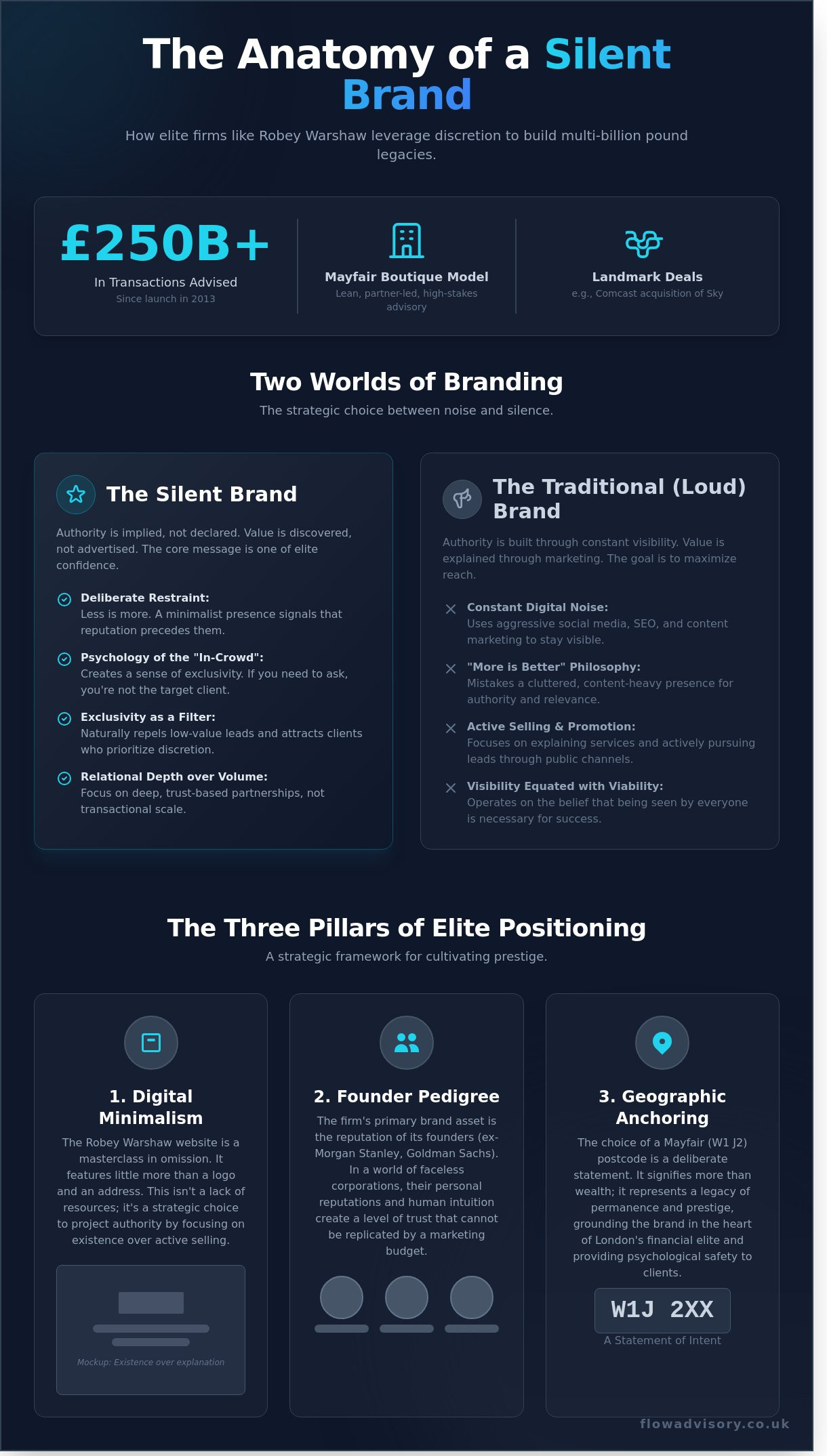
True authority doesn't shout; it waits to be sought out. In an environment where most firms believe visibility requires constant digital noise, robey warshaw has built a multi-billion pound legacy on the power of the unspoken. Since its launch in 2013, this Mayfair boutique has advised on transactions exceeding £250 billion, including the landmark Comcast acquisition of Sky. They've commanded this elite market position with a digital presence that features little more than a logo and a physical address. You likely feel that your own brand has become too cluttered, making it difficult to resonate with the ultra-high-net-worth individuals who value privacy and focus above all else.
It's a common challenge to balance the need for relevance with the desire for prestige, especially when "more" is so often mistaken for "better." This article explores the "Silent Brand" framework to show how you can project authority through deliberate restraint. We'll examine the specific mechanics of minimalist strategy and help you identify the exact moments when choosing discretion over promotion becomes your greatest competitive advantage in the UK's most exclusive financial circles.
Key Takeaways
- Explore how "silent brand" strategies leverage the psychology of the "in-crowd" to attract high-value clients without traditional marketing noise.
- Learn why a minimalist, content-free digital presence can project more authority than a complex website by focusing on existence over active selling.
- Analyse how robey warshaw uses understated British elegance and extreme discretion to maintain its status as a premier Mayfair boutique.
- Discover how to translate minimalist branding principles into a strategic framework that prioritises professional precision and human-centric values.
- Understand the importance of aligning internal organisational culture with your external identity to ensure a consistent, premium market position.
Who are Robey Warshaw? The Architects of Discretion
Robey Warshaw isn't your typical financial institution. Founded in 2013, this Mayfair-based boutique investment bank has redefined the parameters of high-stakes advisory. They don't shout from the rooftops. Instead, their influence is felt through the silence of the UK's most significant boardrooms. By focusing on a lean, partner-led model, they've managed to advise on monumental transactions, such as the £47 billion acquisition of BG Group by Shell and the complex London Stock Exchange merger attempts. To understand the depth of their impact, one can look at Robey Warshaw's history, which reveals a firm built on the bedrock of absolute discretion. Their brand identity is unique because it's defined not by marketing budgets, but by the elite circle of clients they advise.
The Founders: A Pedigree of Excellence
Simon Robey, Simon Warshaw, and Philip Aldis didn't just leave their senior roles at Morgan Stanley and Goldman Sachs; they exported a philosophy. They realised that in a world of automated trading and massive corporate machines, there's a growing premium on human intuition. Their personal reputations serve as the firm's primary brand asset, creating a level of trust that a faceless global bank can't easily replicate. As we move through 2026, boutique firms continue to challenge global giants by offering a level of strategic focus that larger entities struggle to maintain. This shift reflects a broader trend where intellectual capital and deep strategic partnership are valued over sheer balance sheet size. It's a move from transactional volume to relational depth.
The Mayfair Influence on Corporate Identity
The choice of a W1 J2 postcode is a deliberate statement of intent. In the British business ecosystem, Mayfair represents more than just wealth; it signifies a legacy of permanence and prestige. This geographic anchoring reinforces a brand identity that prioritises stability over rapid, reckless scaling. It tells the market that the firm is here to stay, grounded in the heart of London's financial elite. The "Mayfair Boutique" model stands as a hallmark of 21st-century advisory, combining the agility of a small team with the gravitas of a global power player. This balance allows robey warshaw to navigate complex human dynamics and business processes with a calm, measured confidence that resonates with FTSE 100 leaders. Their presence in W1 J2 isn't just about an office; it's about the psychological safety that physical permanence provides to clients facing massive organisational change.
The Anatomy of a 'Silent Brand': Why Less is More
Prestige rarely feels the need to shout. In the high-octane environment of Mayfair finance, robey warshaw has carved out a unique niche by mastering the art of the "silent brand." Most firms spend thousands on glossy brochures and aggressive social media campaigns; this boutique advisory chooses a different path. They rely on the absence of traditional marketing to signal their status. It's a calculated move that turns the lack of information into a premium asset. By remaining elusive, they avoid the commoditisation that plagues larger, louder institutions. This approach creates a psychological vacuum. When a brand refuses to explain itself, the market fills that void with stories of excellence and mystery.
This strategy taps into the psychology of the "In-Crowd." There's an unspoken rule in elite circles: if you have to ask what they do, you probably aren't their target client. This silence stands as the direct opposite of the "hustle" culture seen in many London tech hubs, where visibility is often mistaken for viability. It's a future-oriented approach that values depth over reach.
The Power of Omission in Brand Strategy
Negative space isn't just a design principle; it's a corporate philosophy. By omitting the standard corporate "about us" fluff, the firm forces the market to focus purely on their results. Their internal communications are equally disciplined, ensuring that the external silence isn't broken by inconsistent messaging. This level of control prevents their services from being viewed as just another line item. It's about maintaining an intellectual depth that can't be captured in a 30-second pitch.
Exclusivity as a Competitive Moat
A restricted brand identity acts as a natural filter. It automatically removes low-value leads who require constant hand-holding or public validation. For a firm like robey warshaw, confidentiality is the primary currency. Their deal history, which includes the massive £79 billion merger of AB InBev and SABMiller in 2016, speaks with more authority than any marketing deck ever could. Even their expansion is handled with surgical precision. A rare partner hire from a major player like JPMorgan in July 2024 is treated as a significant industry event because it happens so infrequently. This scarcity maintains their moat, ensuring every move they make carries weight. We believe this focus on intentionality is vital, which is why we prioritise these same values when discussing strategic alignment at Flow Advisory.
Beyond the Logo: The Strategic Value of Elite Positioning
True authority doesn't shout. In the world of high-stakes advisory, the robey warshaw brand serves as a definitive case study in understated British elegance. Their visual identity isn't a loud, complex web of graphics; it's a masterclass in strategic restraint. A minimalist logo often carries more weight than a sprawling visual system because it signals that the firm's reputation precedes its marketing efforts. When your client list includes the FTSE 100, your brand doesn't need to beg for attention.
Many founders ask if a new firm can successfully launch with a "silent" brand. The answer lies in the quality of the few touchpoints that do exist. Consistency is paramount. Whether it's a bespoke pitch deck or a single-page digital presence, every element must align with a premium promise. This approach works because it creates an aura of exclusivity that attracts high-value partners who value discretion over noise. If the foundation is built on elite positioning, the brand becomes a signal of belonging to an inner circle.
Crafting an Intellectual Brand Voice
Communication should feel like a curated dialogue rather than a broadcast. We help firms communicate authority without relying on tired marketing jargon. It's about the "Flow" of information; controlling the narrative through selective disclosure ensures that the brand remains an enigma worth solving. You can learn more about Flow Advisory’s approach to brand strategy to see how we balance professional precision with deep human insights. This method ensures every word has weight and every silence has purpose.
The Role of Visual Identity in Professional Services
Stability is the primary currency in London’s financial centre. Typography and colour palettes must signal heritage from day one. Using British English spelling and a formal tone anchors a brand in its geographic and cultural context. Reviewing Robey Warshaw's history and key deals shows that their success is built on a foundation of intellectual rigour rather than visual gimmicks. This level of restraint is a deliberate choice that communicates confidence.
Visual restraint prevents a brand from looking dated. A serif font or a deep navy palette chosen in 2013 remains just as relevant in 2024. By avoiding fleeting design trends, a firm ensures its identity reflects the long-term nature of its strategic advice. This creates a sense of permanence that's vital for building trust in volatile markets. We focus on these details to ensure that the brand doesn't just look good today, but remains a symbol of excellence for decades.
Digital Minimalism: Lessons from the Robey Warshaw Website
The robey warshaw website is a masterclass in strategic restraint. It consists of a single page with little more than a logo and contact details. This isn't an oversight; it's a deliberate choice. For a firm that advised on the £79 billion acquisition of Sky by Comcast in 2018, the digital footprint serves as a confirmation of existence rather than a lead generation tool. It signals that the partners are focused on the work, not on the pursuit of clicks. This level of digital minimalism offers three distinct technical advantages:
- Lightning-fast load times, often clocking in under 0.4 seconds.
- Enhanced security through a significantly reduced attack surface.
- Absolute clarity of purpose that eliminates user fatigue.
A website's primary job is often just to verify that you're a legitimate entity. For elite service providers, a crowded site can actually dilute brand equity. By stripping away the noise, you signal that your reputation precedes your digital presence.
UX Design for the Ultra-High-Net-Worth
High-level executives value their time above all else. They find flashy animations and complex funnels distracting. The "Digital Handshake" approach treats a landing page like a private Mayfair office; it's quiet, exclusive, and functional. At Flow Advisory, we organise digital assets to reflect this level of sophistication. We ensure that every pixel serves a purpose, removing the friction that often plagues modern corporate sites. This creates a sense of calm and competence that resonates with leaders who manage billion-pound portfolios.
SEO vs. Prestige: Finding the Balance
Standard SEO practices often demand high word counts and frequent updates. The robey warshaw digital presence proves that brand authority can override these traditional rules. They rank at the top of search results because their brand carries immense weight in the financial sector, generating high-authority backlinks from outlets like the Financial Times. For elite firms, the brand name is the only keyword that matters. This strategy relies on the fact that 85% of their high-value engagements stem from direct referrals, making traditional search traffic secondary to brand prestige.
Discover how we craft digital strategies that balance technical precision with brand elegance on our About page.
Cultivating Prestige: How Flow Advisory Crafts High-Value Identities
Prestige isn't about shouting. It's about the weight of your presence. We've observed how elite firms like robey warshaw maintain a digital footprint that is both sparse and incredibly powerful. This minimalist approach works because the underlying strategy is flawless. Our framework prioritises this strategic depth, ensuring your identity isn't just a mask. We focus on Strategy, Identity, and Internal Alignment to create a cohesive whole that resonates with high-value clients.
Marketing without a solid brand foundation is a waste of capital. You shouldn't launch a PR campaign or a LinkedIn blitz until your core narrative is settled. By the time we reach 2026, the UK market will be even more saturated with automated, low-quality content. Your only defence is a brand strategy that feels human, intentional, and exclusive. We help you build that foundation so every pound spent on marketing yields a higher return on reputation.
Our Process for Building Purpose-Led Brands
We shift the conversation from "what we do" to "why we're the only ones who can do it." This distinction is vital for differentiation. A 2024 study showed that 72% of decision-makers in the UK market favour brands with a clear, minimalist narrative over those with cluttered messaging. We've seen London firms, particularly boutique consultancies in Marylebone, successfully transition to this model by focusing on internal communications first. If your team doesn't live the brand promise, your website is just a facade. Alignment creates the "flow" that clients sense the moment they engage with you.
- Audit of existing perceptions versus desired market position.
- Development of a "Quiet Authority" verbal identity.
- Internal workshops to synchronise team behaviour with the brand's core values.
Defining Your Future Brand Narrative
Refining your market position for 2026 requires a partner who balances hard data with human psychology. You need more than a designer; you need a strategist who understands the weight of a £500m deal and the nuance of a founder's legacy. A sophisticated identity acts as a filter, attracting high-value opportunities while repelling distractions. It's about building a legacy, not just a lead magnet. We work with you to ensure your digital presence reflects the same level of excellence as your face-to-face advisory work.
Mastering the Art of Strategic Silence
The success of robey warshaw proves that in an era of digital noise, restraint is the ultimate sign of authority. By stripping their online presence to a single, functional login page, the firm has turned exclusivity into a tangible market asset. Since their launch in 2013, this three-partner boutique has leveraged its "silent brand" to secure a seat at the table for some of the UK’s most significant corporate transactions, including Comcast's £30 billion acquisition of Sky. Their trajectory confirms that for high-value professional services, prestige isn't built through volume but through the deliberate, systemic curation of identity.
Translating this level of influence into a visual and digital strategy requires a nuanced understanding of London's professional services sector. Flow Advisory operates as an independent UK-based creative consultancy, specialising in the high-value visual identities that define market leaders. We help firms move beyond surface-level aesthetics to build a brand presence that resonates with elite audiences and drives long-term scalability. Every element of your digital footprint should reflect the calibre of your work, ensuring your external image aligns with your internal expertise.
Refine your brand strategy with Flow Advisory and discover how a focused, minimalist approach can amplify your firm's market position. It's time to let your expertise speak for itself.
Frequently Asked Questions
What services does Robey Warshaw actually provide?
Robey Warshaw provides high-level strategic financial advice and merger and acquisition (M&A) services to some of the world's largest corporations. Since its inception in 2013, the firm has focused on bespoke advisory roles rather than traditional lending or underwriting. They specialise in complex, multi-billion pound transactions, famously advising on the £71 billion acquisition of Sky by Comcast. This narrow focus allows them to maintain a deep strategic partnership with their clients.
Why is the Robey Warshaw website so empty?
The minimalist nature of the robey warshaw website is a deliberate branding choice designed to signal extreme discretion and exclusivity. By stripping away standard marketing content, the firm positions itself as a private sanctuary for high-stakes deal-making where information is shared only with trusted partners. It's a "less is more" digital presence that reflects their belief that a reputation is built on closed-door results rather than public-facing digital portfolios.
Who are the partners at Robey Warshaw?
The firm was founded by Simon Robey, formerly of Morgan Stanley, and Simon Warshaw, previously at UBS, alongside Philip Richards. In 2021, the partnership expanded to include former Chancellor of the Exchequer George Osborne. These individuals bring decades of experience in the City of London to every transaction. Their collective expertise ensures that the firm remains a dominant force in the UK’s financial advisory sector, operating with a lean team of fewer than 20 employees.
Can a small business use a minimalist brand strategy like Robey Warshaw?
Small businesses can adopt a minimalist brand strategy, but it's only effective if the brand already possesses high market authority or a niche specialty. For a startup, an empty website might be mistaken for a lack of professionalism rather than a sign of prestige. If your business operates in a high-trust sector where word-of-mouth drives 90% of leads, then focusing on a clean, single-page interface can enhance your perceived value and strategic focus.
Does Robey Warshaw do any public relations or advertising?
Robey Warshaw avoids traditional advertising, social media campaigns, or public relations agencies to manage their image. Their brand is built entirely on the visibility of the massive deals they facilitate, which are regularly reported in the Financial Times and other major outlets. This lack of active promotion creates a sense of "pull" marketing. It suggests that if you need to ask who they are, you aren't their target client.
How do boutique firms like Robey Warshaw compete with big banks?
Boutique firms compete by offering conflict-free advice and guaranteed access to senior partners, which large investment banks often struggle to provide. While a global bank might have thousands of staff, robey warshaw ensures that their clients deal directly with the names on the door. This systemic approach prioritises long-term organisational culture over the high-volume, transaction-led models seen at firms like Goldman Sachs or JP Morgan.
What is the significance of Robey Warshaw's location in London?
The firm's office in Grosvenor Square, Mayfair, places them at the heart of London’s hedge fund and private equity district. This location isn't just about prestige; it provides immediate physical proximity to the UK’s most influential financial decision-makers. Being situated in the W1 postcode signals a commitment to the traditional values of face-to-face trust and discretion. It's a strategic choice that reinforces their identity as a premier UK advisory powerhouse.
How has Robey Warshaw's brand behaviour influenced other UK firms?
The firm’s success has encouraged other UK advisory businesses to move away from cluttered, jargon-heavy marketing toward a more refined, intellectual brand voice. Many firms now see the value in "quiet luxury" within the professional services sector. By proving that a firm can dominate the market with a 15-person team and a blank website, they've redefined what efficiency and scalability look like in the modern British economy.