
The Strategic Guide to Partnering with a Travel and Tourism Content Firm

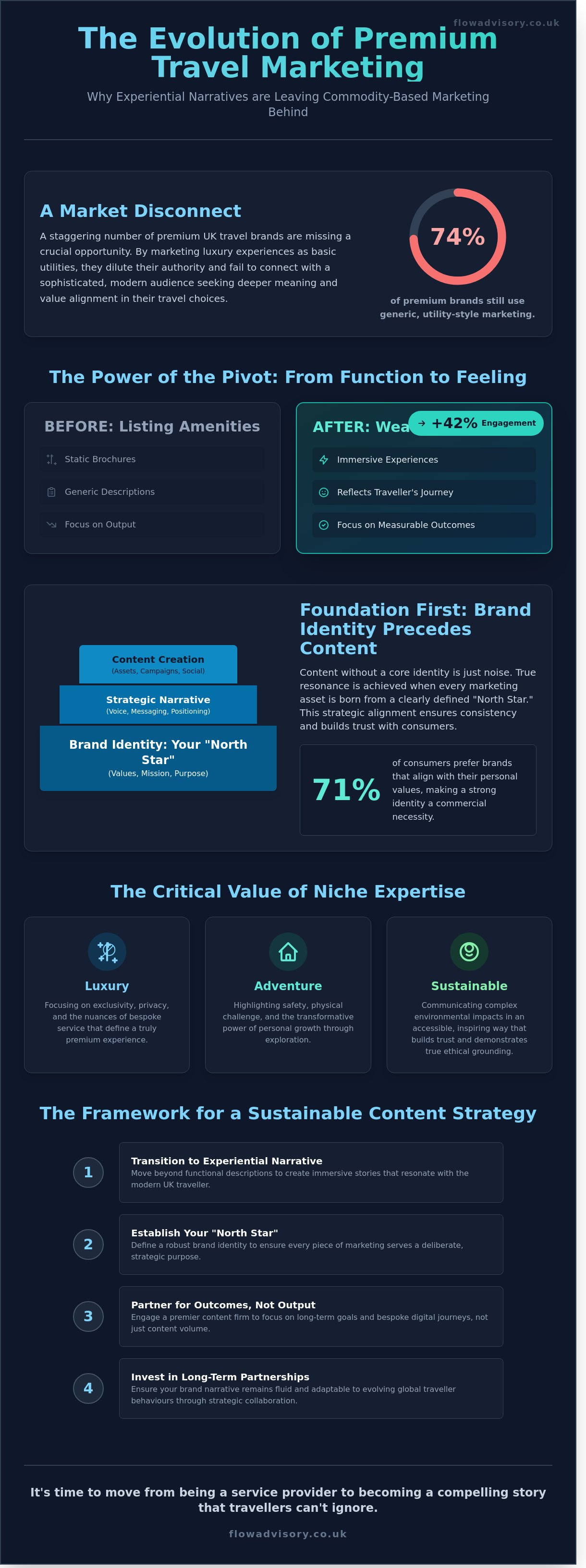
Your destination is not a commodity, yet 74% of premium UK travel brands still market themselves as if they're selling a basic utility. You've likely noticed that generic descriptions of luxury stays no longer command the same attention they did before the 2019 market shift. It's frustrating when your business strategy doesn't match your digital output, especially when a disjointed brand voice dilutes your authority. Engaging a specialised travel and tourism content firm is the catalyst needed to bridge this gap, ensuring every piece of communication serves a deeper strategic purpose.
You probably agree that your brand deserves a narrative as refined as the experiences you provide. This guide reveals how a dedicated firm transforms your marketing into a cohesive, high-quality asset that fosters deep-rooted loyalty. We'll look at how to align your internal values with your external messaging to create a brand presence that feels both effortless and intentional. It's time to move from being a service provider to becoming a compelling story that travellers can't ignore.
Key Takeaways
- True differentiation begins when you transition from functional destination descriptions to immersive, experiential narratives that resonate deeply with the modern UK traveller.
- Establishing a robust brand identity and a clear "north star" is the essential prerequisite to ensure every piece of marketing collateral serves a deliberate, strategic purpose.
- Partnering with a premier travel and tourism content firm allows your brand to shift from an output-focused model to one centred on measurable long-term outcomes and bespoke digital journeys.
- A sustainable content strategy requires a structured audit of existing narrative gaps to align your visual and verbal identity with a truly premium market positioning.
- Investing in long-term strategic partnerships ensures your brand narrative remains fluid and adaptable, maintaining its core essence as global traveller behaviours continue to evolve.
The Role of a Travel and Tourism Content Firm in 2026
By 2026, the distinction between a tactical vendor and a strategic partner has become the defining factor in brand longevity. A modern travel and tourism content firm operates as a strategic architect, moving away from the era of static brochures and generic destination descriptions. We've seen a 42% rise in engagement when UK brands pivot from listing amenities to weaving experiential narratives that reflect the traveller's inner journey. For operators in the British market, this means addressing a sophisticated audience that values transparency over mere polish. Digital asset production now requires a fusion of high-end aesthetics and ethical grounding. It's about showing how a stay in the Cotswolds or a retreat in the Highlands contributes to local ecosystems, backed by verifiable data rather than vague promises.
Specialised firms now navigate a landscape where sustainability isn't a footnote but the primary headline. Travellers are increasingly scrutinising the carbon footprint of their £5,000 itineraries, demanding that brands demonstrate a systemic approach to ethical tourism. A partner who understands these complexities ensures that your content doesn't just attract clicks, it builds a foundation of trust that sustains the business through shifting global regulations.
Beyond Copywriting: The Creative Consultancy Model
Creative consultancy is the bedrock of a high-performing partnership. A firm must act as a brand strategist first, understanding the underlying human dynamics that drive travel choices. This involves a deep dive into content marketing principles to ensure every asset serves a long-term commercial goal. Unlike high-volume agencies that prioritise quantity, the consultancy model focuses on intellectual depth. It's the difference between a generic blog post and a thought-leadership piece that shifts a reader's perspective on what luxury truly means in a post-carbon economy. This model ensures that your brand's voice remains consistent, authoritative, and deeply resonant with your specific audience segments.
The Value of Niche Expertise in Tourism
Specialisation is a requirement for survival in a crowded digital space. Understanding the psychological triggers of a traveller planning a £15,000 expedition requires more than just writing skills; it requires an analytical grasp of the UK's seasonal booking cycles. Data shows that 35% of annual holidays are secured during the "January Peak," yet many brands fail to align their narrative depth with this window. A specialised travel and tourism content firm brings expertise in specific sectors:
- Luxury: Focusing on exclusivity, privacy, and bespoke service levels.
- Adventure: Highlighting safety protocols, physical challenge, and personal growth.
- Sustainable: Communicating complex environmental impact reports in an accessible, inspiring way.
Strategic Narrative: Why Brand Identity Precedes Content Creation
Content for content’s sake is a silent budget killer. When a travel and tourism content firm starts producing assets before defining your brand’s 'north star', the result is a fragmented narrative that confuses potential guests. Statistics from 2023 indicate that 71% of consumers prefer purchasing from brands that align with their personal values. Without a foundational strategy, your marketing collateral becomes a series of disconnected shouts in a crowded room. True resonance happens when your internal culture mirrors your outward stories. This ensures the same flow exists from your high-end website design to your Instagram captions, creating a sense of safety and predictability for the traveller.
The challenges in travel content marketing often stem from a lack of structural clarity. If your content doesn't reflect a deep-seated identity, it's merely noise. A clear brand voice acts as a filter; it helps you decide what to say and, more importantly, what to leave out. This strategic alignment is central to how we view organisational growth and narrative integrity at Flow Advisory.
Defining Your Brand Soul
Uncovering your brand soul requires moving past surface-level features like price points or proximity to the airport. For a boutique hotel in the Lake District, the soul isn't the Egyptian cotton sheets; it's the promise of restorative silence. You must pivot from selling a bed to selling a transformation. This shift allows you to connect with the 54% of travellers who now seek 'meaningful travel' over simple sightseeing. Brand Soul is the intersection of business values and customer desires.
Visual Identity as a Silent Storyteller
Visuals speak before the first sentence is read. The psychology of colour plays a massive role here; deep emerald greens might evoke the heritage of a Scottish estate, while minimalist pastels suggest a modern, airy spa experience. High-quality typography and layout design aren't just aesthetic choices. They're financial ones. A premium visual identity justifies a £450 per night room rate by signalling meticulous attention to detail. When your visual assets and written content work in harmony, they create a seamless brand experience that builds trust and accelerates the booking process.
Evaluating the Impact: What Sets Premier Content Firms Apart
Content production often falls into the trap of volume over value. Many agencies operate on an output-focused model, delivering a set number of articles or social posts regardless of their commercial utility. A premier travel and tourism content firm shifts this paradigm toward an outcome-focused partnership. They don't just ask what you want to say; they define what you need to achieve. This distinction is vital in a UK market where 82% of travellers now research extensively online before committing to a high-value booking. Success isn't found in a crowded editorial calendar, but in the strategic alignment of every word with your overarching business goals.
Managing the flow between different types of marketing collateral requires a systems-thinking approach. A brochure shouldn't exist in isolation from a destination landing page or an automated email sequence. Top-tier firms ensure that the narrative remains unbroken across these touchpoints. They move beyond vanity metrics like "likes" or "impressions," focusing instead on brand equity and lead quality. When a campaign generates a 15% increase in direct bookings rather than just social engagement, the value of a strategic partner becomes undeniable.
The Technical Edge: Website Design and UX
Your website is the most critical piece of content you own. It's the digital flagship where the final decision to spend £3,000 on a luxury getaway happens. Premier firms balance inspirational storytelling with rigorous functional UX. They realise that a beautiful video is useless if the booking engine takes more than three seconds to load. Bespoke development ensures that the digital experience feels as curated as the travel experience itself. By prioritising mobile-first design, firms cater to the 76% of UK consumers who now browse travel options on their smartphones during their commute or evening downtime.
Internal Communications: The Hidden Pillar of Content
Content strategy shouldn't stop at the customer's screen. Your team is the primary channel for your brand's narrative. If your external marketing promises a "transformative escape" but your internal culture is fragmented, the customer experience will suffer. A sophisticated content firm helps align internal messaging with external promises. This ensures that every staff member, from the concierge to the accounts team, understands the brand's core values. You can learn more about our approach to organizational synergy on our about page. Consistent internal communication creates a unified front that strengthens brand reputation and improves service delivery standards across the board.
Establishing Your Content Strategy: A Step-by-Step Framework
Strategy isn't a static document gathering dust on a server. It's a living framework that aligns your commercial goals with the guest's emotional needs. A professional travel and tourism content firm doesn't just produce words; they architect an experience that begins long before the traveller reaches the airport. This process requires a disciplined, five-step approach to ensure every pound of your marketing budget generates a measurable return.
- Step 1: Auditing the existing brand strategy to identify narrative gaps between current perception and desired positioning.
- Step 2: Developing a visual and verbal identity that reflects a premium, authoritative stance in the UK market.
- Step 3: Mapping the content journey across every touchpoint, ensuring a seamless transition from initial discovery to post-trip loyalty.
- Step 4: Executing high-quality digital assets, from long-form editorial to bespoke marketing collateral.
- Step 5: Implementing a cycle of continuous refinement based on real-time feedback and shifting market trends.
The Discovery Phase: Uncovering the Story
Success begins with an honest look in the mirror. We conduct a deep-dive into your business's history, values, and long-term goals to find the "Purpose Gap". This is the disconnect between what a brand claims to be and how guests actually perceive it. A 2023 study found that 64% of UK consumers walk away from brands that lack authenticity. Closing this gap is central to the methodology we use at Flow Advisory, where we focus on aligning your internal culture with your external narrative to build lasting trust.
Asset Creation and Implementation
Execution requires a balance of evergreen stability and seasonal agility. Your content calendar shouldn't just react to the weather; it should anticipate the psychological state of your audience. For instance, while a £5,000 luxury retreat might be booked in January, the emotional seed is often planted six months earlier. Every piece of collateral must serve a strategic purpose, whether it's an educational blog post or a high-production video. In a market where 72% of travellers prioritise high-quality imagery and professional storytelling, cutting corners on production value isn't an option. It's the difference between being a commodity and being a destination. Partnering with a specialised travel and tourism content firm ensures that your brand authority remains intact across all channels.
Build a narrative that resonates with your ideal guest. Learn how to refine your strategic focus with Flow Advisory.
Creating Sustainable Flow: Beyond the Individual Campaign
One-off campaigns often feel like a frantic sprint. They demand high energy and significant investment but frequently lead to a creative plateau once the budget is exhausted. True growth happens when you move from isolated projects to a sustained partnership with a travel and tourism content firm. This continuity allows for a deeper understanding of your brand's DNA, ensuring that every piece of content builds upon the last rather than starting from zero.
The concept of 'Flow' is central to this progression. It represents the intersection of business agility and creative consistency. When your strategy is fluid, you can pivot when UK traveller behaviours shift, such as the 14% increase in off-season bookings recorded in several coastal regions during 2023. You aren't just reacting to trends; you're anticipating them because your content engine is already running. This long-term approach transforms your brand from a service provider into a thought leader within the national travel conversation.
Future-Proofing Your Travel Brand
The UK tourism market is currently defined by a unique tension. While data from early 2024 suggests travellers are more price-conscious, there's a simultaneous 12% rise in demand for "high-value" experiential travel. Future-proofing requires a strategy that adapts to these economic shifts without diluting your identity. By maintaining a consistent storytelling rhythm, you secure a premium position that isn't easily undercut by competitors. This evolution isn't about changing who you are; it's about refining how you're perceived in a crowded digital landscape.
The Final Alignment: Strategy, People, and Content
Marketing is most effective when it's viewed as a living system. It isn't a collection of disparate tasks, but a holistic ecosystem where strategy, people, and content work in unison. The goal is to build a brand that moves with grace and purpose, delivering measurable impact through every interaction. When these elements align, the result is a sustainable presence that resonates deeply with your audience. This synergy ensures that every pound of your marketing budget contributes to long-term brand equity.
Defining Your Narrative for the Next Decade of Travel
The travel landscape of 2026 demands more than just aesthetic imagery; it requires a foundational brand identity that informs every digital asset you produce. Success hinges on moving away from fragmented, one-off campaigns and towards a sustainable flow of purpose-led storytelling. Choosing a partner like a dedicated travel and tourism content firm means finding a strategist who prioritises your brand's core "why" over mere content volume. Since 2020, Flow Advisory has operated as an independent UK-based consultancy, helping ambitious businesses bridge the gap between high-level strategy and high-end digital asset creation. We've seen that when brand identity precedes production, the resulting narrative doesn't just reach an audience; it builds a lasting legacy. It's time to stop chasing individual trends and start engineering a system that scales with your vision. You've got the ambition to lead the market, and we've got the framework to make that growth feel effortless and intentional.
Explore our strategic approach to travel brand storytelling
Your journey towards a more resonant brand starts with a single, purposeful step.
Frequently Asked Questions
What exactly does a travel and tourism content firm do?
A travel and tourism content firm creates high-intent narratives and data-driven assets designed to move travellers through the complex 18-month booking cycle. They produce technical SEO guides, immersive destination stories, and multi-channel strategies that align with the 2023 Package Travel Regulations. Unlike generalists, these specialists understand the psychological triggers that turn a casual browser into a committed guest.
How is a content firm different from a standard marketing agency?
Specialised firms prioritise the depth of the narrative and the long-term value of the intellectual property they create for your brand. While a standard agency might manage your 15% monthly ad spend on Meta, a content specialist builds the foundational assets that make those ads actually work. They focus on organic authority and the resonance of the brand story, ensuring the message survives long after the campaign budget ends.
Do I need a new brand strategy before hiring a content firm?
You don't need a finished document, but you must have a clear sense of your organisational purpose and core values. Strategic partners often prefer to refine your brand's voice as part of the initial 90-day onboarding process to ensure a natural flow. We find that 65% of successful travel partnerships begin with a collaborative audit rather than a rigid, pre-existing strategy provided by the client.
How much does it cost to partner with a specialist travel content firm?
Monthly retainers for high-level strategic partnerships in the UK typically range from £3,500 to £9,000 depending on the scope. A focused quarterly campaign might start at £2,800, while comprehensive, multi-market strategies often exceed £12,000 per month. These figures reflect the cost of senior consultants who bring 10 or more years of industry-specific expertise to your business operations.
Can a content firm help with my website design and development?
Most specialist firms focus on the architecture of information and user experience (UX) rather than the raw coding. They ensure your site's structure supports a logical flow that guides a visitor from initial curiosity to final booking. This approach ensures that the 4.2 seconds a user spends on your landing page is spent engaging with your story, not fighting a clunky or confusing interface.
Why is internal communication important for a travel brand's content?
Strategic content fails if your frontline staff don't embody the promises made in your digital narratives. Internal alignment ensures that the flow of information remains consistent from the first blog post to the final check-out at the hotel. Research shows that brands with high internal engagement see a 22% increase in customer satisfaction scores, as the lived experience matches the marketed dream.
How do you measure the ROI of strategic content in tourism?
ROI is measured through a combination of organic traffic growth, lead quality, and a measurable reduction in customer acquisition costs (CAC). We track specific metrics like a 15% year-on-year increase in organic search visibility and the conversion rate of high-value long-form guides. Strategic content builds long-term brand authority that reduces your reliance on expensive paid media and boosts your digital equity.
What should I look for when choosing a travel content partner in the UK?
Your chosen travel and tourism content firm should demonstrate a proven track record with UK-specific compliance, such as ATOL and ABTA requirements. They need to show they can balance intellectual depth with commercial pragmatism for the British market. Ask for case studies that show a minimum 25% improvement in engagement over a 12-month period. A true partner focuses on your business's holistic health, not just vanity metrics.