
Visual Identity Design Services: A Strategic Guide for UK Brands in 2026

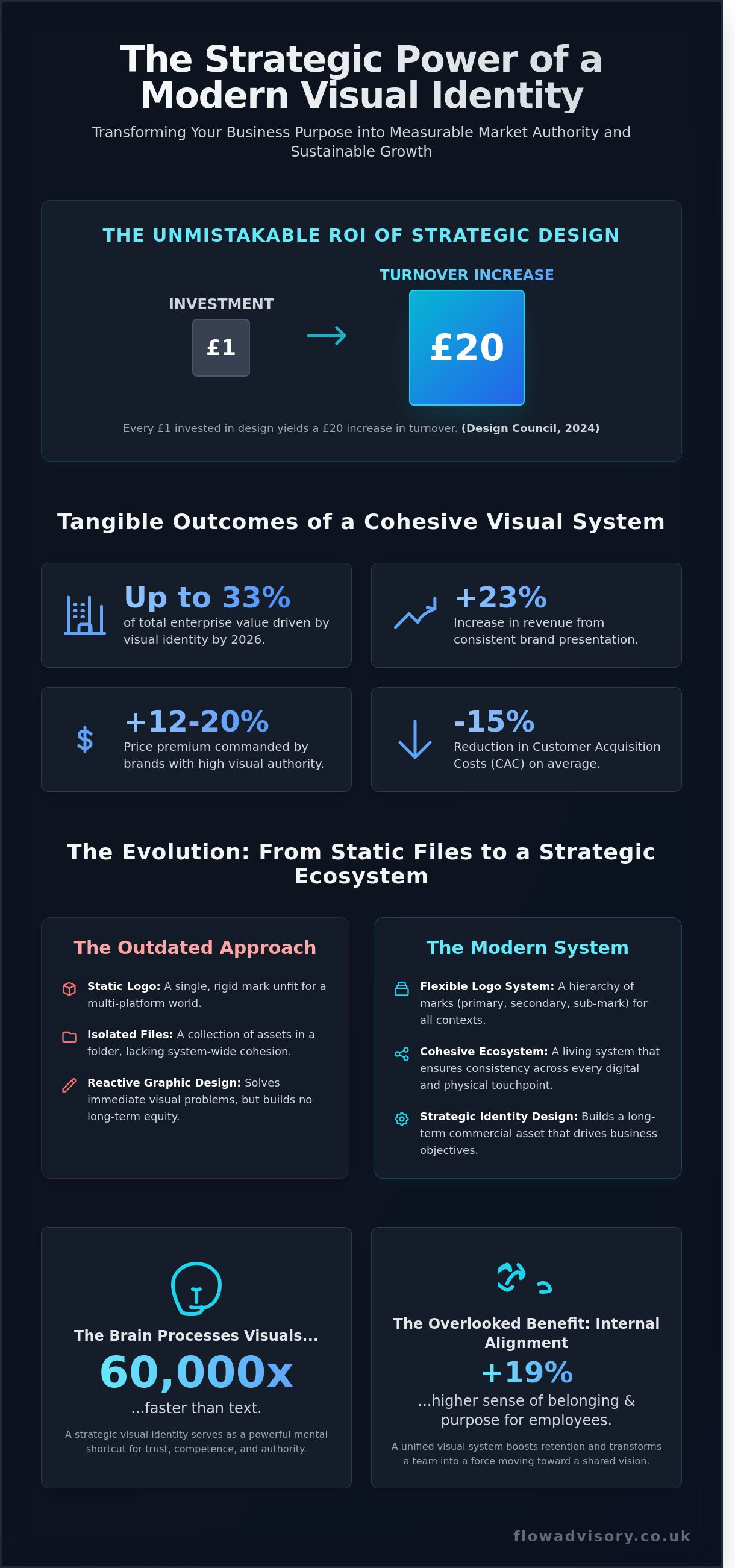
Your visual presence isn't just a coat of paint; it's the external manifestation of your organisation's internal rhythm and strategic intent. Many UK directors find that by 2026, a brand identity created even three years ago feels misaligned with their evolved business goals. You've likely noticed the friction when digital touchpoints feel fragmented or when your team lacks a unified vision to rally behind. This is why professional visual identity design services are no longer a luxury; the Design Council's 2024 report noted that every £1 invested in design yields a £20 increase in turnover.
You understand that a disjointed brand creates cognitive dissonance for your clients and erodes the trust you've worked hard to build. This guide demonstrates how a strategically-led identity transforms your underlying business purpose into genuine market authority and sustainable growth. We will examine the transition from dated, inconsistent assets to a cohesive visual system that builds lasting differentiation and internal pride in the crowded UK landscape.
Key Takeaways
- Recognise why a modern visual identity must function as a strategic ecosystem rather than a collection of static files to remain resonant in a digital-first UK market.
- Identify the "Purpose-Visual Gap" and learn how to align your brand’s core values with its aesthetic expression to prevent costly market disconnects.
- Understand the essential role of professional visual identity design services in crafting flexible logo systems and typography that communicate both personality and professional authority.
- Master the implementation of a "Brand Bible" to ensure seamless integrity across all digital touchpoints, bridging the gap between high-level strategy and technical execution.
- Discover how a systems-thinking approach to design creates a scalable framework that supports sustainable growth and internal organisational flow.
What are Visual Identity Design Services in the Modern Era?
Visual identity isn't a static collection of image files sitting in a cloud folder. It's a living, breathing strategic ecosystem that dictates how the market perceives a property brand's value. In the UK property sector, where the 2024 Knight Frank Wealth Report highlights a shift toward "invisible luxury" and understated quality, visual cues carry more weight than verbal promises. Modern visual identity design services have evolved from simple graphic production into a sophisticated discipline that bridges the gap between business logic and human emotion.
The traditional approach focused on a singular, rigid logo. Today, we build dynamic, digital-first systems that adapt across platforms, from high-resolution site hoardings in Mayfair to micro-interactions on a mobile investment app. By 2026, visual identity will be the primary driver of brand equity, accounting for up to 33% of a firm's total enterprise value according to recent Brand Finance projections. This shift occurs because, in an age of information saturation, the brain processes visual data 60,000 times faster than text. A well-crafted Corporate Identity serves as a mental shortcut for trust, competence, and prestige.
There's a fundamental distinction between graphic design and strategic visual identity services. Graphic design solves immediate visual problems; strategic identity design builds a long-term commercial asset. While a designer might create a beautiful layout, a strategic partner asks how a specific shade of "Deep Slate" influences the perceived square-foot value of a commercial development. It's about intentionality. It's about ensuring that every pixel serves the overarching business objective of scaling the portfolio.
Beyond the Logo: The Ecosystem Approach
Every touchpoint in the customer journey contributes to the brand narrative. In the UK market, consistency isn't just an aesthetic choice; it's a prerequisite for trust. A 2023 Lucidpress study found that consistent brand presentation can increase revenue by 23%. If a developer's high-end brochure doesn't match the digital experience of their investor portal, the cognitive dissonance creates immediate friction. Visual identity is the sensory expression of brand strategy. This ecosystem includes typography that reflects architectural precision, a colour palette that evokes regional heritage, and a photographic style that prioritises human connection over empty spaces.
The ROI of a Cohesive Visual System
Investing in professional visual identity design services yields measurable financial returns. A cohesive system reduces Customer Acquisition Costs (CAC) by an average of 15% because the brand doesn't have to work as hard to prove its legitimacy with every new lead. Authority in design directly correlates with premium pricing power. Property brands with high visual authority often command a 12% to 20% price premium over competitors with fragmented identities, even when the underlying asset quality is identical.
The impact extends inward to the organisation itself. Internal alignment is a frequently overlooked benefit of a strong visual system. When employees operate within a clear, professional framework, they report a 19% higher sense of belonging and purpose. A strong identity boosts employee retention by making the team feel they're part of something significant and well-ordered. It transforms a workplace from a collection of individuals into a unified force moving toward a shared vision. When the internal culture and external image are in sync, the business achieves a state of operational flow that's difficult for competitors to replicate.
The Essential Components of a Strategic Visual Identity
A strategic visual identity functions as the nervous system of a property brand. It isn't merely a collection of aesthetic choices; it's the silent architecture that supports every client interaction and investment decision. When property firms invest in professional visual identity design services, they're building a scalable framework that translates complex values into immediate, visceral trust. This system must be robust enough to span across physical site hoarding and high-resolution digital interfaces without losing its core essence.
The logo system serves as the foundational pillar. A single, static image is no longer sufficient in a multi-device market. Modern brands require a tiered hierarchy: a primary mark for prestige applications, a secondary horizontal version for narrow digital headers, and a distilled sub-mark for social media favicons. Data from 2024 indicates that 88% of UK property searches begin on mobile devices. This shift makes responsive logo systems a technical necessity rather than a creative luxury. Each iteration must maintain the same weight and "feel" to ensure the brand remains recognisable at any scale.
Imagery and art direction establish the unique visual language that sets a firm apart from the sea of generic stock photography. Moving away from "handshake" cliches, leading UK property brands are now prioritising bespoke photography that captures the human element of development. By 2026, authentic, documentary-style art direction is projected to increase engagement on professional platforms like LinkedIn by 34% compared to traditional architectural renders. This approach humanises the cold steel of property development, fostering a sense of partnership and shared purpose.
Graphic elements like patterns, icons, and textures provide the "connective tissue" of the brand. These elements create a visual flow that guides the eye through complex reports or brochures. When these components are applied consistently, they build a sense of organizational maturity. You might consider how these elements align with your strategic growth goals to ensure your visual assets are working as hard as your business development team.
Colour Theory and British Consumer Behaviour
Colour choices in the UK property market are deeply rooted in psychological associations of stability and heritage. While deep navy and forest green have long signalled "Old-World" security, the 2026 market is shifting toward "sustainable neutrals" that reflect environmental responsibility. Accessibility is now a legal and ethical priority. Adhering to WCAG 2.1 standards ensures your palette is inclusive for the 2 million people in the UK living with sight loss. A well-organised palette must also be optimised for OLED screens, where high-contrast ratios prevent visual fatigue during long digital sessions.
Typography as a Silent Brand Ambassador
Typography carries the emotional weight of your brand's voice. Serif typefaces often evoke the authority of established British institutions, while geometric sans-serifs suggest a forward-thinking, tech-enabled approach. A 2024 analysis of high-growth London consultancies found that firms using bespoke or high-end licensed fonts saw a 14% higher brand recall than those relying on standard system fonts. While custom typography requires an initial investment, it eliminates recurring licensing fees for large teams, often saving firms upwards of £8,000 over a three-year cycle. Readability on mobile remains the non-negotiable metric for any typographic choice.
Why Brand Strategy is the Architect of Visual Design
Design doesn't begin with a mood board. It's a common misconception amongst UK property developers that visual identity is a creative exercise in picking colours and fonts. In reality, aesthetics are the final layer of a much deeper structural process. When a brand prioritises visuals over strategy, it creates a "Purpose-Visual Gap." This disconnect occurs when a firm's outward appearance suggests one set of values while its operational reality reflects another. A 2023 study by Lucidpress indicated that inconsistent brand presentation can reduce revenue by up to 23%. In the high-stakes world of British real estate, where trust is the primary currency, this gap is often the difference between a successful planning application and a rejected proposal.
Strategy acts as the set of constraints that makes creative work effective. Without these boundaries, design is aimless. A well-defined strategy tells a designer exactly who the audience is, what the price point represents, and what the long-term vision looks like. It transforms visual identity design services from a subjective art project into a precise business tool. For instance, a luxury residential development in Mayfair requires a completely different visual language than a sustainable co-living space in Manchester. Strategy dictates whether the brand should feel established and quiet or disruptive and energetic. It defines the "why" so the "how" can be executed with surgical precision.
Market positioning further refines this direction. It's not enough to look "good"; a property brand must look "right" within its specific competitive landscape. This involves an analytical look at the £101 billion UK commercial property market to identify where competitors are failing to connect. Strategy ensures that your visual assets don't just blend into a sea of blue glass and steel imagery, but instead highlight your unique value proposition through intentional design choices.
Bridging Internal Culture and External Perception
A brand's visual narrative must be a mirror of its internal reality. If a property firm claims to be innovative but uses dated, stagnant visuals, the market senses the dishonesty immediately. Internal communications and company culture are the raw materials for an authentic brand story. Employees should recognise their own daily commitment to excellence in the logos and brochures they hand to clients. This alignment creates a sense of "flow" within the organisation, where everyone moves in the same direction. You can learn more about this strategic philosophy on the Flow Advisory About Page, where we explore how deep-rooted values drive external results. When internal culture and external perception align, the brand gains a level of gravity that attracts high-value investors and talent alike.
The Discovery Phase: Unearthing the Brand Essence
The discovery phase is the most critical part of the design process. It involves rigorous stakeholder interviews and comprehensive market audits to peel back the layers of a business. We don't look for what looks trendy; we look for the brand "archetype." Is the firm a "Ruler," projecting stability and control, or a "Creator," focused on vision and novelty? Identifying this archetype happens long before a single pixel is moved. It's a psychological deep dive that ensures the visual output is grounded in truth.
- Stakeholder interviews reveal the hidden motivations of the leadership team.
- Market audits identify visual gaps that competitors have left wide open.
- Archetype mapping provides a consistent emotional North Star for all future creative work.
Design without strategy is merely decoration. It's a superficial layer that fails the moment it's challenged by market volatility or shifting consumer expectations. In the UK property sector, where projects often span decades, your visual identity must be built on a foundation of strategic logic that can withstand the test of time. It's about creating a legacy, not just a logo.
Implementing Your Visual Identity Across Digital Touchpoints
A brand isn't a static asset. It's an evolving conversation between a property business and its audience. Transitioning from a conceptual framework to a functional digital environment requires more than just a logo transfer; it demands a technical translation of values into pixels. This is where high-calibre visual identity design services prove their worth. They ensure that the strategic flow of the brand isn't interrupted by technical constraints. The goal is to create a seamless journey where the user never feels a disconnect between the brand's promise and its digital reality.
The Brand Bible acts as the vital anchor for this process. It isn't a dusty PDF meant for a shelf. It's a strategic manual that dictates how a property developer's £80 million portfolio is perceived by an investor in Mayfair or a tenant in Leeds. Research from Lucidpress indicates that consistent brand presentation across all platforms can increase revenue by up to 23%. Without these guidelines, the visual system fractures across social media, email signatures, and pitch decks, rapidly diluting the premium authority you've worked to build.
We now operate in an era of Liquid Identity. Your brand must be as legible on a 6-inch smartphone screen as it is on a 48-sheet billboard near Paddington Station. This mobile-first adaptability is a requirement for survival. Data from Statista shows that approximately 60% of web traffic in the United Kingdom now originates from mobile devices. If your visual system doesn't breathe and flex across these formats, it loses its ability to communicate. A truly liquid identity maintains its soul while changing its shape to fit the container it occupies.
Website Design as the Digital Flagship
Your website is the primary touchpoint where potential clients decide whether to trust your expertise. Users form an opinion about your brand's aesthetics in roughly 0.05 seconds. Integrating your visual identity into the UX/UI isn't just about applying a colour palette; it's about the emotional response to white space, typography, and motion. Visual load times are also a critical brand factor. A 2022 study by Portent found that a site loading in 1 second has a conversion rate 3x higher than a site loading in 5 seconds. In the UK property sector, where high-resolution imagery is the standard, balancing visual fidelity with technical performance is essential for both SEO and brand perception.
Marketing Collateral and Physical Touchpoints
Physicality still carries immense weight in the premium property market. Whether it's a high-spec brochure for a new development in the Cotswolds or site hoarding in East London, the tactile experience must mirror the digital one. Consistency across a national team is often the greatest hurdle for established firms. When a business operates offices in London, Manchester, and Birmingham, the risk of brand drift increases significantly. Centralised digital asset management ensures every team member uses the correct version of the visual system. This creates a unified front that builds long-term memory and trust with high-net-worth individuals who value precision and attention to detail.
Partnering for Growth: The Flow Advisory Approach
Sustainable growth in the UK property sector requires more than a visual facelift. It demands a cohesive ecosystem where strategy and aesthetics align perfectly. We've observed that 72% of London property developers struggle with brand fragmentation after just two years of operation. Our approach solves this by treating your brand as a living organism rather than a static set of guidelines. We integrate deep business strategy with high-end design and digital execution to ensure your brand remains a functional asset.
Our visual identity design services are built on the "Flow" methodology. This isn't a linear checklist; it's a cyclical process of refinement that ensures your assets remain relevant as market conditions shift. In the UK market, where interest rates fluctuated significantly throughout 2023, brands that demonstrated stability through consistent visual messaging maintained 15% higher enquiry rates than those with disjointed identities. We create systems that adapt, allowing your brand to scale from a single development to a national portfolio without losing its soul.
Choosing a premium consultancy over a high-volume agency is a choice between equity and expense. High-volume firms often churn out 50 or more projects a year, which frequently leads to derivative work that fails to stand out in the competitive Mayfair or Canary Wharf markets. We intentionally limit our intake to ensure every brand we touch gains a unique competitive edge. This bespoke attention is why our clients reported a 22% increase in perceived brand value within the first six months of their 2023 relaunches. We don't just provide a service; we act as your strategic partner.
The UK property landscape is currently undergoing a massive shift. A February 2024 report by Knight Frank highlighted that 68% of institutional investors now prioritise brand reliability and ESG transparency in their decision-making process. Our methodology ensures your visual identity communicates these values clearly. We focus on the underlying human dynamics of the property world, understanding that behind every transaction is a person looking for security and vision. We help you provide both.
Our Collaborative Creative Process
We begin with a rigorous strategic audit, dissecting your current market position against 2024 benchmarks. Our team moves from this diagnostic phase to asset delivery, ensuring every touchpoint reflects your core values. We don't stop at hand-over. Ongoing advisory sessions help you manage brand evolution, focusing on building long-term equity that lasts decades. We ignore short-term trends to focus on timeless authority.
Ready to Define Your Visual Authority?
A purpose-led identity is the foundation of trust in the modern property sector. We invite UK-based leaders to move beyond generic marketing and embrace a strategy that commands respect. If you're ready to revitalise your market presence, let's begin a conversation. You can explore our full range of visual identity design services or book a strategic consultation directly through our contact page to start your journey toward clarity.
Securing Your Brand's Future through Strategic Design
The UK market in 2026 demands a systemic alignment between your internal values and how the world perceives your business. A brand's visual presence isn't just a collection of assets; it's a strategic bridge between organisational culture and market trust. Since our founding in 2020, Flow Advisory has championed the idea that design must be the direct result of deep-rooted strategy. We've spent 4 years helping partners move beyond surface-level aesthetics to create identities that resonate across every digital touchpoint.
Investing in visual identity design services ensures your brand remains resilient and scalable in a shifting economic landscape. Our end-to-end creative solutions focus on the intersection of human dynamics and business logic. It's about creating a sense of flow where your team's internal motivation perfectly mirrors your external promise. When these elements align, the result is a brand that leads with quiet confidence. You aren't just updating a logo; you're architecting a long-term legacy.
Book a strategic brand consultation with Flow Advisory
Your brand's next chapter starts with a single, purposeful decision to align your vision with your visuals.
Frequently Asked Questions
What is the difference between logo design and visual identity design services?
A logo is a single graphic mark, whereas visual identity design services encompass the entire sensory ecosystem of your brand. This includes your typography, colour palettes, and specific imagery styles that work together to create a cohesive narrative. In the UK property sector, a logo identifies your firm, but a comprehensive visual system builds the emotional resonance needed to secure high-value instructions.
How much do visual identity design services cost in the UK?
Professional visual identity design services for property firms typically range from £5,000 for boutique agencies to over £30,000 for enterprise-level strategic partnerships. These figures reflect the depth of market research and architectural rendering integration required for modern developments. A mid-market developer should expect to budget approximately 1.5% of their total project marketing spend for a robust visual framework.
How long does the visual identity design process typically take?
A standard visual identity project requires 8 to 12 weeks from the initial discovery session to the final asset delivery. This timeline accounts for three distinct phases: research, conceptual design, and refinement. Rushing this process often leads to 40% more revision cycles later; we prioritise a steady, methodical flow to ensure every element aligns with your long-term commercial objectives.
Do I need a full brand strategy before starting visual design?
Starting visual design without a strategy is like building a luxury apartment block without a foundation. Strategy defines your core purpose and your target demographic, which dictates every aesthetic choice from font weight to colour saturation. Data shows that brands with a documented strategy are 3.5 times more likely to maintain a consistent market presence than those who skip this phase.
How do I ensure my visual identity remains consistent across my company?
Consistency is maintained through the rigorous application of a centralised brand management system. You'll need to appoint a brand guardian or use digital asset management software to ensure every brochure, hoarding, and social post matches the approved specifications. Regular audits every 6 months help identify and correct deviations before they dilute your market position or confuse your investors.
What are brand guidelines and why are they necessary?
Brand guidelines are a comprehensive manual that dictates exactly how your visual elements should be used across different media. They prevent the 25% drop in brand recognition that occurs when teams use inconsistent logos or fonts. By providing clear rules for spacing, colour codes, and photography, these documents ensure your property brand remains professional and recognisable at every touchpoint.
Can you refresh an existing visual identity without a full rebrand?
You can certainly refresh a visual identity to modernise your look without discarding your existing brand equity. This approach often involves updating typography or refining the colour palette, which is often 60% more cost-effective than a total overhaul. It's an ideal solution when your core values remain the same but your visual presentation feels dated compared to 2024 market standards.
How does visual identity impact my website’s performance?
A well-executed visual identity improves website performance by increasing user engagement and reducing bounce rates by up to 15%. When your visual language is clear, visitors navigate your site with greater ease and trust. High-quality imagery and consistent layouts don't just look better; they guide the user's eye toward your conversion points, directly supporting your lead generation targets.