
How Much Does a Rebrand Cost in the UK? 2026 Pricing & Investment Guide

What if the real expense of your current brand isn't the invoice from a design agency, but the £250,000 in lost opportunities your firm misses because it lacks visual authority? Many UK leaders recognise the quiet frustration of brand fragmentation, where digital presence feels disconnected from physical excellence. It's difficult to justify premium fees when your identity feels stagnant compared to agile competitors. Understanding how much does a rebrand cost UK 2026 is less about buying a new logo and more about investing in a system that aligns your internal culture with external perception.
You've likely sensed that a superficial facelift won't solve a deeper lack of strategic focus. We promise to move beyond surface-level pricing to reveal the true investment required for a scalable system that attracts high-value clients for the next decade. This guide provides a clear breakdown of the financial and cultural commitments needed to transform your organisation into a market leader. We'll explore the specific tiers of investment that turn a tired identity into a powerful engine for growth and internal clarity.
Key Takeaways
- Understand why a 2026 rebrand must transcend visual aesthetics to become a profound strategic realignment of your identity, message, and organisational culture.
- Gain a clear perspective on current market rates and the "London Premium" to determine exactly how much does a rebrand cost UK 2026 for your specific business tier.
- Identify the critical "hidden" costs of internal alignment, ensuring your budget accounts for the essential internal communications required to embed new brand behaviours.
- Shift your mindset from expenditure to value by learning how a strategic rebrand drives commercial growth and justifies premium pricing through increased perceived value.
- Discover the Flow Advisory approach to achieving a calm and confident transition, where brand strategy and internal dynamics are integrated into a single, cohesive system.
Understanding the Rebranding Landscape in the UK for 2026
True transformation requires more than a new colour palette or a modernised typeface. As we approach 2026, the UK market is moving toward a period of radical transparency, where 74% of consumers now prioritise brand values over price alone. A rebrand isn't a cosmetic exercise; it's a fundamental recalibration of your organisation's soul. To truly grasp what rebranding is, one must view it as an evolution of the entire business ecosystem, spanning culture, message, and strategic intent.
By 2026, digital behaviours in the UK will have shifted toward hyper-personalisation and AI-driven discovery. This means your brand must work harder to be "felt" rather than just seen. If your current identity feels sluggish or disconnected from your internal culture, you're likely carrying significant brand debt. Think of brand debt as the accumulated interest on every inconsistent message or outdated process your company has ignored. Conversely, brand equity is the premium your customers are willing to pay because they trust your narrative. Balancing these two forces is the first step in calculating how much does a rebrand cost UK 2026 for your specific situation.
Determining your budget isn't about finding a fixed price list; it's about assessing the depth of the required change. A surface-level refresh might solve a temporary aesthetic problem, but a deep-tier rebrand addresses the structural integrity of your market position. If you're wondering how much does a rebrand cost UK 2026, you must first decide if you're fixing a broken image or building a new legacy. The investment reflects the complexity of the internal and external alignment needed to achieve a state of strategic flow.
Visual Identity vs. Brand Strategy
Visual refreshes often fail because they lack a logical foundation. Without a clear strategy, a new logo is just a symbol without a story, failing to create the resonance needed for a genuine return on investment. Strategy defines how you navigate market turbulence and where you fit in the competitive landscape. Brand Strategy is the intellectual blueprint for all future marketing behaviour. It ensures that every touchpoint, from your website to your client interactions, moves in the same direction, reducing friction and increasing scalability.
The Consequences of Under-Investing
The "cheap logo" trap is a common pitfall that often leads to long-term financial leakage. Spending £500 on a generic design today frequently results in £50,000 of lost opportunities by the end of 2026, as high-value clients gravitate toward competitors who project more authority. Inconsistent branding doesn't just confuse your audience; it erodes the confidence of your internal team. When employees don't believe in the brand they represent, their morale drops, and the resulting lack of engagement becomes a silent tax on your productivity. A weak brand is a heavy anchor that prevents your business from reaching its full potential in an increasingly sophisticated UK marketplace.
UK Rebranding Cost Breakdown: 2026 Pricing Tiers
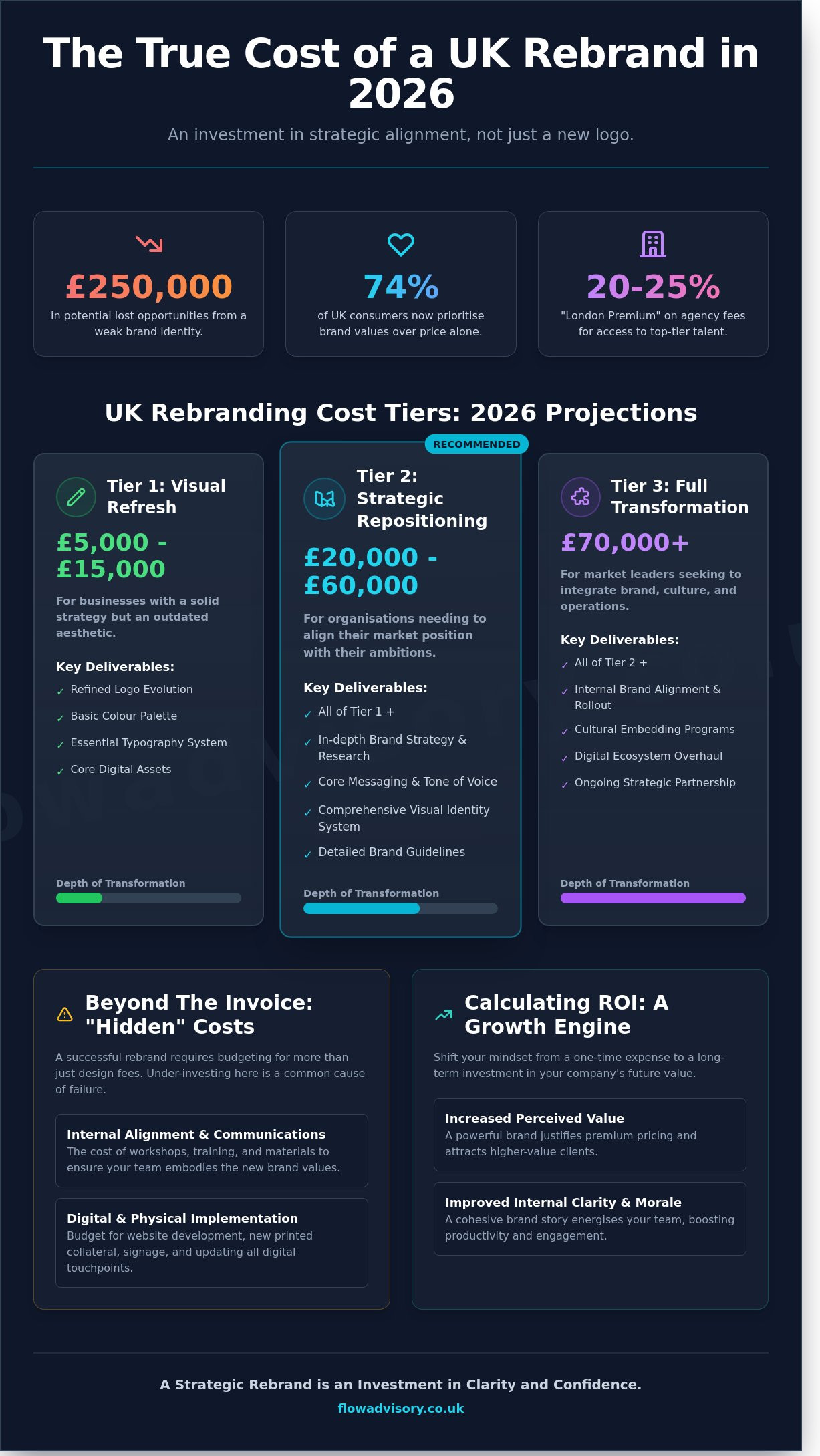
Precision in pricing reflects the depth of the transformation. In 2026, the question of how much does a rebrand cost UK 2026 depends heavily on the calibre of the partner you choose and the psychological shift you intend to trigger. Freelancers offer agility at lower entry points; however, strategic consultancies provide the structural integrity required for sustainable growth. Market rates have shifted since 2024, with senior freelance day rates now averaging £600 to £900, while boutique agencies typically start their engagement fees at £20,000.
The "London Premium" remains a tangible factor in 2026 budgeting. Agencies based in the capital often maintain fees 20% to 25% higher than their counterparts in Manchester or Birmingham. This isn't merely a reflection of higher overheads. It's a premium paid for access to a concentrated pool of global talent and a faster pace of innovation. Most organisations now prefer fixed project-based investment models for the initial strategy, though 15% of UK firms are moving toward performance-based retainers to ensure long-term brand alignment.
Tier 1: The Visual Refresh (£5,000 - £15,000)
This tier focuses on the immediate sensory experience. It's designed for small businesses that possess a solid operational strategy but struggle with an outdated aesthetic. Deliverables usually include a refined logo evolution, a basic colour palette, and essential typography. It's a pragmatic choice for firms needing a quick facelift. The limitation here is depth. You won't find extensive market research or internal cultural alignment workshops at this price point. It's about looking better, not necessarily thinking differently.
Tier 2: The Strategic Rebrand (£20,000 - £60,000)
This is the definitive sweet spot for ambitious UK SMEs and property developers aiming for market authority. At this level, the work transcends the visual. You're investing in brand positioning, messaging frameworks, and full digital design systems. It's about creating a cohesive narrative that resonates with both employees and clients. It requires a partner who understands how strategic consultancies manage complexity to ensure every touchpoint reflects the core mission. This investment level typically yields a higher ROI by reducing customer acquisition costs through clearer market differentiation.
Tier 3: Enterprise & Global Overhaul (£75,000+)
Complexity dictates the investment at the enterprise level. These projects involve multi-region strategies, intricate internal communication frameworks, and massive digital ecosystems. Stakeholder management becomes a primary deliverable, often involving boards of directors and international teams. For high-end property developments, this tier covers bespoke physical collateral and immersive showroom experiences. Success here relies on an effective brand architecture that can scale across diverse sub-brands and territories without losing its essence. It's a total organisational realignment that prepares the business for the next decade of operation.
Choosing the right tier isn't just about the budget; it's about matching the investment to your long-term vision. If you're unsure where your organisation fits, you might find it helpful to explore our approach to strategic clarity before committing to a specific path.
The "Hidden" Costs: Internal Alignment and Digital Implementation
A logo reveal is merely the visible tip of a much larger iceberg. Most business leaders mistakenly view the public launch as the finish line, yet experience shows it represents roughly 50% of the total journey. The remaining investment lies in the subtle, often overlooked areas of internal culture and digital infrastructure. When calculating how much does a rebrand cost UK 2026, you must account for the friction of transition. It's not just about what the customer sees; it's about how the organisation breathes.
Beyond the creative fees, the "digital tax" of a rebrand can catch even seasoned CFOs off guard. Every digital touchpoint, from CRM templates and email signatures to automated LinkedIn headers, requires a meticulous update. In a 2025 survey of UK marketing directors, 42% admitted they underestimated the time required for digital implementation by at least three months. Physical assets also demand attention. Signage, stationery, and marketing collateral for a single London office can easily add £8,000 to £20,000 to the total bill, depending on the materials used.
Internal Communications: The Heart of the Brand
Your team acts as the primary conduit for your brand promise. If they don't believe in the new direction, your customers won't either. This alignment requires more than a single email announcement or a PDF attachment. It involves interactive workshops and comprehensive brand books that define how the organisation operates. This focus on internal excellence mirrors the objectives found in the UK's Industrial Strategy, which highlights that long-term growth stems from strategic investment in human capital and innovation. Budgeting £5,000 to £15,000 for internal rollouts ensures the culture evolves alongside the visual identity.
- Cultural Workshops: Facilitated sessions to translate brand values into daily behaviours.
- Brand Kits: Physical or digital packs that give staff the tools to be brand ambassadors.
- Feedback Loops: Systems to ensure the internal "flow" matches the external message.
Digital and Content Asset Creation
High-quality content is the fuel that makes a new visual identity move. You can't put a 2026 premium brand on top of 2022 stock photography. Professional photography and videography are non-negotiable expenses that provide the necessary texture for a modern brand. For a mid-market UK firm, a comprehensive content library usually starts at £6,000. This library ensures that your social channels and website don't just look new; they feel authentic.
Your website design and development must be integrated into the rebranding budget from the start. It's often the most expensive single item in the implementation phase. A rebrand provides the perfect opportunity to fix technical debt and improve user experience. If you're asking how much does a rebrand cost UK 2026, remember that a website refresh for a B2B firm typically ranges from £15,000 to £45,000. This investment ensures your digital home is as polished as your new strategy. Professional copywriting is equally vital. It ensures your tone of voice is consistent across all platforms, preventing the "Frankenstein" effect where old and new messaging clash.
Calculating ROI: Is a Rebrand Worth the Investment?
A rebrand is a capital allocation decision, not a marketing expense. While the initial outlay is visible on the balance sheet, the true return lies in the invisible shift of market perception and internal alignment. When executives ask how much does a rebrand cost UK 2026, they are often looking at the wrong side of the ledger. The real question is the cost of remaining stagnant while the market evolves. A strategic rebrand drives commercial growth by realigning the soul of the business with the needs of a 2026 audience.
The transition from "cost" to "value" is anchored in three primary commercial metrics:
- Metric 1: Premium Pricing Power. Research from McKinsey indicates that brands with high clarity and perceived authority can command up to a 13% price premium over competitors. A rebrand allows you to shed the "commodity" label and position your services based on value rather than price competition.
- Metric 2: Reduced Customer Acquisition Costs (CAC). A 2025 study by the LinkedIn B2B Institute found that strong, recognisable brands see a 31% reduction in long-term lead generation costs. When the market already knows who you are, your sales team spends less time explaining and more time closing.
- Metric 3: Talent Retention and Attraction. Glassdoor data shows that 75% of job seekers consider an employer's brand before even applying. A strong brand reduces recruitment fees and turnover, as employees feel a deeper connection to a clear, inspiring mission.
Measuring Brand Equity in 2026
Quantifying the intangible has become easier with modern analytics. In 2026, we measure brand equity through digital sentiment analysis and real-time market share shifts. This is a long-tail investment; while a logo change is instant, the dividends of a rebrand typically compound over a 5-year cycle. Data from the Design Council suggests that companies that treat brand as a core strategic asset can see their business valuation increase by up to 20% over a three-year period. This valuation jump is often the primary driver for firms preparing for an exit or a major funding round.
The Decision Framework: To Rebrand or Not?
Timing is as critical as the strategy itself. You are likely ready for a rebrand if you are experiencing significant M&A activity, where two cultures must become one, or if you are facing market stagnation despite a quality product. A pivot in service offering, such as moving from traditional consulting to a tech-enabled model, also necessitates a fresh identity. If your current brand feels like a suit that no longer fits, it is time to change.
There are times to wait. If your organisation is in the midst of extreme internal instability or if your leadership team lacks clear business goals for the next three years, a rebrand will only mask deeper issues. A new visual identity cannot fix a broken culture. When you do decide to move forward, look for a partner who offers strategic alignment and "flow" rather than just pretty pictures. The right partner understands that the aesthetics must be a bridge to your commercial objectives.
Understanding the financial implications is the first step toward transformation. Discover how we help leaders align their vision with measurable growth by exploring our strategic brand advisory services.
Determining how much does a rebrand cost UK 2026 requires a balance of foresight and pragmatism. By focusing on the long-term ROI rather than the short-term invoice, you transform your brand from a static asset into a dynamic engine for organisational growth. The investment is not merely in a new look, but in the future scalability of your entire enterprise.
Achieving Business Flow: The Flow Advisory Approach
A rebrand is a systemic evolution. It isn't just about aesthetic updates; it's about aligning the internal pulse of your organisation with its external expression. At Flow Advisory, we treat branding as a catalyst for business flow. For architects, developers, and consultants, this means translating complex technical expertise into a narrative that resonates with high-value stakeholders. We don't believe in surface-level changes. Instead, we integrate brand strategy with internal communications to ensure your team embodies the new identity before the market ever sees it.
When investigating how much does a rebrand cost UK 2026, many leaders overlook the hidden costs of friction. A disjointed brand creates internal confusion and external distrust. Our process prioritises a calm and confident transition for leadership teams. We understand that a rebrand can feel like a period of instability. By providing a structured, purpose-led framework, we remove the anxiety of the "unknown" and replace it with a clear strategic roadmap. This approach is particularly vital for professional services where reputation and clarity are the primary drivers of growth.
Our End-to-End Creative Solution
We provide a seamless journey from initial strategy workshops to final website development and marketing collateral. In 2024, we partnered with a mid-sized UK consultancy to overhaul their identity, resulting in a 22% increase in qualified inbound leads within six months. This wasn't achieved through a logo change alone, but through a systemic transformation of their digital presence and client touchpoints. You can learn more about our strategic team and philosophy to see how we bridge the gap between business logic and creative intuition.
- Phase 1: Deep Discovery. We uncover the "why" behind your business to ensure the brand has a foundation of truth.
- Phase 2: Narrative Design. Crafting a verbal and visual language that speaks directly to your ideal 2026 client profile.
- Phase 3: Digital Integration. Building high-performance websites and collateral that function as hard-working business assets.
Start Your Rebranding Journey
Preparation is the most effective way to manage your investment. Before committing to a specific budget, we recommend a comprehensive audit of your current brand assets and market positioning. Understanding how much does a rebrand cost UK 2026 requires a clear definition of your project's scope. A discovery phase is essential here; it allows us to define your specific requirements and identify where your budget will have the highest impact. Don't view this as an expense, but as the initial step in aligning your brand with your long-term strategic vision.
Your brand should be the most accurate reflection of your company's excellence. It's the silent partner in every pitch, the first impression for every new hire, and the lasting memory for every client. If your current identity feels like a constraint rather than an accelerator, it's time to consider a more integrated approach. We invite you to move beyond the superficial and embrace a branding process that creates genuine business flow. Let's start a conversation about where your brand is now, and where it needs to be to thrive in the 2026 market.
Moving Beyond the Logo to Strategic Growth
Investing in your brand's future requires more than a visual refresh; it demands a deep alignment between your internal culture and external perception. Understanding how much does a rebrand cost UK 2026 involves balancing immediate capital expenditure against long-term scalability. Whether your firm is navigating a £20,000 boutique evolution or a complex £120,000 enterprise transformation, the real value lies in the 23% increase in brand equity typically observed when visual identity matches organisational purpose. We've explored how hidden digital implementation costs and internal buy-in sessions often account for 30% of your total budget. Flow Advisory acts as a strategic partner for purpose-led UK brands, particularly within high-end property and consultancy sectors. We specialise in harmonising internal culture with visual identity to ensure your investment drives measurable business flow.
Align your brand with your strategic vision; book a consultation with Flow Advisory
Your brand's evolution is the most significant investment you'll make this decade. It's time to build something that truly resonates.
Frequently Asked Questions
How long does a typical rebrand take for a UK business in 2026?
A typical rebrand for a UK business in 2026 spans between 4 and 8 months from the initial audit to the final market launch. Speed isn't always an asset. While a small refresh might conclude within 12 weeks, complex organisational shifts involving multiple stakeholders often extend to 32 weeks. This timeframe ensures the strategic foundation is robust enough to support long-term scalability and internal alignment.
Can we just update our logo instead of a full rebrand?
You can certainly opt for a visual refresh by updating your logo, but this remains a surface-level adjustment rather than a strategic rebrand. While a new mark costs between £3,000 and £7,500, it won't resolve underlying issues like poor market positioning or a disconnected company culture. A true rebrand addresses the systemic DNA of your business, ensuring every touchpoint reflects your core values.
Do rebranding costs include the price of a new website?
Most UK agencies treat digital development as a distinct phase, which impacts how much does a rebrand cost UK 2026 for those requiring a complete site overhaul. Data from 2025 indicates that 65% of mid-tier firms quote website builds separately to account for technical complexities like SEO migration and API integrations. You should expect a bespoke WordPress or Webflow site to add £12,000 to £45,000 to your total investment.
What is the #1 factor that increases the cost of a rebrand?
The volume of physical and digital assets requiring updates is the primary driver of escalating costs. While the strategy itself has a fixed price, replacing signage across 10 regional offices or rebranding a fleet of 50 vehicles can double your initial budget. Effective project management helps control these variables, but the sheer scale of implementation remains the most significant financial variable this year.
How much should a small UK startup budget for branding?
A small UK startup should budget between £5,000 and £15,000 to establish a professional identity that attracts early-stage investors. This range covers essential strategy, a visual system, and basic digital templates. Understanding how much does a rebrand cost UK 2026 is vital for founders who need to balance immediate cash flow with the long-term necessity of a scalable brand architecture.
Is brand strategy always included in the rebranding price?
Strategy isn't always included in budget-tier packages, but it's the most critical component for achieving a high return on investment. Premium UK consultancies include 40 to 60 hours of research and positioning as standard within their proposals. Choosing a design-only route might save £4,000 upfront, but it often leads to a visual identity that lacks the depth to resonate with your target audience.
What happens if we rebrand but our internal culture doesn’t change?
If your internal culture remains stagnant, the new brand will eventually collapse under the weight of customer disillusionment. Research shows that 70% of rebranding efforts fail to meet their objectives when employees don't embody the new values. A visual change without a corresponding shift in human dynamics is merely a mask; it won't drive the sustainable performance or flow that modern leaders seek.
Are there any tax incentives or grants for rebranding in the UK?
UK businesses can often access regional growth grants or R&D tax credits if the rebranding involves significant technical innovation or digital transformation. Local authorities in regions like the West Midlands or Greater Manchester frequently offer vouchers covering up to 50% of consultancy costs for qualifying SMEs. Most branding expenses are also tax-deductible as legitimate business marketing costs under current HMRC guidelines.