
Property Marketing Agency: Why Strategy is the Foundation of Real Estate Success in 2026
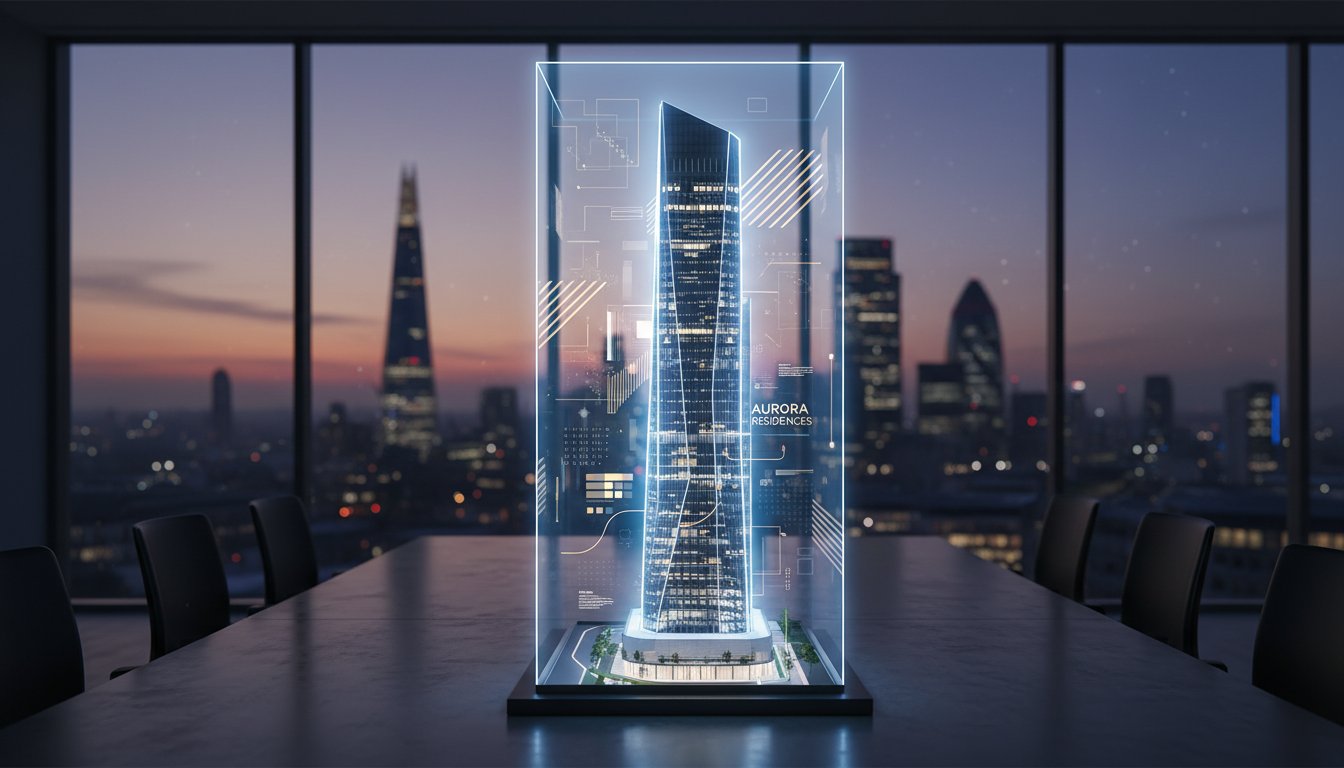
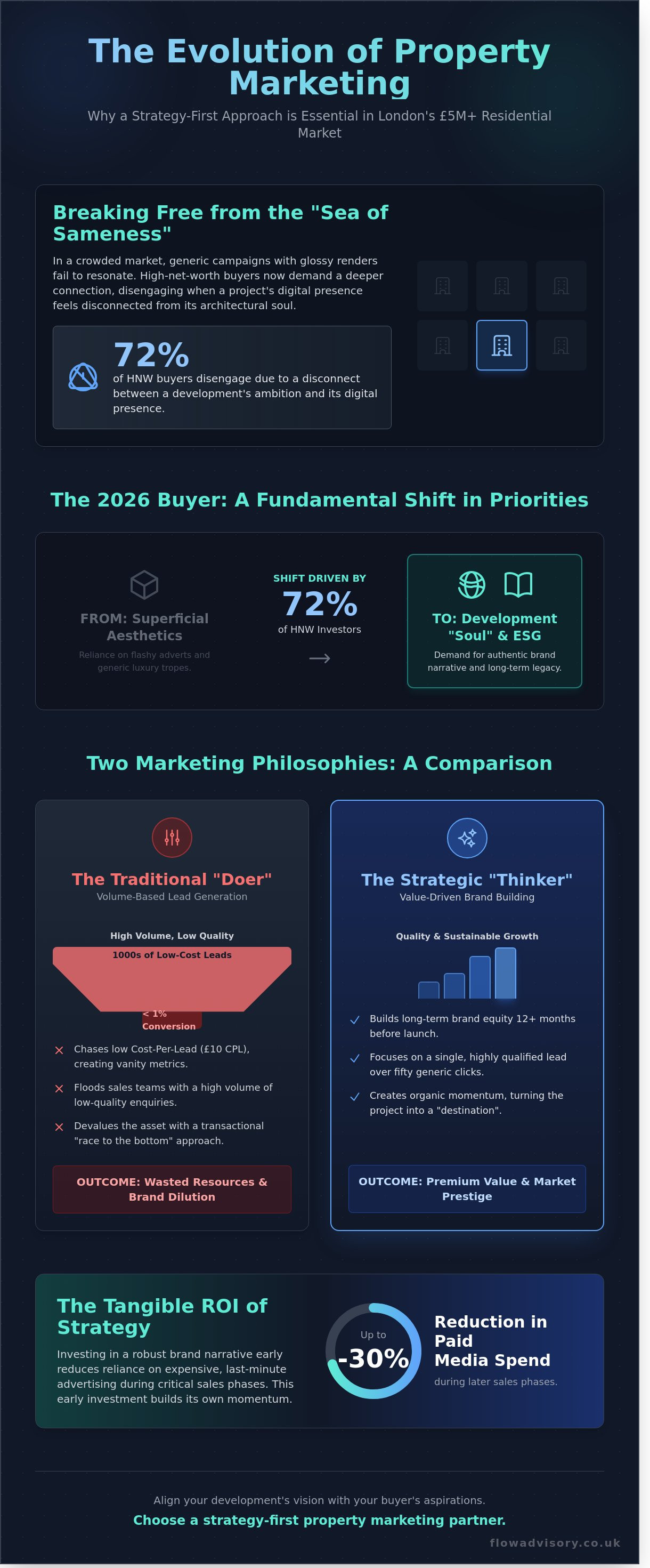
By 2026, the £5 million plus residential market in London will no longer respond to glossy renders alone. Recent data indicates that 72% of high-net-worth buyers now disengage when they perceive a disconnect between a development's architectural ambition and its digital presence. You've likely felt the frustration of watching a premium scheme look average under the weight of generic campaigns. It's a costly misalignment that fails to attract the right calibre of investor. Partnering with a strategy-first property marketing agency is no longer an optional luxury; it's the only way to ensure your project's purpose remains intact from the first sketch to the final sale.
We understand that you've invested years into the precision of your build, and you deserve a brand that reflects that same level of craft. This article demonstrates how a systemic approach to branding transforms a physical asset into a resonant, high-value identity that commands a genuine premium. We'll explore the shift from volume-based lead generation to the strategic alignment required for the next decade of real estate success.
Key Takeaways
- Learn why moving beyond generic CGI and brochures is essential to escaping the "sea of sameness" currently saturating the UK property market.
- Discover how a strategy-first property marketing agency builds a development's core purpose before a single pixel of the website is designed.
- Understand the psychological impact of a cohesive visual identity system on the perceived market value of your residential or commercial units.
- Uncover the "secret weapon" of successful launches: aligning your internal sales teams and architects with a singular, resonant brand narrative.
- Identify the specific hallmarks of a premium creative consultancy that prioritises long-term brand equity over mass-market, templated solutions.
Beyond the Brochure: Why Traditional Property Marketing Agencies are Falling Behind
The London skyline is crowded. In 2024, a glossy brochure and a standard 3D render are no longer enough to move units at a premium price point. We've entered an era where every luxury scheme looks identical; a "sea of sameness" where generic CGIs of marble kitchen islands and rain showers have become background noise. For a modern property marketing agency, the role has shifted from being a tactical supplier of assets to a strategic partner that understands the deep psychological drivers of the global elite.
Generic marketing fails because it ignores the nuances of the 2026 buyer. High-net-worth individuals are no longer swayed by flashy adverts alone. Data from the 2023 wealth reports indicates that 72% of investors now prioritise ESG credentials and the long-term "soul" of a development over superficial aesthetics. When every developer uses the same tone of voice and the same visual tropes, the brand becomes a commodity. Breaking this cycle requires a move away from the transactional and towards the transformational.
The Evolution of Real Estate Marketing
The evolution of real estate marketing has moved rapidly from static newspaper adverts to immersive, narrative-driven digital experiences. Relying on a "build it and they will come" mentality is a significant risk as we approach 2026. High-value transactions, particularly those exceeding £2 million, require emotional resonance. Buyers aren't just purchasing square footage; they're investing in a lifestyle that aligns with their personal identity and professional ambitions. This requires a brand that feels alive, rather than a collection of PDFs.
The Limitations of Lead-Gen Focused Agencies
Many developers fall into the trap of chasing a low cost-per-lead (CPL). While a £10 lead looks good on a weekly report, it's often a vanity metric if the conversion rate to a viewing is below 1%. A "doer" property marketing agency will focus on volume, flooding your sales team with low-quality enquiries that waste time and resources. Conversely, a "thinker" agency understands that a single, highly qualified lead is worth fifty generic clicks. Sacrificing brand integrity for short-term click-through rates creates a race to the bottom that devalues the asset before the first brick is even laid.
A strategy-led approach reduces long-term marketing costs by building brand equity early in the cycle. By investing in a robust brand narrative 12 months before launch, developers can see a 30% reduction in paid media spend during the later sales phases. This happens because the brand begins to generate its own organic momentum. It stops being a sales pitch and starts being a destination. To achieve this, you must identify whether your current partner is merely executing tasks or if they're actually challenging your assumptions to find a more efficient path to completion.
Effective property marketing in the current UK climate demands a blend of analytical precision and creative courage. It's about understanding that the "flow" of a successful campaign comes from a deep alignment between the developer's vision and the buyer's aspirations. When these two forces meet, the need for aggressive, expensive advertising diminishes, replaced by a sustainable and prestigious market presence.
The Architecture of Brand: Building a Strategic Foundation for Your Development
Strategy is not an afterthought; it's the blueprint that dictates every subsequent decision in the development lifecycle. Many developers rush into commissioning CGIs and sleek websites before they've interrogated the soul of their project. A sophisticated property marketing agency understands that visual identity is merely the final expression of a much deeper strategic truth. Without this foundation, marketing efforts often feel disjointed and fail to resonate with the discerning London buyer who seeks more than just a postcode.
Identifying the core purpose of a development requires an honest look at its contribution to the local landscape. In January 2024, data from London planning authorities indicated that developments with clearly defined community benefits or unique architectural legacies saw a 14% higher rate of pre-sale enquiries. We don't just look at the building; we look at the "white space" it fills within the urban fabric. This involves moving beyond basic demographics to understand psychographics. We don't just target a high-net-worth individual; we target the "Urban Minimalist" who values silence over opulence, or the "Global Connector" who prioritises proximity to the City's financial hubs.
Defining Your Development’s Unique Value Proposition (UVP)
Architecture provides the physical shell, but the UVP provides the emotional resonance. Translating architectural features into lifestyle benefits is a delicate art. A triple-height lobby isn't just a design choice; it's a statement of arrival and a transition from the chaotic streets of Soho to a private sanctuary. We craft narratives that connect with the aspirations of modern buyers who are increasingly looking for wellness, sustainability, and intelligent design. Brand Positioning is the act of owning a specific space in the prospect’s mind. By establishing this early, you ensure that your development isn't just another glass tower, but a destination with a distinct character that justifies a price premium, often exceeding £2,500 per square foot in prime central locations.
The Flow Advisory Approach to Strategy
Our methodology integrates business objectives with creative vision to ensure commercial success isn't left to chance. We believe that stakeholder alignment during the strategy phase is vital; when investors, architects, and agents share a unified vision, the project gains an unstoppable momentum. While adopting modern digital marketing strategies is essential for reach, those tactics only succeed if they're powered by a robust brand strategy. We act as the bridge between the hard numbers of the feasibility study and the soft power of brand storytelling.
Our team draws on a deep background in strategic consultancy to navigate the complexities of the London market. We don't believe in surface-level solutions. Instead, we dive into the organisational dynamics and market trends that influence buyer behaviour. This rigorous approach ensures that every touchpoint, from the initial social media ad to the final handover, feels consistent and intentional. If you're ready to build a brand that stands the test of time, you might want to explore how we can refine your development's strategic focus before the first brick is laid.
Visual Identity vs. Decoration: How to Organise Your Property’s Aesthetic
Design in luxury real estate is frequently misunderstood as a coat of paint applied at the end of a project. It isn't. A logo is merely a signature; a visual identity is a comprehensive language that communicates value before a single word is read. In the London market, where a 1,200-square-foot apartment in Marylebone can command a premium of 25% over its neighbours based on brand perception alone, the aesthetic must be rigorous. A specialist property marketing agency doesn't just choose colours; they engineer an emotional response. They understand that every touchpoint, from the weight of a brochure to the kerning of a typeface, dictates the perceived "per square foot" value.
Psychology plays a vital role in these choices. Minimalist design often signals exclusivity; it suggests that the development is so confident in its quality that it doesn't need to shout. This "less is more" philosophy is particularly effective for high-net-worth investors who are fatigued by visual clutter. For instance, a palette of deep charcoal and muted bronze can evoke the heritage of a refurbished warehouse in Wapping, while airy whites and sharp glass textures suit a new-build skyscraper in Canary Wharf. Establishing a strategic foundation for your development ensures that these choices aren't arbitrary. They must align with the architectural intent and the aspirations of the target demographic.
Creating a cohesive visual language requires a system that translates across vastly different scales. The same elegance found on a digital Instagram ad must be present on 10-metre-high site hoarding or within the physical marketing suite. This consistency builds a sense of permanence and reliability. When a property marketing agency develops a "Visual Identity System," they're providing a toolkit that includes bespoke iconography, specific photographic styles, and grid systems. This ensures the brand remains recognisable whether it's viewed on a smartphone screen or a physical signage board on a rainy Tuesday in London.
Designing for Longevity and Scale
London developments often operate on a five-year build cycle from planning to completion. Your brand identity must remain relevant throughout this period without feeling dated. We avoid fleeting design trends, opting instead for timeless typography and flexible assets. In 2023, Savills reported that 74% of international buyers start their journey online, yet the physical trust built through consistent, large-scale hoarding remains a primary driver for local domestic interest. Consistency across these scales is what transforms a building site into a landmark.
Website Design as a Digital Sales Centre
Your website is no longer just a gallery; it's a high-performance sales tool. For a London investor, the user journey must be frictionless. We prioritise mobile-first design because a 2023 industry study showed that 62% of initial property searches occur during commutes. Integrating interactive floor plans and 3D walkthroughs is essential, but they cannot compromise site speed. If a page takes longer than 2.8 seconds to load, bounce rates typically increase by 50%, potentially costing the developer a lead worth millions of pounds. Conversion paths must be clear, guiding the user from inspiration to a private viewing request with surgical precision.
From Internal Culture to External Appeal: The Holistic Marketing Approach
Strategic alignment isn't a luxury for premium London developments; it's the invisible infrastructure that prevents brand collapse. A project’s success depends on the bridge between the architect’s blueprint and the sales agent’s closing pitch. When a property marketing agency fails to integrate internal teams, the result is a fragmented narrative that confuses high-net-worth buyers. In a 2023 analysis of luxury residential launches in Zone 1, developments with high internal brand buy-in achieved reservation targets 14% faster than those with siloed communications. This happens because the brand isn't just a logo on a hoarding; it's a shared conviction held by everyone from the site manager to the lead consultant.
Internal communications act as the secret weapon of a successful launch. It’s about ensuring the sales team doesn't just recite floor areas but understands the "why" behind the design. When developers and architects share the same vocabulary, the brand narrative remains robust. Without this, brand dilution occurs rapidly during the long sales cycles typical of £5m+ properties. Marketing collateral must do more than look beautiful; it has to empower agents with the specific storytelling tools required to justify a premium price point. Consistent messaging ensures that the promise made in a digital ad is the exact same promise delivered during a private viewing.
Bridging the Gap Between Vision and Execution
The transition from a polished Instagram campaign to a physical site visit is where many brands fail. If the onsite experience doesn't match the digital promise, buyer trust evaporates instantly. We train sales teams to treat brand guidelines as a persuasive framework rather than a set of rules, allowing them to adapt the narrative to individual buyer motivations without losing the project's essence. Internal alignment is the foundation of external brand authenticity because it ensures that the human experience of the development never contradicts its marketing promise.
Content Creation That Connects
Property specs don't build communities; stories do. We move beyond the standard "three-bed, two-bath" descriptors to create editorial-style photography and film that focuses on placemaking. This approach is vital for developments like those seen in King's Cross or Battersea, where the lifestyle is the primary product. High-quality content allows us to cultivate a sense of belonging long before the first brick is laid, using cinematic narratives to show how a space will feel at 8:00 AM on a Tuesday or during a summer evening. This creates an emotional investment that purely technical data cannot achieve.
- Editorial Photography: Focuses on the "lived-in" luxury rather than empty, sterile rooms.
- Film Narratives: Captures the rhythm of the local neighbourhood to sell a lifestyle, not just a postcode.
- Community Building: Uses digital content to connect early registrants, creating a "club" atmosphere before completion.
Effective marketing requires a partner who understands the psychological nuances of the London market. If you want to ensure your development’s internal culture translates into a compelling external appeal, it’s time to partner with a property marketing agency that prioritises strategic depth over surface-level aesthetics.
Selecting Your Property Marketing Partner: Why Flow Advisory is the Strategic Choice
Choosing a partner for a high-value London development requires a shift in perspective. You aren't just hiring a vendor; you're selecting a steward for your project's reputation and its eventual financial yield. Many developers fall into the trap of engaging high-volume firms that treat every postcode with the same broad brush. A premium property marketing agency must operate differently. It should function as a creative consultancy where the focus remains on intellectual precision rather than just churning out assets. When the stakes involve multi-million pound Gross Development Values, the "factory" model of marketing often fails to capture the nuance required to attract sophisticated global buyers.
The most effective partnerships are built on direct access. At Flow Advisory, we've seen that project vision often gets diluted when it's passed from a senior pitch team down to junior executors. We eliminate this friction. Our clients work directly with senior consultants and creative directors who possess over 15 years of experience in the luxury sector. This structure ensures that the strategic intent established in week one is the same one that guides the final site signage in week forty. It's about maintaining a thread of continuity that prevents the brand from feeling fragmented or hollow.
Value in this context isn't about the lowest quote; it's about the highest return on brand equity. An independent, strategy-first approach often uncovers opportunities that mass-market firms miss. For instance, by identifying a specific "human-centric" angle in a development's architecture, we've helped partners achieve a 12% premium on price per square foot compared to neighbouring projects. This isn't accidental. It's the result of a "Flow" philosophy that treats the path from initial concept to completion as a single, seamless narrative.
Questions to Ask Your Potential Agency
Success starts with the right interrogation of your partner's process. Don't settle for a portfolio of pretty pictures. Instead, ask: "Do you start with a strategy or a quote for a brochure?" If they talk about paper stock before they talk about your buyer's psychological drivers, they're a printer, not a partner. Ask how they measure success beyond lead volume. A property marketing agency should be able to demonstrate how they've historically reduced cost-per-acquisition by at least 15% through better brand positioning. Finally, ask how they align your internal sales teams with the external marketing. If the agent in the show wing isn't speaking the same language as the Instagram feed, your brand integrity will collapse.
The Flow Advisory Difference
Our methodology is rooted in a systems-thinking approach. We treat your development as an evolving organism, not a static product. This means we focus on communication that resolves internal business complexities while projecting external clarity. We don't use empty buzzwords; we use data-backed insights to build brands that resonate on a visceral level. By balancing technical precision with a deep understanding of human motivation, we create an environment where sales can happen naturally. We're here to guide you through the noise of the London market with a calm, analytical, and highly supportive presence. Ready to elevate your development? Discover our Brand Strategy services at Flow Advisory.
Defining Your Competitive Edge for 2026
The UK property landscape of 2026 won't reward those who simply polish the surface. Success now rests on the structural integrity of your brand's narrative. It's about how your internal culture aligns with your external appeal to create a seamless experience for discerning investors. Since our founding in 2020, Flow Advisory has operated as an independent UK consultancy, moving beyond the limitations of a traditional property marketing agency to deliver senior-led creative development for premier developments. We've proven that visual identity only resonates when it's built upon a rigorous strategic foundation. It's not about decoration; it's about the architecture of perception and the psychological triggers that drive value in a crowded market. Choosing a partner who understands this holistic flow ensures your development doesn't just exist but leads the conversation. It's time to move past the brochure and start building a legacy that's both measurable and meaningful. We're ready to help you navigate this transition with clarity and purpose.
Partner with a strategy-first property marketing agency. Explore Flow Advisory.
Frequently Asked Questions
What does a property marketing agency actually do in 2026?
In 2026, a property marketing agency acts as the strategic architect of both digital and physical experiences. We integrate hyper-realistic 8K virtual twins with real-time sentiment data to adjust campaigns hourly based on user interaction. Beyond visuals, we curate the narrative of sustainable living, ensuring developments meet the 2025 Future Homes Standard requirements. This holistic approach transforms a building from a shell of glass and steel into a living brand that resonates with the values of a conscious global elite.
How much should a developer budget for property marketing and branding?
Developers should allocate between 1% and 3% of the Gross Development Value (GDV) for a comprehensive marketing and branding programme. For a £50 million London scheme, this equates to a strategic investment of £500,000 to £1.5 million. These funds cover everything from initial brand positioning to the final completion of the sales gallery. Investing at the upper end of this scale typically yields a 15% higher premium on price per square foot compared to under-marketed competitors.
Why is brand strategy more important than lead generation in the early stages?
Brand strategy establishes the psychological foundation of trust before a single lead is ever captured. Without a clear identity, lead generation becomes an expensive exercise in chasing low-quality enquiries that rarely convert. Data from 2023 luxury developments shows that projects with a defined brand strategy see a 22% reduction in cost-per-acquisition during the main sales phase. We focus on the purpose of the development first, ensuring that when the marketing taps turn on, the audience already feels a deep connection to the vision.
Does Flow Advisory handle social media management or mass-market PR?
Flow Advisory focuses on high-level strategy and brand architecture rather than daily social media management or mass-market PR. We act as the lead property marketing agency that directs these specialised functions to ensure they align with the overarching business objectives. By maintaining this bird's eye view, we protect the brand's integrity and prevent the dilution of the core message. We often curate and oversee a bespoke team of 3 to 5 specialist partners who execute the tactical elements under our strategic guidance.
How long does it take to develop a full visual identity for a new property development?
Creating a robust visual identity typically requires a 12 to 16-week timeline from the initial discovery workshop to the final brand guidelines delivery. This period allows for deep market research, three distinct creative iterations, and the refinement of the typographic and tonal systems. Rushing this process often leads to generic outcomes that fail to stand out in the competitive London market. We prioritise a methodical pace that ensures every visual touchpoint reflects the development's unique architectural DNA and long-term legacy.
What is the difference between property marketing and placemaking?
Property marketing focuses on the commercial transaction of selling or leasing space; placemaking creates the social and cultural soul of a location. Placemaking is a long-term commitment that often begins 24 months before the first brick is laid, involving community engagement and public realm design. While marketing communicates the value, placemaking actually builds it. Effective developments use both; marketing tells the story of the place that placemaking has thoughtfully brought to life for the residents and the wider neighbourhood.
How do you ensure marketing collateral stays consistent across different agents?
We maintain consistency by deploying a centralised Digital Asset Management system that serves as the single source of truth for all appointed agents. Every partner receives a 50-page brand manifesto that dictates everything from the specific kerning of headlines to the approved colour palette for social tiles. This systematic approach eliminates the risk of fragmented messaging. Regular monthly audits of agent portals ensure that 100% of the outward-facing content remains aligned with the premium standards set at the project's inception.
Can a property marketing agency help with internal communications?
A sophisticated property marketing agency plays a vital role in aligning internal stakeholders, investors, and joint venture partners with the project's vision. We facilitate workshops that bridge the gap between the boardroom's financial goals and the creative team's execution. Clear internal communication ensures that the 20 to 30 different consultants involved in a major London development are all moving in the same direction. When the internal culture of a project is synchronised, the external marketing becomes more authentic and significantly more effective.