
Anthrology: A Strategic Framework for Internal Communications and Brand Culture

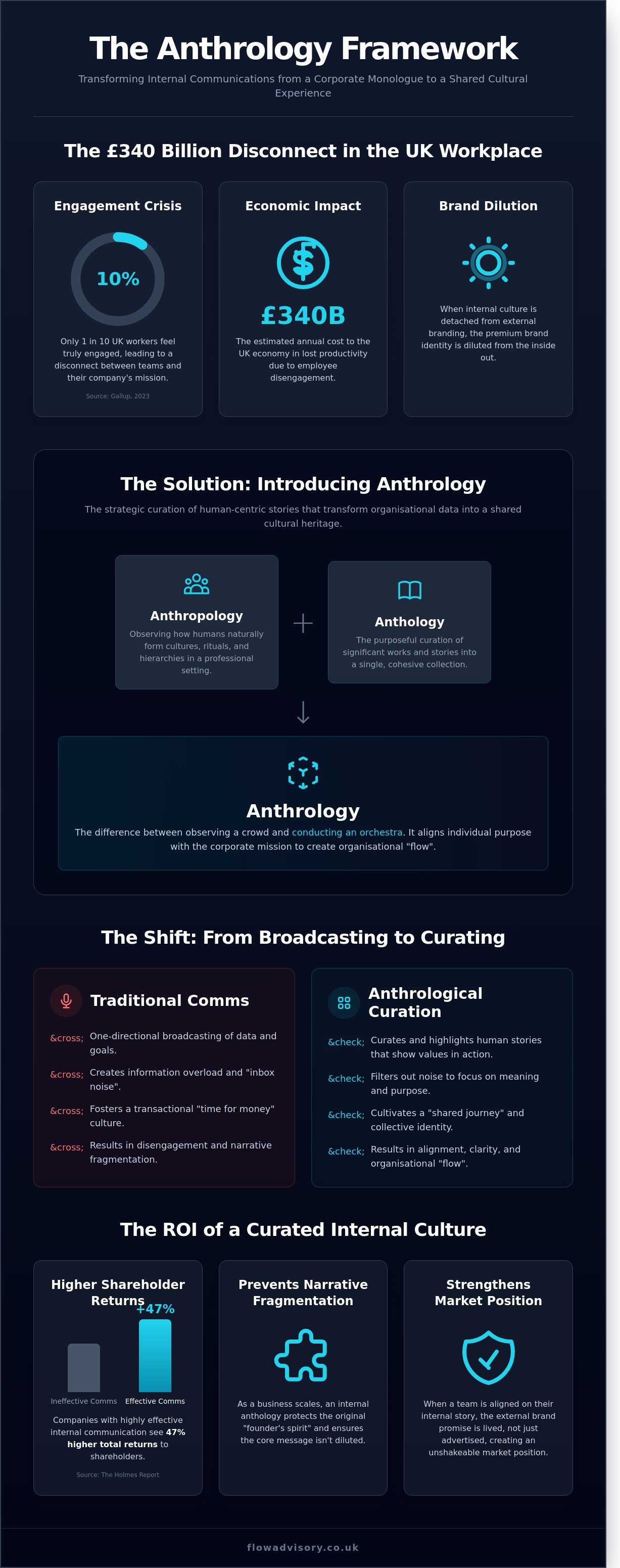
A 2023 Gallup report found that only 10% of the UK workforce feels truly engaged at work, a figure that highlights the urgent need for a more robust anthrology within our corporate structures. You've likely felt that friction where strategic goals remain trapped in slide decks while the actual team culture drifts in a different direction. It's exhausting to see a premium brand identity diluted because the internal narrative feels dry, corporate, or entirely detached from the daily reality of the office.
We've developed a framework to bridge this divide by aligning your team's behaviour with your brand's highest aspirations. By adopting an 'anthrological' approach to your internal communications, you'll learn how to protect your visual identity and cultivate an environment where organisational flow becomes a measurable asset. We're going to examine the specific steps needed to transform your internal messaging into a cohesive narrative that improves retention and finally brings your leadership's vision to life.
Key Takeaways
- Understand how the concept of anthrology bridges the gap between behavioural science and curated storytelling to transform internal messaging into a shared cultural experience.
- Gain insights into the unique 'tribal' dynamics of the modern UK office to ensure your communication resonates with local cultural nuances and social behaviours.
- Discover why a consistent visual identity and a library of value-driven internal stories are essential for protecting your brand’s integrity from the inside out.
- Learn how to transition from fragmented, chaotic communication to a structured framework that prioritises the right digital channels for your team’s specific centre.
- Explore the strategic benefits of an external perspective in aligning your brand culture with operational flow to achieve sustainable organisational performance.
What is Anthrology in Business? Defining the Human Collection
Traditional internal communication is failing. In 2023, Gallup's State of the Global Workplace report revealed that only 10% of workers in the United Kingdom feel truly engaged at work. This disconnect isn't just a HR headache; it costs the UK economy an estimated £340 billion every year in lost productivity. Leaders often respond by increasing the volume of their messaging, yet more noise rarely leads to more clarity. To solve this, we must look toward a more sophisticated framework: anthrology.
The term represents an intentional etymological bridge. It adopts an anthropological lens to study how humans naturally form cultures, rituals, and hierarchies within a professional setting. It then merges this with the concept of an anthology, the purposeful curation of significant works into a single, cohesive collection. While anthropology seeks to understand what is happening, anthrology seeks to curate what matters. It's the difference between observing a crowd and conducting an orchestra.
Modern brands are moving beyond the "internal comms" label because it feels clinical and one-directional. Anthrological storytelling treats the organisation as a living archive. In this model, the leader's primary role shifts from being a broadcaster of facts to becoming a curator of the collective narrative. They don't just state the quarterly goals; they select and highlight the human stories that demonstrate those goals in action. This approach creates a sense of "flow" by aligning the individual's sense of purpose with the corporate mission, making the work feel like a shared journey rather than a series of disconnected tasks.
The Shift from Information to Curation
Top-down messaging often hits a brick wall in the modern British workplace. When a leadership team simply broadcasts data, it creates a "transactional" culture where employees trade time for money but never offer their full creative potential. Curation changes the dynamic by filtering out the noise and focusing on meaning. Anthrology is the strategic curation of human-centric brand stories that transform raw organisational data into a shared cultural heritage. This ensures that every piece of communication serves to reinforce the collective identity rather than just filling an inbox.
Why Your Brand Needs an Internal Anthology
London SMEs face a unique risk: narrative fragmentation. As a business scales from 15 to 50 or 100 employees, the original "founder's spirit" often gets lost in the shuffle of rapid growth. Research from the Holmes Report indicates that companies with highly effective internal communication see 47% higher total returns to shareholders. By building an internal anthology, a brand prevents its core message from being diluted. This internal cohesion acts as a foundation for external success; when a team is aligned on their internal story, their market position becomes unshakeable because the brand promise is lived, not just advertised. A curated internal narrative ensures that every team member, from the senior partner to the new associate, understands their specific role in the company's evolving history.
The Anthropological Lens: Understanding the Behaviour Behind the Brand
Culture isn't defined by what's written in the employee handbook. It's the lived experience of the 85 employees in a Leeds creative hub or the 200 staff members in a City of London financial firm. To build a resilient internal communication strategy, leaders must apply the principles of Business anthropology. This involves observing how people actually interact during a 10:00 am stand-up or within a high-pressure Microsoft Teams thread. It's about looking past the job titles to see the human rituals that drive the business.
UK offices often operate as distinct micro-tribes. In London, where 41% of the workforce was born outside the UK as of 2023, communication styles are a complex tapestry of global influences and high-context social cues. This differs significantly from the more direct, often self-deprecating communication found in regional hubs like Manchester or Birmingham. Recognising these nuances is a core part of a modern anthrology approach to organisational health. If you ignore the unspoken hierarchy or the local dialect of the office, your most expensive brand messages will likely be ignored. Observing employee behaviour before designing a framework ensures the system fits the people, rather than forcing people into a rigid, unnatural box.
Unwritten rules can either support or sabotage your brand strategy. These are the "shadow" processes that dictate how work really gets done. When an executive's door is always closed despite an "open-door policy", the policy becomes a source of cynicism. Identifying these discrepancies is the first step toward genuine alignment.
Mapping the Internal Culture
Effective audits go beyond simple surveys. Recent 2023 data suggests that 64% of UK workers experience survey fatigue, leading to skewed results. Instead, focus on identifying cultural champions. These are the individuals who naturally embody the brand's visual and ethical identity without being prompted. They're often the informal mentors or the people who facilitate social cohesion. You must also identify and mitigate "noise". This isn't just literal sound; it's the digital clutter of redundant Slack channels or legacy email chains that add 20 minutes of friction to every working hour. Streamlining these flows restores the organisational rhythm.
Behavioural Alignment and Brand Integrity
Visual identity must be lived internally before it can be sold to a client in Mayfair or a partner in Edinburgh. Brand integrity fails when the external promise contradicts the internal reality. In 2022, a well-known UK retail chain faced significant backlash when their external "wellness" campaign was met with internal reports of 60-hour weeks and lack of break times. This dissonance erodes trust instantly. Internal comms shouldn't just broadcast news; they should bridge the gap between corporate values and daily habits. Correcting cultural misalignment requires targeted, honest communication that acknowledges where the brand strategy feels disconnected from the shop floor. When employees feel the brand is authentic, they become its most powerful advocates. If you're ready to bridge this gap, a structured cultural assessment can help identify the specific levers needed for change.
A successful anthrology based strategy treats the organisation as a living organism. It recognises that change doesn't happen through memos, but through the gradual shift of collective habits. By respecting the tribal dynamics of the UK workplace, you create a communication flow that feels natural, sustainable, and ultimately, more profitable.
Curating the Corporate Anthology: Transforming Comms into Storytelling
Every organisation possesses an underlying archive of experiences that define its true culture. We view this as the corporate anthrology; a curated collection of narratives that transform dry data into meaningful heritage. In the UK, recent data suggests that 74% of employees report feeling they miss out on company news or feel disconnected from the central mission. This disconnect often stems from a lack of storytelling. When we treat internal updates as chapters in an ongoing book, we move beyond mere notification into the realm of inspiration.
Building this library requires a deliberate focus on brand values in action. It's not enough to state that integrity is a core value. Instead, share the story of a project lead who paused a £25,000 procurement process because the supplier failed to meet ethical standards. This is where Business Anthropology becomes vital. By observing and documenting these human behaviours, leaders can create a culture that feels grounded and authentic. Treating your team with the same respect as your high-ticket clients means investing in the quality of these messages. Marketing collateral techniques, such as high-production video or long-form editorial, shouldn't be reserved for external prospects.
The Narrative Arc of a Brand
Structure your internal updates using the hero's journey framework. Every project update has a protagonist, a challenge, and a resolution. Instead of simply stating a 15% increase in efficiency, describe the specific obstacles the team overcame to reach that figure. This approach makes the anthrology of the company relatable. Encouraging employee-generated content adds diverse voices to this collection. When a junior developer shares their journey of solving a complex bug, it humanises the technical process and validates their contribution to the wider story.
Visual Identity as an Internal Language
Internal documents must be as beautifully designed as your external website. Poorly formatted memos signal that the internal audience is an afterthought. High-quality design fosters a sense of pride and professional belonging. A 2023 industry study found that companies prioritising internal design saw a 22% increase in employee engagement scores. The visual language you use internally should mirror your external brand to ensure consistency. You can learn more about our approach to visual identity design services to see how aesthetic precision drives organisational trust. Beautifully crafted assets communicate that the work being done inside the four walls is just as valuable as the products sold outside them.
Consistency remains the cornerstone of this strategy. If your client newsletters are glossy and thoughtful, but your internal staff emails are cluttered and cold, you create a psychological rift. Your team notices this disparity. Aligning the two ensures that every member of the organisation feels like a valued stakeholder in the brand's future. It's about creating a sense of flow where the internal culture and external reputation are two sides of the same coin. This level of care reduces turnover and builds a resilient workforce that understands not just what they do, but why it matters in the larger narrative.
How to Organise an Anthrological Internal Comms Strategy
Transitioning from fragmented, chaotic email chains to a curated anthrology requires a fundamental shift in organisational mindset. It isn't merely about changing software; it's about treating your internal culture as a living archive that deserves careful curation. Research from McKinsey suggests that employees spend nearly 20% of their working week searching for internal information or tracking down colleagues. By moving towards an anthrological framework, you reduce this cognitive load and replace noise with meaning. You're no longer just sending messages; you're building a repository of shared wisdom that guides every decision.
Step 1: The Cultural Audit
Start by gathering the raw materials of your story through structured 1:1 interviews and anonymous surveys. A 2023 study by Gallup found that only 23% of employees feel strongly connected to their company's culture. To fix this, you must identify the core themes that actually drive daily behaviour. Is your culture defined by quiet resilience, or perhaps by restless innovation? Establishing a baseline of current communication effectiveness allows you to measure the distance between where you're today and where your narrative needs to be. These interviews often reveal the "hidden gems" of your organisation, such as a long-standing tradition or a unique way of solving problems, which become the cornerstone of your new strategy.
Step 2: Designing the Framework
Designing your framework involves more than picking a platform. You're creating a style guide that mirrors your brand's external elegance while remaining accessible. Select tools that fit your specific team centre; a mobile-first app might suit a remote logistics team, while a curated monthly newsletter or an internal podcast might better serve a London-based consultancy. The goal is to set a rhythm that avoids information fatigue. UK businesses lose an estimated £15,000 per employee annually due to poor communication; a structured rhythm prevents this waste. Aim for a 70/30 split between planned strategic updates and organic, spontaneous moments of flow. This balance ensures that while the direction is clear, there's still room for the team's personality to breathe and evolve naturally.
Step 3: Execution and Feedback
Launching the new narrative is the beginning of a conversation, not the end of a project. Use feedback loops like monthly sentiment polls to ensure the anthrology remains a living document that reflects the current reality of the workforce. Monitor your brand health through internal Net Promoter Scores (eNPS). Data from 2024 shows that a five-point increase in eNPS often correlates with a 10% rise in overall productivity. You should look for patterns in how employees interact with your content. Are they engaging more with peer-led stories or leadership updates? True anthrological success relies on the understanding that communication must be a two-way street where every voice has the potential to shape the collective story. By inviting participation, you transform passive recipients into active contributors to the company legacy.
Strengthening Your Organisation with Flow Advisory’s Strategic Approach
True organisational strength isn't found in a handbook or a set of static policies. It's built through the lived experience of your people and the consistency of the stories they tell. Flow Advisory bridges the gap between what you tell the world and what your team hears every morning. We treat your internal culture as a living anthrology; a curated collection of stories, values, and shared wins that define your unique identity. When your brand strategy and internal culture move in unison, you eliminate the friction that slows down growth.
Leaders often struggle to see the subtle disconnects in their own systems. An external partner brings the clarity needed to identify where the narrative is breaking down. In 2023, data from Gallup showed that only 10% of UK employees felt truly engaged at work. This gap usually stems from a disconnect between the high-level brand promise and the daily internal reality. We help you synchronise these two worlds. By providing an objective lens, we help you curate an internal anthrology that resonates with your staff, ensuring that the "human collection" of your brand is as polished as your external marketing.
We don't view website design, external content, and internal comms as separate silos. They're part of one continuous flow. If your website speaks of innovation but your internal tools feel like relics of the past, the friction will eventually erode your brand's credibility. We ensure every touchpoint reflects a single truth. Our approach integrates these elements into a seamless narrative that supports both your market position and your employee retention goals.
Our Creative Consultancy Process
London's competitive market demands more than just a polished logo; it requires deep-rooted authenticity. We help businesses across the capital define their market position by first ensuring internal alignment. When your team understands the "why" behind your visual identity, they become your most effective brand ambassadors. Our process links visual identity development directly to employee engagement, creating a synergy that drives performance. You can discover our full range of brand strategy and creative development services to see how we unify these essential business elements.
Ready to Find Your Flow?
Investing in your team's collective narrative isn't a luxury. It's a strategic necessity with measurable outcomes. Research suggests that companies with highly engaged workforces see a 21% increase in profitability. This long-term ROI comes from building an anthrologically-aligned team that moves with purpose and clarity. The right time to act is before the disconnect becomes a crisis. Contact Flow Advisory today to start curating the future of your brand and turn your internal communications into a driver of sustainable success.
Building a Resilient Narrative for the Future
Your organisation's culture is its most valuable asset, yet it's often the most misunderstood. By implementing anthrology, you shift the focus from simple information sharing to the intentional curation of a meaningful human collection. This strategic framework ensures that every piece of internal communication reinforces your brand's core identity. Flow Advisory specialises in this delicate balance, bringing years of expertise to London's competitive property and SME markets. We don't believe in one-size-fits-all solutions. Instead, we develop bespoke visual identities and communication strategies that create a genuine sense of organisational flow. Our work with growing UK businesses has proven that when people understand the story they're part of, sustainable growth follows naturally. You've built the foundation; now it's time to refine the narrative that will carry your team forward. We're here to help you navigate the complexities of human dynamics with precision and purpose.
Book a strategy consultation with Flow Advisory to align your brand and culture today.
Frequently Asked Questions
What is the difference between an anthology and an anthrology in a business context?
An anthology is a static collection of completed works or documents, whereas an anthrology represents the active study and application of human narratives within an organisation. While your brand guidelines might be an anthology of rules, your anthrology is the living, breathing story of your people. Data from 2023 suggests that companies focusing on these deeper human patterns see a 22% increase in staff engagement compared to those who only distribute static information.
How does internal communication affect my brand's visual identity?
Internal communication serves as the psychological bridge between your core values and how your team perceives your brand's visual identity. If your external marketing looks premium but your internal memos use outdated 2005 templates, you create a cognitive dissonance that impacts 74% of employee trust levels. Aligning these visuals ensures that your staff don't just see the brand; they inhabit the professional standards you promise to your clients.
Can a small business benefit from an anthrological approach to comms?
Small businesses often experience the most immediate benefits from an anthrological approach because their cultural feedback loops are naturally shorter. Research indicates that UK SMEs with fewer than 50 employees can improve staff retention by 31% by actively mapping and nurturing their internal stories. This method allows founders to move beyond simple management into true stewardship, creating a culture that scales without losing its original soul as the headcount grows.
What are the common mistakes in UK internal communications?
Many UK firms rely too heavily on "cascade" emails that 60% of staff admit to ignoring or skimming. Another frequent error involves ignoring regional nuances, which often leads to a "London-centric" tone that alienates teams in the North or Midlands. Successful strategies avoid the "them and us" mentality by prioritising two-way dialogue over top-down announcements, ensuring every office feels connected to the central mission.
How do I measure the success of a storytelling-based internal strategy?
You measure storytelling success by tracking the adoption of specific cultural micro-narratives through quarterly pulse surveys. A successful strategy should result in a 15% rise in employees using company-specific terminology in their peer-to-peer feedback within the first six months. We also monitor the internal referral rate, as employees who believe in the company story are three times more likely to recommend the firm to high-quality candidates.
Why is visual identity important for internal communications?
Visual identity provides the essential psychological cues that signal the importance and professional nature of your internal messages. When internal documents mirror the high standards of your customer-facing materials, it reinforces the belief that the team is as valuable as the external client. In 2024, firms using consistent internal branding reported a 28% higher rate of information retention among their staff during periods of significant change.
How can Flow Advisory help with our internal brand strategy?
Flow Advisory acts as a strategic partner to help you integrate your internal brand with your broader commercial objectives. We don't just provide templates; we conduct deep-dive audits to identify the "flow-state" of your current communications and culture. Our interventions typically result in a 20% improvement in cross-departmental collaboration within the first year by aligning your people's daily experience with your brand's premium promise.